

Want to close more deals faster?
Get Pod!
Fill out the form and book your demo today.
Thank you for subscribing!
Oops! Something went wrong. Please refresh the page & try again.

Stay looped in about sales tips, tech, and enablement that help sellers convert more and become top performers.

Revenue teams are past the point of wondering whether AI belongs in go-to-market. The harder question is where it belongs, how it should act, and who owns the operating model around it.
Salesforce's sixth State of Sales report found that 81% of sales teams are already experimenting with or fully using AI. The same report found that reps spend 70% of their time on non-selling tasks. Those two numbers explain the current moment: revenue organizations are under pressure to grow, customer-facing teams are still buried in operational work, and AI is being pulled into the revenue engine because the old way is too slow.
Agentic AI for sales and revenue teams takes that shift one step further. It is not just a chatbot that answers questions or a writing assistant that drafts emails. It is the orchestration layer that connects CRM data, emails, meetings, transcripts, playbooks, deal signals, customer context, and human approvals so the team can move from insight to action faster.
Here is the reality most AI content skips: the technology alone does not create a better revenue motion. Teams get value when they redesign their workflows around AI instead of layering disconnected tools on top of messy process. The gap between adopting AI and operationalizing AI is where most revenue teams get stuck.
This guide addresses that gap. You will learn what agentic AI for sales means in practice, how it changes core revenue operations across roles, how RevOps ownership shifts, and how to build an implementation strategy that turns intelligence into measurable execution.
The term "AI-powered sales" gets thrown around loosely. Vendors use it to describe everything from basic email generation to autonomous prospecting to pipeline analytics. That ambiguity creates confusion for sales leaders and RevOps teams trying to make real investment decisions.
Agentic AI for sales is more specific. It refers to AI systems that can reason across revenue context, choose the next step within a defined workflow, use tools, prepare work, and coordinate action with human oversight.
That means agentic AI is not only about producing content. It is about orchestrating go-to-market workflows.
In a traditional AI sales tool, the user asks for something: summarize this call, draft this email, score this lead, or answer this question. In an agentic revenue workflow, the system can detect a trigger, gather context, analyze the situation, recommend the next move, prepare the artifact, and route the output for human review.
Understanding the capability tiers helps:
Task automation handles repetitive work that drains rep productivity: CRM updates, meeting summaries, follow-up drafts, research notes, scheduling, and activity logging. This is where many teams start because the output is concrete and easy to approve.
Intelligence augmentation goes further. It analyzes conversation patterns, deal health, stakeholder coverage, stage movement, close-date changes, playbook gaps, handoff risk, customer context, and pipeline risk. Reps, managers, solution engineers, CSMs, SDRs, and RevOps still make the decisions, but they make them with better context.
Agentic orchestration is the more advanced tier. Agents coordinate multi-step workflows across systems. A post-meeting agent can summarize the call, identify next steps, suggest CRM updates, draft the follow-up, check whether a MEDDPICC field is missing, and alert the right owner if a late-stage deal has no economic buyer engagement. A handoff agent can prepare context for a solution engineer or CSM before the next customer interaction. The agent does not replace the revenue team. It orchestrates the operational work around the people responsible for the customer.
Effective agentic AI requires more than bolting a model onto a CRM. It requires a connected context layer, clear approval rules, and workflows that define when the agent should observe, recommend, draft, or act.
The goal is not to replace your revenue team. The goal is to remove the friction that slows them down and amplify what they do best: build relationships, understand buyer politics, solve customer problems, create trust, and grow accounts.
AI adoption is accelerating because the pressure on revenue teams is real. Salesforce reports that 40% of sales organizations are experimenting with AI and another 41% have fully implemented it. Teams using AI were also more likely to report revenue growth: 83% of sales teams with AI saw revenue growth, compared with 66% without AI.
Those numbers explain why AI has become a growth topic, not just an efficiency topic. Companies are not investing in AI only to reduce admin work. They expect it to improve revenue execution.
But adoption and implementation are not the same thing.
Many organizations are still experimenting with point solutions: an AI email tool here, a meeting recorder there, a CRM assistant in another tab, and a few rep-level prompts floating around the team. Some of those tools save time. Few of them change the operating model.
That is where agentic orchestration matters. The teams that unify AI across the revenue workflow will outperform teams that run disconnected pilots. Not because they have more AI, but because the AI is connected to the way work actually moves through the team.
For RevOps, this changes the job. RevOps has historically owned process design, CRM governance, reporting, territory rules, routing logic, handoffs, and tool administration. In an agentic revenue motion, RevOps also becomes the orchestration owner: defining what agents can access, which workflows they run, what actions require human approval, and how agent outputs are measured.
The strategic question is no longer "which AI tools should we buy?" It is "how should AI coordinate the work of our revenue team?"
The biggest mistake is treating agentic AI as a rep productivity tool only. The rep experience matters, but revenue work crosses roles. A deal can move from SDR discovery to AE qualification to solution engineering to procurement to onboarding to renewal. Each handoff creates risk, and each role needs a different kind of context.
For SDRs, agentic AI can prepare account research, summarize inbound context, prioritize follow-up, draft first-touch messaging, and flag when a lead has enough signal for sales handoff. The value is not simply more outbound volume. It is cleaner qualification and faster movement from interest to the right next conversation.
For AEs, agentic AI helps coordinate active deal execution: meeting prep, follow-up drafting, stakeholder mapping, methodology gaps, CRM update suggestions, and risk alerts. This is the most obvious use case because the work is tied directly to pipeline and close plans.
For solution engineers, the value is different. SEs need technical context before they enter the deal. They need to know what the buyer cares about, what has already been promised, what integrations or security questions are likely to come up, and where the technical evaluation could create risk. An agent can prepare that context from the deal record, prior calls, emails, notes, and playbook gaps so the SE is not starting from a forwarded thread and a rushed pre-call. That is part of the broader shift in AE, SE, and manager playbooks.
For CSMs, agentic AI can make the sales-to-success handoff stronger. It can summarize why the customer bought, what outcomes were promised, which stakeholders matter, what risks surfaced during the deal, and what next steps should carry into onboarding. That matters because revenue does not stop at closed-won. Expansion, renewal, and retention depend on whether the post-sale team inherits the real story, not just the CRM fields.
For managers, agentic AI creates a better coaching surface. Instead of asking every rep for status, managers can focus on the deals, handoffs, and customer moments where the system detects risk or missing context.
For RevOps, agentic AI becomes the coordination layer across all of these roles. RevOps is not just maintaining CRM hygiene or routing rules. It is designing the workflows that decide which agent runs, what context it uses, who reviews the output, and how the action gets measured.
That is why persona-specific AI matters. A generic assistant gives every role the same blank box. AI agents for different personas should understand the job each revenue role is trying to do and the handoffs that connect them.

Here is what agentic AI for sales looks like when it is embedded across the revenue operating rhythm.
Planning has traditionally been a manual, spreadsheet-heavy process. Even when a company has strong RevOps discipline, the plan often struggles to survive contact with the week-to-week reality of selling. Account ownership changes, deal quality shifts, stakeholders go quiet, territories become uneven, and managers need to know where attention should go now.
Agentic AI changes the planning conversation from static assignment to dynamic focus.
At the team level, AI can analyze account data, historical activity, pipeline coverage, deal stage movement, and engagement patterns to identify where capacity is being used well and where the team is misallocated. At the rep level, AI can translate that context into a daily action plan: which deals need attention today, which accounts are going cold, and which opportunities should move into a manager's review.
This is where AI sales agents become more than a productivity layer. They help turn pipeline context into prioritized work, so customer-facing teams and managers are not forced to inspect every deal manually.
For RevOps, the implication is important. Planning is no longer only the annual or quarterly exercise of assigning coverage. It becomes a continuous orchestration motion: monitor where the plan is breaking down, route attention to the right people, and adjust workflows before execution drifts.
Forecasting accuracy remains one of the hardest problems in revenue operations. Traditional forecasting depends heavily on rep self-reporting, manager judgment, and CRM fields that may not reflect the real state of the deal.
Agentic AI does not need to replace the forecast system to improve forecast quality. It can improve the inputs.
AI-powered deal intelligence can analyze pipeline data, email and meeting activity, transcripts, stakeholder coverage, close-date movement, stage progression, and playbook completion. It can surface risk before the forecast call instead of waiting for a manager to discover it in review.
Pod's agentic approach reflects this shift from static inspection to guided action. A deal with low activity, weak stakeholder coverage, a slipped close date, and no recent champion engagement should not sit quietly in the CRM. It should trigger a recommendation, draft the next step, or route the risk to the right person for review.
The impact extends beyond accuracy. When AI spots risk earlier, managers coach earlier. Reps can repair the deal while there is still time. RevOps can see whether the problem is a one-off deal issue or a repeatable process gap across the team.
That is the shift from reporting to orchestration. The system does not simply show that the number is at risk. It helps the team decide what should happen next.
Personalization at scale used to be a contradiction. A rep could deeply personalize a few strategic accounts, or they could scale generic outreach and follow-up. Agentic AI reduces that tradeoff.
AI can prepare account research, summarize recent interactions, identify buyer priorities, draft follow-up emails, and recommend relevant next steps based on actual deal context. It can help customer-facing teams deliver more relevant messaging across their book of business without asking them to manually assemble every detail.
This matters most after real buyer interactions.
Before a meeting, an agent can prepare context from CRM, email history, calendar data, and prior conversations. After a meeting, AI can summarize the call, identify open questions, draft a follow-up, and suggest CRM updates for review. This is why custom AI agents matter: the workflow should reflect how the team actually sells, implements, and supports customers.
Agentic orchestration makes the workflow stronger. A post-meeting agent should not only summarize what happened. It should check whether next steps are clear, whether the right stakeholders were involved, whether the sales methodology has gaps, whether the CRM needs updates, and whether the manager should be alerted.
The seller still owns judgment. They decide how to phrase the follow-up, how much pressure the champion can handle, and whether an executive touch is appropriate. AI prepares the work. The rep decides how to use it.
Methodology is where many revenue teams expose the difference between having a process and operating one.
Most teams have a sales methodology. Fewer teams know whether it is being followed in live deals. MEDDPICC, BANT, NEAT, ALIGN, and custom playbooks are useful only if they show up in real conversations, CRM fields, manager coaching, and next steps.
Agentic AI can make methodology operational.
It can analyze calls, emails, notes, CRM fields, and deal history to identify which topics have been covered and which gaps remain. Has the economic buyer been identified? Are decision criteria clear? Is there a real champion? Is paper process understood? Has the rep connected pain to business impact?
For managers, this creates targeted coaching. Instead of asking every rep to walk through every deal from scratch, managers can focus on exceptions: deals with missing stakeholder coverage, unclear next steps, weak engagement, or unaddressed methodology gaps.
For RevOps, it creates governance without adding a second job to every rep. The process becomes inspectable through the system, not dependent on manual cleanup after the pipeline review.
CRM hygiene is one of the most obvious places AI can help, but it is also one of the places where teams need strong guardrails.
AI can detect missing fields, suggest updates, summarize recent activity, identify inconsistencies, and prepare changes for review. It can reduce the manual burden on customer-facing teams while improving the quality of the data managers and RevOps rely on.
The key phrase is "for review."
Agentic AI should earn autonomy gradually. Early workflows should focus on read-only analysis, recommendations, drafts, and suggested updates. As the team builds trust, lower-risk actions can be approved more quickly. Higher-risk actions, such as customer-facing messages or important CRM changes, should stay human-reviewed until the organization has clear policies and confidence.
This is where RevOps becomes central. RevOps defines the approval model:
Agentic orchestration is powerful because it coordinates work across systems. That same power requires governance. Without it, teams risk creating faster confusion instead of better execution.
Successful agentic AI implementation requires more than selecting the right tools. It demands operational transformation. Here is a practical framework for getting it right.
Start by mapping where manual work creates the biggest bottlenecks.
Look at the handoffs between planning, pipeline inspection, meeting prep, follow-up, CRM updates, manager coaching, onboarding, customer success, and RevOps reporting. Where does information get lost? Where do customer-facing teams repeat the same admin work? Where do managers find out about risk too late? Where does RevOps clean up data that should have been captured in the workflow?
The goal is to identify where agentic AI can remove friction and improve execution quickly.
Strong first workflows usually have three traits: they happen often, they require context from multiple systems, and the output is easy for a human to review. Meeting prep, post-meeting summaries, follow-up drafts, deal risk checks, CRM update suggestions, and stakeholder gap analysis are good candidates.
AI is only as good as the context it can access.
If CRM data lives in one system, meeting notes in another, transcripts in another, email history in another, and methodology definitions in a document nobody references, agentic AI cannot see the full picture. It can still produce useful one-off summaries, but it cannot orchestrate the workflow.
A connected data foundation gives agents the context to reason across the account journey. For revenue teams, that usually means CRM, email, calendar, transcript, activity, stakeholder, playbook, onboarding, and customer-history data.
Pod connects to the systems where sales context already lives, including Salesforce or HubSpot, email, calendar, and transcript sources. That connected context is what lets agents move beyond generic prompts and operate against real deal conditions.
Teams do not need perfect data to start. They do need enough reliable data for the agent to produce useful recommendations, and they need a clear understanding of which outputs should be treated as suggestions.
Do not treat AI as a standalone tool that lives outside the team's daily process.
If a rep has to open a separate product, write a prompt, paste context, review a generic answer, and then manually translate it into CRM, email, and manager updates, adoption will be inconsistent. The workflow is still manual. The AI just added another stop.
Agentic AI works when agents are embedded where revenue teams already operate: before meetings, after calls, inside CRM, during pipeline review, during handoffs, and in the daily action plan.
Pod's AI Agent Builder is designed around that workflow logic. Agents should run against real deal context, respect the team's revenue process, and prepare outputs people can inspect before acting.
That is the difference between an AI tool and agentic orchestration. The tool waits for a prompt. The orchestration layer knows the workflow.
Agentic AI needs a clear owner.
In many organizations, the owner should be RevOps in partnership with revenue leadership. RevOps understands systems, data, workflow design, governance, and process consistency. Revenue leadership understands behavior change, coaching, and adoption.
Together, they need to define the operating model:
This is where many AI rollouts fail. They focus on capability before ownership. The result is a set of impressive demos with no durable operating rhythm.
The future of revenue is not only AI-assisted sellers. It is AI systems interacting with other AI systems across buying, selling, onboarding, and expansion.
Buying committees are already using AI to research vendors, summarize options, compare claims, and prepare internal recommendations. Sellers will increasingly use agents to prepare responses, tailor messaging, and coordinate follow-up. Over time, parts of the buying and selling process will be mediated by AI on both sides.
That does not remove the human relationship. It changes what humans need to govern.
Revenue teams should start building policies now for AI-generated content, AI-assisted customer communication, source attribution, approval rules, and escalation paths. They should also make sure their sales content, pricing narratives, security answers, and product claims are accurate enough for both human and machine evaluation.
Agentic AI makes the revenue team faster. Governance makes sure faster does not become sloppier.
The economic argument for agentic AI starts with productivity, but the stronger case is execution quality.
Traditional sales operations are expensive and inconsistent. Reps spend too much time preparing, updating, searching, summarizing, and reporting. Managers spend pipeline reviews collecting status instead of coaching. RevOps spends too much time cleaning up data, enforcing process, and reconciling what the CRM says with what is actually happening.
Agentic AI addresses those inefficiencies by coordinating the work around the revenue motion.
When agents handle meeting prep, customer-facing teams walk into calls with better context. When agents draft follow-ups, customers get clearer next steps faster. When agents inspect deal risk, managers intervene earlier. When agents suggest CRM updates, data quality improves without adding more team burden. When agents monitor methodology gaps, coaching becomes more specific.
The value compounds because the system improves the operating rhythm. Better context creates better recommendations. Better recommendations create better actions. Better actions create cleaner data. Cleaner data makes the next agent run more useful.
For RevOps, this is the real transformation. RevOps moves from maintaining the sales machine to orchestrating how work moves through it. The team is no longer only asking whether the CRM is configured correctly. It is asking whether intelligence reaches the right person, at the right time, with the right approval path, so the business can act.
The strongest proof of agentic AI will not be how many prompts people run. It will be whether the team catches risk sooner, executes follow-up faster, improves CRM trust, strengthens handoffs, and spends more review time on coaching instead of status collection.
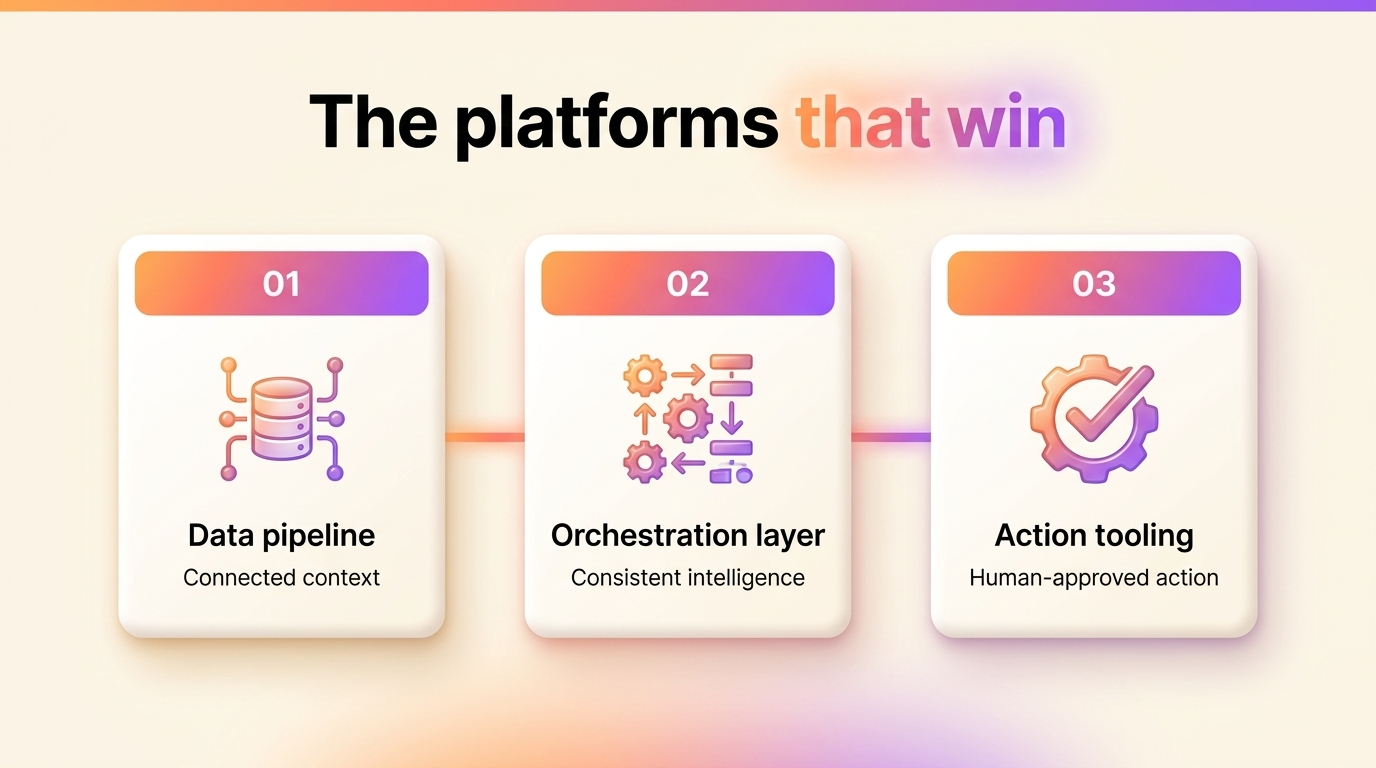
The next era of go-to-market will not be defined by AI tools sitting beside the revenue process. It will be defined by platforms that can run agentic orchestration inside the revenue workflow.
That requires three layers working together.
First, the platform needs a reliable data pipeline. AI for go-to-market cannot reason from scattered, stale, or partial context. It needs CRM records, emails, calendar events, transcripts, activities, stakeholders, playbooks, and deal history connected in a way the system can actually use.
Second, the platform needs a middle orchestration layer. This is where raw data becomes consistent, accurate, and usable. It is the layer that normalizes context, applies business rules, understands the revenue process, tracks approvals, and decides which agent should run against which workflow. Without this layer, AI produces isolated outputs. With it, AI becomes part of how the revenue team operates.
Third, the platform needs tooling that enables action. The winning platforms will not stop at dashboards, summaries, or recommendations. They will help revenue teams do the next thing: prepare for the meeting, update the CRM, draft the follow-up, flag the stakeholder gap, escalate the risk, prepare the handoff, or route the coaching moment to the right manager.
That is the expectation AI is creating in go-to-market. Teams will not be satisfied with systems that only store data or systems that only generate text. They will expect platforms that connect the data pipeline, the orchestration layer, and the action surface.
For RevOps, this changes the platform evaluation. The question is no longer only whether a tool has AI features. The question is whether the platform can create consistent intelligence across the team and turn that intelligence into governed action.
This is why agentic AI belongs so close to the revenue workflow. The platform has to understand the deal, the rep, the manager, the process, and the approval path. Otherwise, it cannot reliably coordinate work across the team.
The companies pulling ahead will not simply adopt more AI. They will choose platforms that make AI operational: connected enough to be accurate, orchestrated enough to be consistent, and action-oriented enough to change how the team executes.
If you want to see how Pod helps revenue teams connect deal context, AI agents, pipeline recommendations, meeting prep, and human-reviewed action, book a demo.
Agentic AI for sales refers to AI systems that can reason across revenue context, choose the next step within a defined workflow, use tools, prepare work, and coordinate action with human oversight. It goes beyond one-off content generation by helping orchestrate revenue workflows such as meeting prep, follow-up, CRM updates, deal risk detection, handoffs, and manager alerts.
A single AI sales tool usually performs one task, such as drafting an email, summarizing a call, or scoring a lead. Agentic AI coordinates multiple steps across a workflow. For example, a post-meeting agent might summarize the call, identify next steps, draft a follow-up, suggest CRM updates, check playbook gaps, and route the output for review.
AI in sales operates across three capability tiers:
Agentic AI expands RevOps from systems administration and process governance into workflow orchestration. RevOps defines which agents run, what data they can access, what outputs they produce, what requires human approval, and how success is measured. The function becomes responsible for how intelligence moves through the revenue team.
Agentic AI can analyze CRM data, email activity, meeting context, transcripts, stakeholders, stage movement, close-date changes, and playbook coverage to identify deal risk earlier. It can then recommend actions, draft next steps, or alert a manager before the risk becomes a forecast problem.
Yes. Agentic AI can prepare account research, summarize recent interactions, identify buyer priorities, and draft relevant follow-ups based on real deal context. The rep still reviews and edits the message, but the starting point is more specific than a generic template.
Agentic AI depends on connected context. If CRM data is stale, emails are disconnected, meetings are not captured, or playbook definitions are missing, the agent will reason from an incomplete picture. Teams do not need perfect data to begin, but they need enough reliable context for recommendations to be useful.
Agentic AI will replace some manual tasks, but it should not replace the human work of complex B2B revenue motions. SDRs, AEs, SEs, CSMs, managers, and RevOps still own trust, discovery, technical judgment, negotiation, customer context, renewal risk, and operating decisions. The best agentic workflows prepare work for humans to approve, adapt, and execute.
Successful teams operationalize AI instead of only adopting tools. They choose specific workflows, connect the right data, define approval rules, give RevOps clear ownership, and measure behavior change. Struggling teams usually run disconnected pilots without changing how the revenue team actually works.


