
Want to close more deals, faster?
Get Pod!
Fill out the form and book your demo today.
Thank you for subscribing!
Oops! Something went wrong. Please refresh the page & try again.

Stay looped in about sales tips, tech, and enablement that help sellers convert more and become top performers.
Most Account Executives know the feeling. It is Monday morning, your calendar is stacked, and your pipeline review is in two hours. You open your CRM and start scrolling, trying to reconstruct which deals moved last week, which ones went quiet, who you owe a follow-up to, and where the landmines are hiding. Thirty minutes later, you have a rough plan scribbled in a notebook or a half-populated spreadsheet. It is already outdated by lunch.
This is not a productivity problem. It is a synthesis problem. The information you need to execute well, like deal history, stakeholder context, competitive dynamics, and next steps, already exists. It is scattered across your CRM, email threads, call recordings, Slack messages, and meeting notes. The real challenge is turning that raw context into a daily action plan that reflects reality.
That is exactly where AI agents come in. Not as chatbots that answer questions, but as autonomous systems that continuously synthesize deal context and convert it into execution guidance. For AEs managing complex B2B pipelines, this is the difference between reacting to your deals and running them.
Most deal execution failures are not caused by laziness. They are caused by incomplete context at the moment of decision. Consider the signals an AE needs to synthesize for a single mid-pipeline deal:
Now multiply that by 30 to 50 active opportunities. No human can maintain that level of contextual awareness across a full book of business. Most AEs do not even try. They default to recency, focusing on whatever deal had the most recent activity (or urgency) chasing whatever their manager asked about in the last pipeline review.
This is rational behavior given the constraints, but it leads to predictable outcomes: promising deals go cold because no one noticed the engagement gap. Winnable opportunities stall because the AE missed a stakeholder signal. Pipeline movement becomes reactive instead of strategic.

When most people hear AI agent, they imagine a chat window where you ask questions. The kind of agent that transforms AE execution is something different: a persistent system that monitors deal context in real time, identifies patterns that signal risk or opportunity, and generates specific action recommendations tied to pipeline outcomes.
Think of it as the difference between a search engine and an analyst. A search engine answers the question you think to ask. An analyst watches everything, notices what you would miss, and tells you what to do about it.
For an AE, an AI agent operating on deal context might surface insights like:
These are not generic productivity tips. They are context-specific, deal-specific recommendations that use the same data the AE would need to synthesize manually — just faster, and without the cognitive overhead.
The most powerful application of AI agents for AEs is not insight generation — it is prioritization. Every AE has more to do than hours in the day. The question is never what could I do but what should I do next, given everything happening across my pipeline.
An AI agent that understands deal context can generate a daily execution plan that looks something like this:
This is not a to-do list generated from CRM fields. It is a reasoning chain: the agent evaluated deal health, cross-referenced activity patterns, identified risk, and ranked actions by impact.
For AEs used to spending their first hour rebuilding context, this kind of daily plan means they start executing immediately. The compound effect over a quarter is substantial — not just in time saved, but in deals advanced, risks caught early, and pipeline velocity improved.
Ask any AE where their unstructured time goes and meeting prep will rank near the top. Before every call, you need to review the last conversation, check for any email or Slack exchanges since then, look up stakeholder roles, refresh yourself on the deal stage and next steps, and anticipate what the prospect might bring up.
For high-value deals, this is time well spent. But when you are doing it five or six times a day across different opportunities, the quality drops. By the fourth meeting, you are skimming notes and hoping you remember the important parts.
AI agents eliminate this bottleneck by generating structured meeting briefs automatically. A good meeting brief — produced by an agent that has access to the full deal context — typically includes:
This is not about replacing the AE's judgment. It is about ensuring they walk into every meeting with the same level of preparation they would have if they had spent 20 minutes reviewing every data source. The agent does the synthesis; the AE does the selling.
The data on follow-up is unambiguous. Most B2B deals require multiple follow-up touches after key meetings, and the timing and relevance of those touches directly correlate with win rates. Yet follow-up is one of the first things that degrades when AEs are busy. Not because they do not care, but because the next deal is already demanding their attention.
AI agents enforce follow-up discipline by tracking commitments and generating timely reminders tied to deal context. This goes beyond a simple task reminder. The agent knows what was discussed, what was promised, and what the prospect's likely expectations are.
A context-aware follow-up system might work like this:
This is where AI agents create a measurable difference in pipeline metrics. Deals that receive consistent, context-relevant follow-up simply move faster. They are less likely to stall, less likely to be ghosted, and more likely to advance to the next stage on schedule.
One of the most common risk patterns in B2B sales is single-threading — relying on a single champion to carry the deal through their organization. When that champion changes roles, goes on leave, or simply loses internal momentum, the deal stalls or dies.
AI agents help AEs multi-thread deals by mapping stakeholder engagement and identifying gaps. If the agent notices that only one contact has been active in a deal with an ACV above a certain threshold, it can recommend specific outreach to other personas — and even suggest messaging angles based on their role.
For example: Your deal with Acme Corp is currently single-threaded through the VP of Sales. No one from Finance or IT has been engaged. For deals of this size in your segment, closed-won outcomes typically involve at least three active stakeholders. Consider reaching out to the CFO's office with a business case summary and to the IT lead with a security and integration overview.
This kind of recommendation requires deep context — not just CRM data, but an understanding of deal dynamics, historical patterns, and stakeholder influence. It is exactly the type of synthesis that AI agents are built to perform. Platforms like Pod's Pipeline Intelligence are designed to surface these multi-threading opportunities automatically, giving AEs a clear view of where stakeholder coverage is thin and what to do about it.
The impact of AI agents on AE execution is not dramatic on any single day. You save 20 minutes on meeting prep. You catch one deal risk you would have missed. You send a follow-up 24 hours earlier than you would have otherwise. These are incremental gains.
But over a quarter, they compound. AEs who operate with AI-driven execution support typically see improvements across several measurable dimensions:
These are not theoretical benefits. They are the direct consequence of giving AEs a system that handles the cognitive overhead of context management — the same overhead that causes good reps to lose deals they should have won. Tools like Pod's Deal Coach are built precisely for this: per-deal health signals, risk flags, and coaching surfaces tied to individual opportunities, delivered in the flow of work rather than in a separate analytics dashboard.
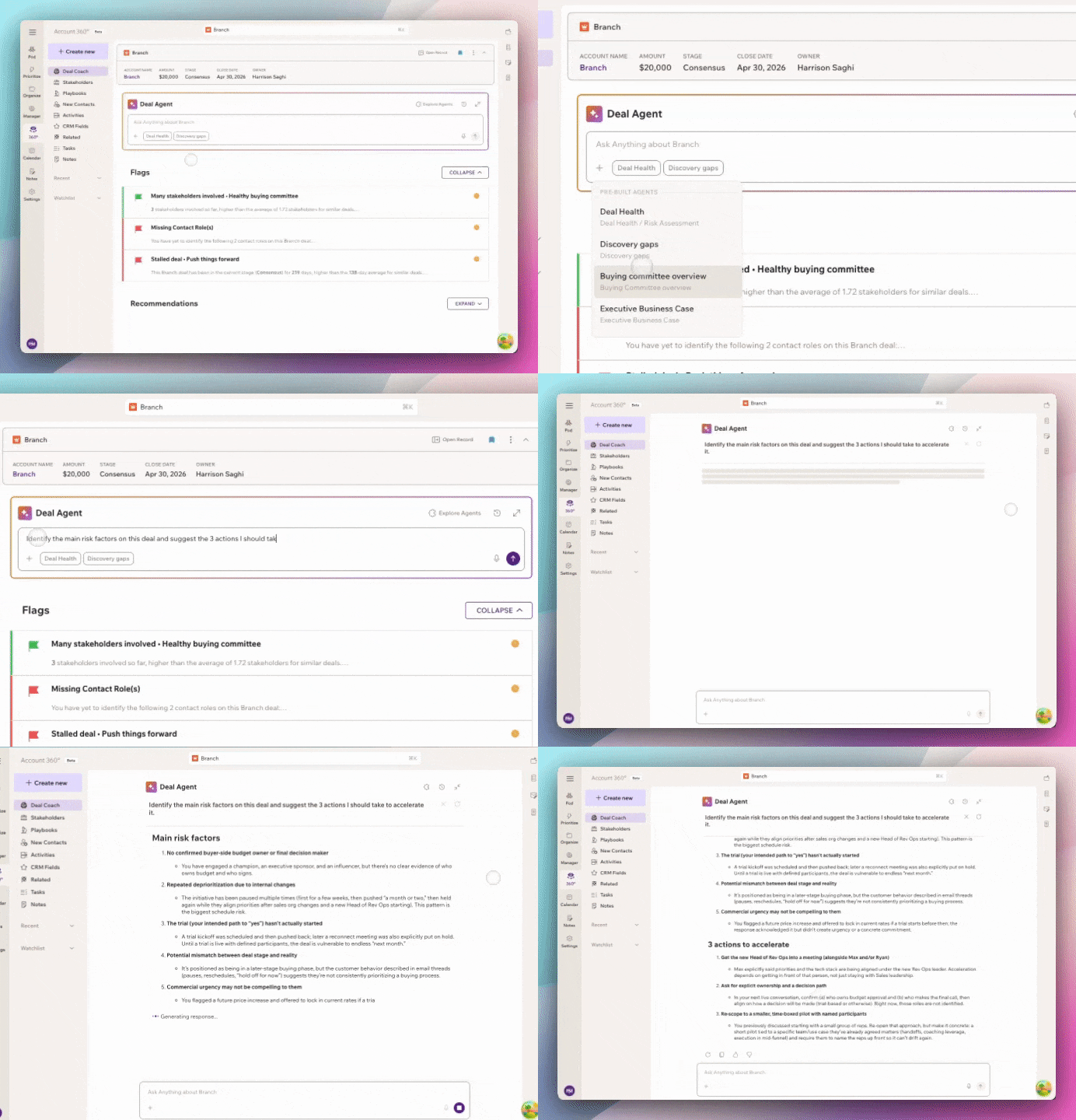
Not all AI tools for sales are agents. Many are reporting layers, dashboards, or chat interfaces that still require the AE to know what to ask. A genuine AI agent for deal execution should meet several criteria:
The AI Agent Builder approach — where teams can configure agents for their specific workflows, methodologies, and deal stages — represents where the market is heading. Rather than a one-size-fits-all tool, the most effective agents are those that can be tuned to the way a particular team sells.
Adopting AI agents for deal execution does not require a complete process overhaul. The most effective approach is incremental: start with one high-value workflow and expand from there.
Connect your CRM, email, and calendar. Let the agent start generating meeting briefs for your upcoming calls. Review them before each meeting and note where they are helpful versus where they miss context.
Once the agent has enough context, enable daily priority recommendations. Start your mornings by reviewing the agent's suggested action plan instead of manually reconstructing your own.
Begin using agent-generated follow-up drafts after key meetings. Track whether response rates and deal progression improve compared to your previous manual follow-up cadence.
Expand to stakeholder analysis and multi-threading recommendations. Use the agent's deal health signals in your pipeline reviews and forecast conversations.
The key is to let the agent earn your trust incrementally. The AEs who get the most value from AI agents are not the ones who flip a switch and delegate everything — they are the ones who start with one workflow, validate the output, and gradually expand the agent's role as it proves itself.
The shift from manual context management to AI-driven deal execution is not speculative. It is happening now, in organizations that have recognized that their best reps are spending too much time on synthesis and not enough on selling.
AI agents do not replace the AE. They remove the cognitive overhead that prevents AEs from operating at their best. When you walk into every meeting fully prepared, follow up with precision, catch risks before they become losses, and prioritize your day based on actual deal dynamics instead of gut instinct — that is what AI-driven execution looks like.
The tools exist today. The question is whether you are ready to stop rebuilding your context every Monday morning and start letting an agent do it for you.
If you want to see how this works in practice, book a demo with Pod and see how it works in your pipeline.
The reps who figure this out first do not just save time. They build a daily operating rhythm that compounds across every deal in their book, every quarter.