


Want to close more deals faster?
Get Pod!
Fill out the form and book your demo today.
Thank you for subscribing!
Oops! Something went wrong. Please refresh the page & try again.

Stay looped in about sales tips, tech, and enablement that help sellers convert more and become top performers.
Most sales teams do not fail at MEDDIC or SPICED because the frameworks are weak. They fail because the frameworks are hard to keep alive once training ends.
You have probably seen the pattern. The team rolls out a methodology. The kickoff is strong. Managers reinforce it for a few weeks. Reps start using the language in pipeline reviews. CRM fields get updated. Then the real work takes over. Deals move quickly, notes scatter across calls and emails, managers get busy, and the methodology becomes something people remember right before inspection.
That is not a rep discipline problem. It is a system problem.
MEDDIC and SPICED only work when they show up inside the daily motion of selling: before discovery, after meetings, during pipeline reviews, and when a deal starts to drift. If the framework only lives in training slides, CRM fields, or manager reminders, adoption will fade.
AI agents can change that. Not because they make sales methodology more complicated, but because they make it easier to apply at the moment it matters.
MEDDIC is a qualification framework built for complex B2B deals. It pushes sellers to understand the Metrics, Economic Buyer, Decision Criteria, Decision Process, Identify Pain, and Champion behind an opportunity. Many teams use MEDDPICC or MEDDICC variants that add Paper Process and Competition.
SPICED is a customer-centric framework from Winning by Design. It helps teams diagnose the buyer's Situation, Pain, Impact, Critical Event, and Decision process.
The acronyms are different, but the goal is similar: make sellers qualify deals through evidence, not hope.
That matters because complex deals rarely fail from one obvious issue. They fail because the economic buyer was never reached. The pain was understood but not quantified. The decision process was assumed. The champion was friendly but untested. The critical event was mentioned once and never confirmed again.
Good sellers know this. The problem is that knowing the framework is not the same as using it every day.
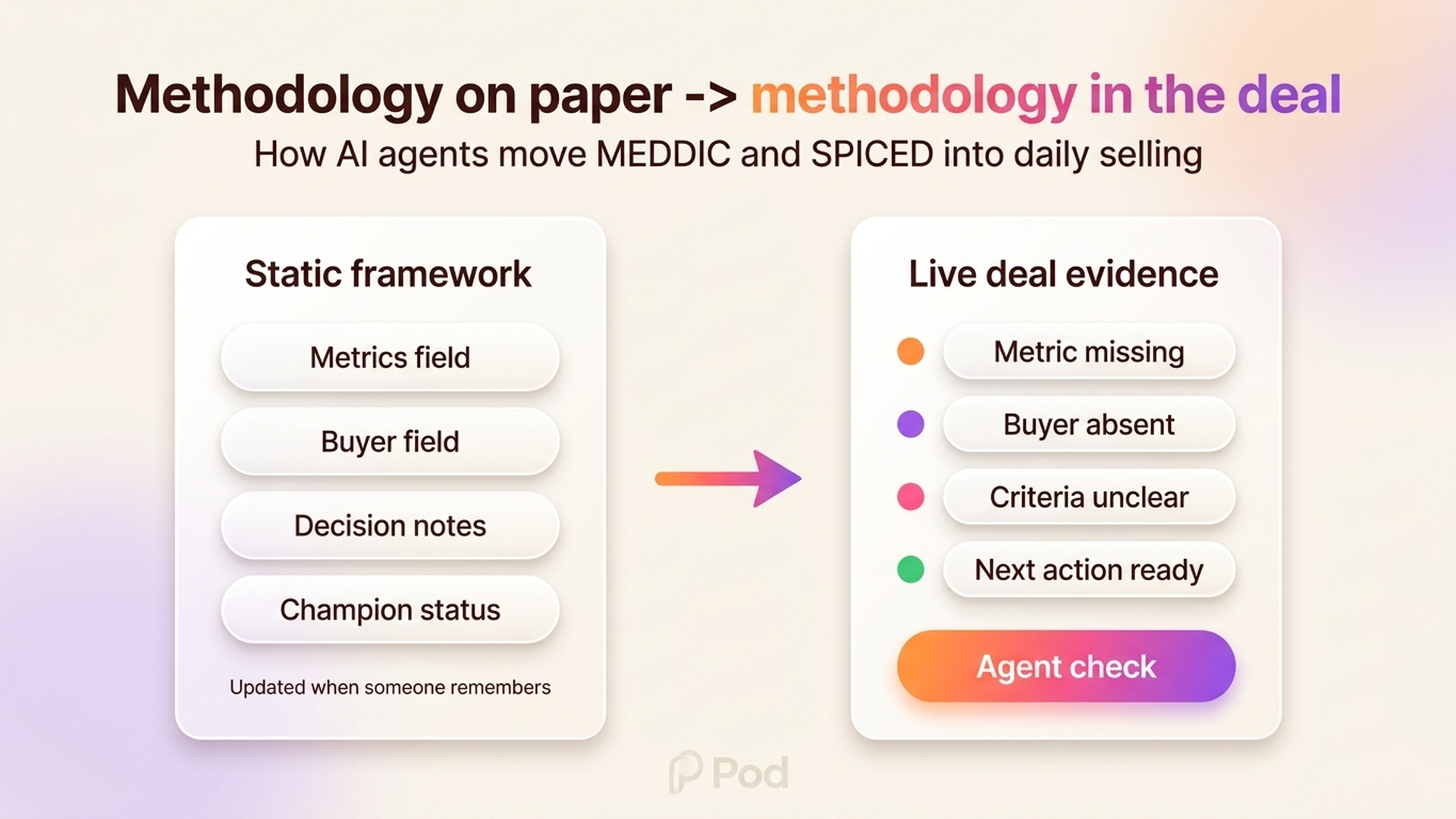
This is where sales methodology playbooks and AI agents become useful. They can check live deal context against the methodology, identify missing evidence, and surface the next question before the gap becomes a slipped deal.
In MEDDIC, Metrics answer a basic question: what measurable business outcome is the buyer trying to create?
The manual version often breaks down here. A rep hears a useful metric on a discovery call, writes it in notes, mentions it in Slack, or half-enters it into the CRM. Two weeks later, the deal summary says "improve efficiency" or "increase productivity," which is not a metric. It is a wish.
An AI agent can monitor the deal record, meeting notes, emails, and transcripts for measurable outcomes. It can flag when the deal has pain but no quantified impact. It can also suggest the next discovery question:
The agent is not inventing the metric. It is reminding the rep that the metric is missing, weak, or unsupported by evidence.
That is the difference between methodology as documentation and methodology as coaching. A CRM field asks the rep to remember. An agent notices when the deal story is incomplete.
The Economic Buyer is the person who can approve the purchase, release budget, or materially influence whether the deal moves forward. In SPICED, the same idea often appears inside the Decision element: who is involved, what authority do they have, and how will the choice get made?
This is one of the most common gaps in real deals. A rep has a strong champion, a good demo, and active engagement from the evaluation team. Everyone feels confident. Then the deal stalls because the economic buyer was never aligned.
Manual inspection catches this late. A manager asks, "Have we met the economic buyer?" The rep says, "Not yet, but the champion is taking it upward." That may be fine early in the cycle. It is dangerous near commit.
An AI agent can check stakeholder coverage as the deal moves through stages. If the opportunity is late-stage and no economic buyer is identified, engaged, or recently contacted, the agent can flag the gap. It can also connect that gap to concrete action: ask for an executive meeting, draft a mutual introduction request, or prepare the business case the champion needs.
This is where stakeholder recommendations matter. MEDDIC does not stick because a rep memorizes "Economic Buyer." It sticks when the system helps the rep see who is missing from the buying committee and what to do next.
Decision Criteria are the standards the buyer will use to choose a solution. In SPICED, this connects to the Decision element: what matters to the buyer, who defines success, and what criteria will drive the choice.
This is another area where teams often confuse activity with clarity. The prospect attended the demo. They asked good questions. They liked the workflow. But liking the workflow is not the same as knowing the decision criteria.
A deal can look healthy while the rep still does not know whether the buyer cares most about implementation speed, CRM fit, manager visibility, methodology compliance, security, pricing, or executive reporting.
An AI agent can review call notes and transcripts for explicit criteria. It can distinguish between vague interest and stated evaluation standards. It can flag a deal where criteria are missing, conflicting, or only known from one stakeholder.
For example, the agent might surface:
That gives the rep and manager a better coaching moment. Instead of saying, "Update the MEDDIC field," the manager can ask, "Which criteria will decide this deal, and who owns each one?"
Decision Process is the path a buyer must follow to make a purchase. It includes the steps, stakeholders, meetings, approvals, timelines, and internal handoffs needed to get from interest to signature.
Reps often capture this once, then treat it as stable. That is the problem.
Decision processes change. Procurement enters late. Legal asks for a different review path. A new executive wants to see the business case. A critical event moves. A buyer says "next month" because they do not know how long internal approval will take.
An AI agent can keep checking the process against deal activity. If a close date is two weeks away and there is no mutual action plan, no legal step, no procurement contact, and no confirmed approval meeting, the agent can flag the mismatch.
This is where deal coaching becomes practical. The point is not to score the rep. The point is to show where the deal story and the deal evidence disagree.
A strong agent might say:
That kind of signal makes the methodology useful during the deal, not only during the post-mortem.
In MEDDIC, Identify Pain means understanding the business problem that makes change necessary. In SPICED, Pain and Impact are separate on purpose: what is broken, and what happens if it is not fixed?
Many reps are good at finding pain. Fewer consistently connect that pain to impact.
A prospect might say, "Our forecast process is messy," or "Reps are not following the methodology." Those are useful signals, but they are not yet a business case. The stronger question is what the pain costs: missed forecasts, delayed deals, manager time, rep ramp, pipeline quality, or lost revenue.
An AI agent can track whether the deal has both pain and impact. It can notice when the rep has captured the problem but not the consequence. It can also surface patterns across conversations:
That gives the rep a clear next step. Go back and connect the pain to the business outcome. Ask who feels the consequence. Ask what changes if the team does nothing.
This matters because methodology adoption often fades when it feels like paperwork. Pain and impact do not feel like paperwork when they help a rep build a stronger business case.
Champion is one of the most misunderstood parts of MEDDIC. A champion is not just a friendly contact. A real champion has influence, access, credibility, and a reason to help you win.
SPICED teams face the same issue inside the Decision element. A contact may like the product, but that does not mean they can drive the decision.
Manual deal reviews often rely on rep confidence here. "The champion loves us." "They said they will socialize it." "They are pushing internally." Sometimes that is true. Sometimes it is optimism.
An AI agent can test champion strength against behavior:
If the answer is no, the agent can flag that the champion is unproven. That changes the coaching conversation. The manager no longer has to ask a generic champion question. They can ask for evidence.
This is how frameworks stick: the team stops treating methodology terms as labels and starts treating them as testable deal conditions.

The old way to enforce methodology was manager inspection. Managers reviewed CRM fields, asked reps to update notes, and corrected gaps in pipeline calls.
That approach can work, but it is expensive. It depends on manager time, rep memory, and consistent inspection. When the team gets busy, the methodology becomes optional.
AI agents change the operating model in three ways.
First, they make methodology continuous. The framework is not checked once before a forecast call. It is checked as the deal changes.
Second, they make methodology contextual. The agent can look across CRM fields, emails, transcripts, notes, stakeholders, and deal activity, then connect methodology gaps to real evidence.
Third, they make methodology actionable. A good agent does not only say "Economic Buyer missing." It suggests the next question, next meeting, next stakeholder, or next manager coaching moment.
That is why Pod AI Agents matter in methodology adoption. They help teams turn frameworks into repeatable workflows that run against real deal context. The methodology stops depending entirely on human memory.
If you are trying to make MEDDIC or SPICED stick, do not start by asking whether every field is filled out. Start by asking whether the methodology improves deal behavior.
A practical rollout should focus on a few operating moments:
RevOps should also care about governance. If agents are checking methodology, the team needs to know which framework is configured, what data is used, where outputs appear, and when a human approves any action. Methodology-aware AI should create consistency, not another black box.

The point of MEDDIC or SPICED is not to make reps recite an acronym. It is to help them understand whether a deal is real, what is missing, and what action would improve the odds of winning.
AI agents make that easier because they move the framework closer to the work. They check for missing evidence. They surface coaching moments. They remind reps of the next question while there is still time to ask it.
That is the version of methodology that sticks.
Not a form. Not a training deck. Not a manager nagging for field updates.
A live operating system for deal quality.
If your team has already invested in MEDDIC, SPICED, MEDDPICC, or a custom sales methodology, the next step is not another training session. It is making the framework show up inside the deals your team is working right now.
To see how Pod helps teams track methodology coverage, identify qualification gaps, and coach deals from live context, book a demo.


