

Want to close more deals faster?
Get Pod!
Fill out the form and book your demo today.
Thank you for subscribing!
Oops! Something went wrong. Please refresh the page & try again.

Stay looped in about sales tips, tech, and enablement that help sellers convert more and become top performers.
Most pipeline reviews put the AE on defense.
You join the meeting with a manager, a forecast call coming up, and a handful of open opportunities that all need more context than the CRM can show in one screen. The questions come quickly. What changed since last week? Why is this still in commit? Who is the economic buyer? When was the last executive touch? What did procurement say? Why did the close date move?
Some of those questions are fair. Some are useful. The problem is the format. Too many deal reviews are structured around what the manager needs to inspect, not what the deal needs next.
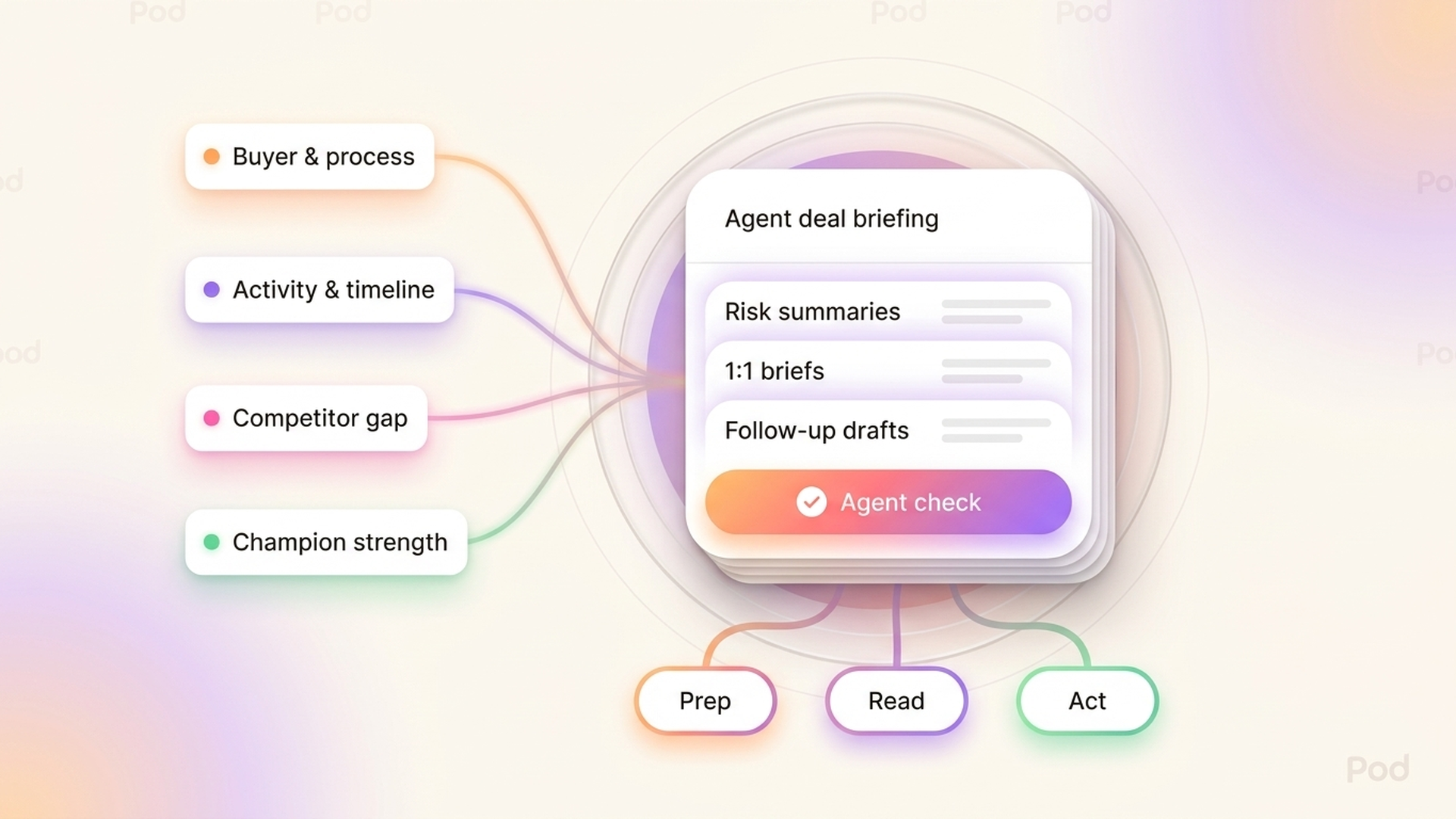
A better deal review starts before the meeting. AI agents should already have pulled together the account context, recent touchpoints, stakeholder signals, deal risks, methodology gaps, and likely next best actions. The AE should walk in ready to make judgment calls, not hunt for answers while sharing a screen.
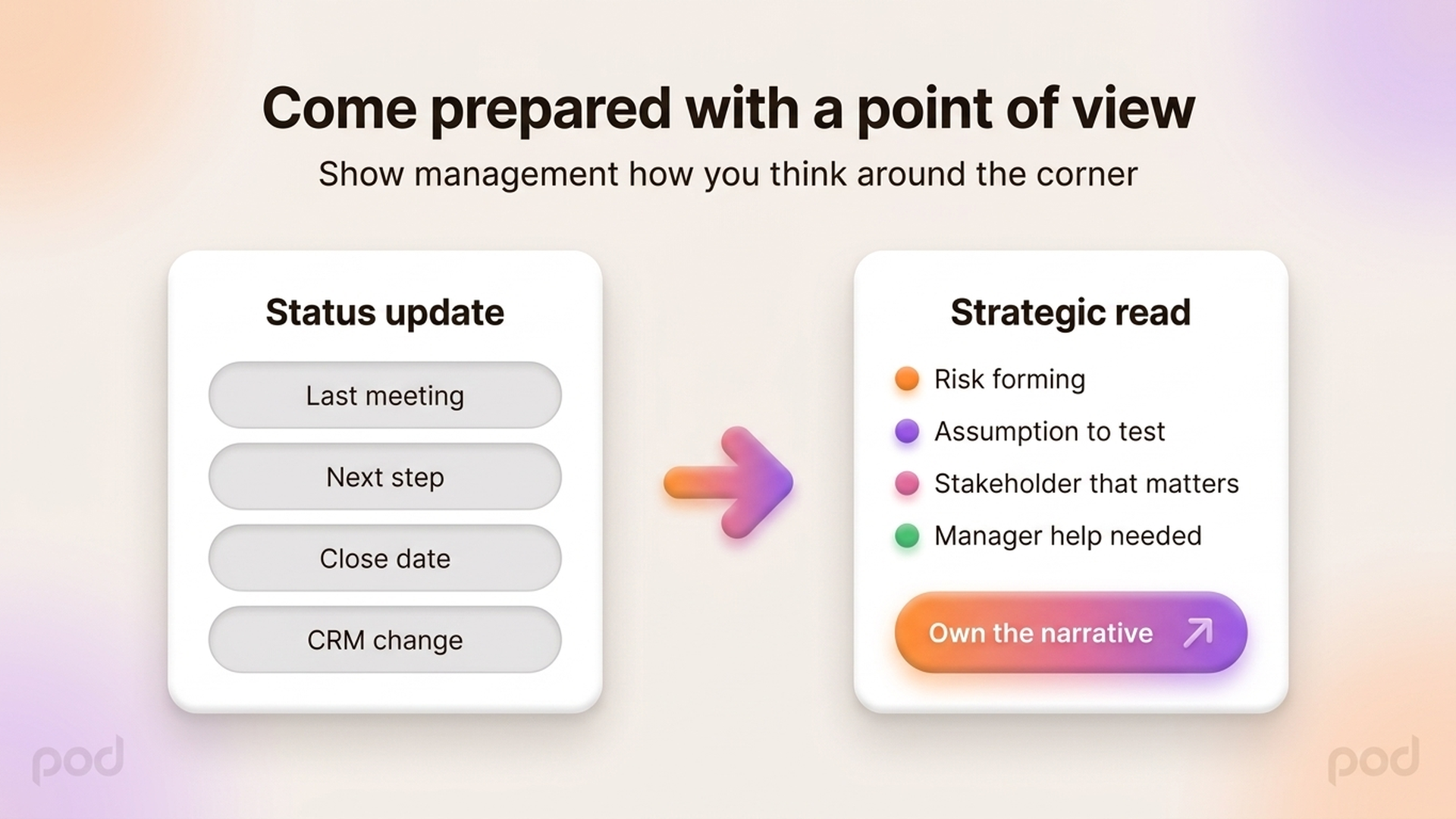
That preparation also changes how management sees the AE. A deal review is one of the clearest moments to show that you think around the corner, understand the deeper dynamics in the account, and can separate real progress from noise. Coming prepared is not only about surviving the meeting. It is how an AE shows strategic ownership.
For enterprise AEs, that shift matters. Complex deals rarely move because someone answered a status question. They move because the seller understands the buying committee, identifies what has changed, makes the next ask with confidence, and keeps every stakeholder aligned.
The old deal review format was built for information scarcity. Managers had limited visibility into what happened on calls, what was sitting in inboxes, which stakeholders were engaged, and where the rep was spending time. The meeting became the place where the manager extracted the story.
That is why the rhythm can feel like an interrogation. The manager asks for facts. The AE tries to remember them. The CRM is open, but it is incomplete. Call notes live somewhere else. Email threads carry important nuance. The champion's tone shifted last week, but that detail never made it into a field. A late-stage objection came up in a meeting transcript, but no one has connected it to the close plan yet.
The result is a meeting that burns time on discovery inside the internal team. Ten minutes disappear while the AE reconstructs the timeline. Another five go to debating whether a risk is real. By the time the group gets to strategy, there is barely enough time to decide what to do.
Enterprise deals make this worse because the facts change constantly. New stakeholders appear. Security reviews add steps. A champion loses influence. A procurement conversation shifts the timeline. The deal can look healthy in stage terms while the real buying process is getting harder.
AI agents do not make the manager unnecessary. They change the starting point. If agents can gather the context, run the right skills against the deal, and flag risks before the meeting, the review can focus on judgment: what is the AE's read, what decision is needed, and what action will move the deal forward?
A deal review with AI agents should not be a fancier dashboard readout. The goal is not to show more data. The goal is to create a clearer operating conversation around the deal.
The meeting should answer five questions:
AI agents can prepare the evidence for those questions. The AE still owns the interpretation.
That distinction matters. An agent may flag that the economic buyer has not been contacted in 21 days. The AE knows whether the champion asked to hold executive outreach until after the technical validation. An agent may detect weaker stakeholder engagement. The AE knows whether that person is a blocker, a skeptic who can be won over, or someone outside the real decision path.
The best review uses AI agents as a proactive operating layer, not as a substitute for sales judgment. Agents give the AE a prepared brief, a risk list, and recommended actions before the meeting begins. Then the AE brings the relationship read, political context, and decision about what to do next.
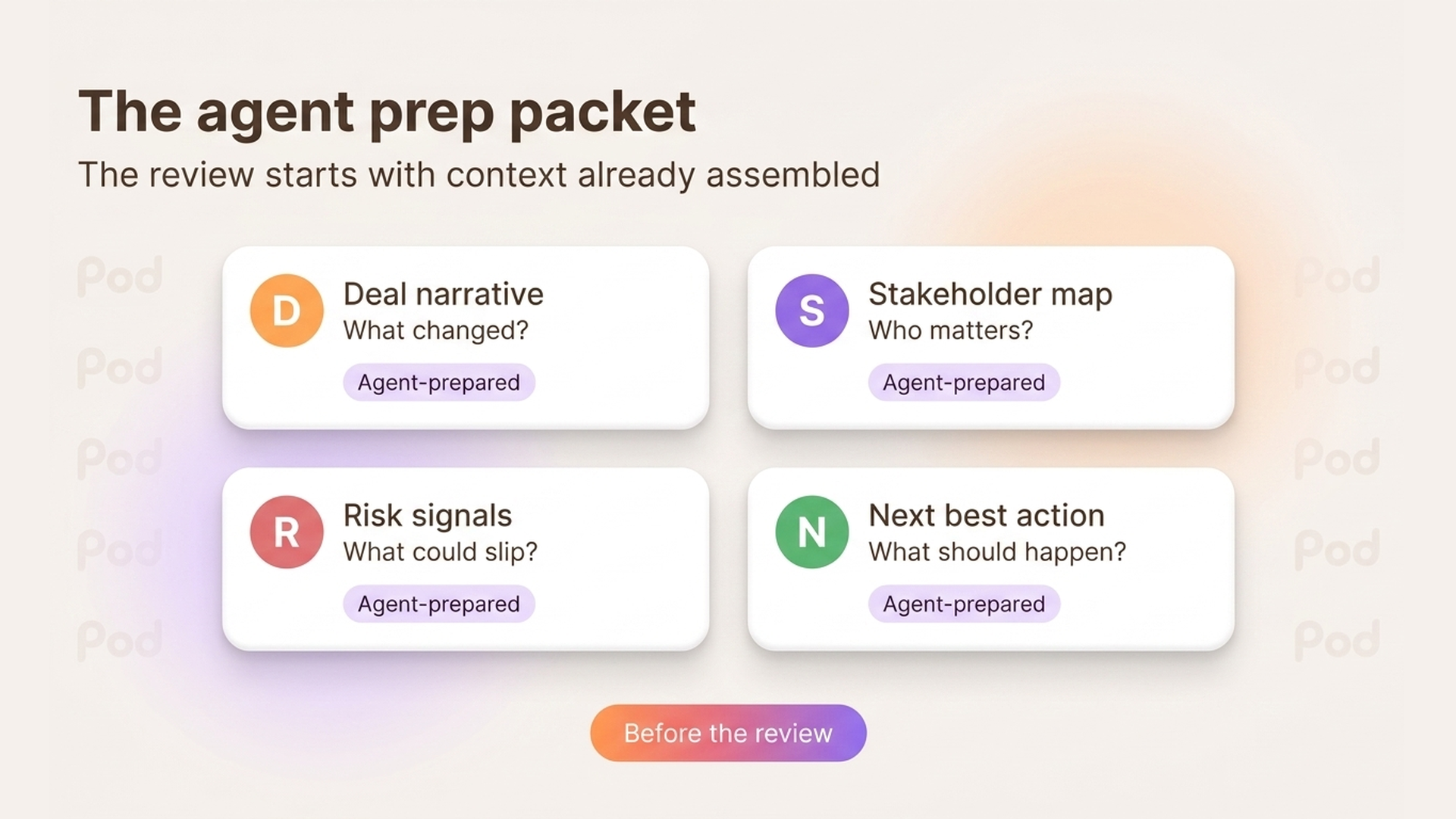
The highest-value part of an agent-assisted deal review happens before the meeting starts.
Instead of building a deal narrative from memory, the AE should arrive with a concise review packet that was prepared automatically. That packet should combine CRM fields, meeting history, email threads, call summaries, stakeholder engagement, sentiment, methodology coverage, and open tasks into one usable view.
Start with the meeting context. An AI agent can run ahead of the review and assemble the account narrative from calendar context, CRM data, emails, transcripts, and notes. For a deal review, the point is simple: the AE should not spend the first half of the meeting searching through scattered touchpoints.
Next, look at deal health. A review-prep agent can run skills that identify per-deal risks, flags, and recommendations. That can include activity gaps, weak stakeholder coverage, stage velocity concerns, close date risk, missing contact roles, or methodology gaps that should be addressed before the next customer touch.
Then check stakeholder quality, not just stakeholder count. Enterprise deals are won through buying committees, not single-threaded enthusiasm. A review should separate "we have contacts" from "we have the right influence mapped." Contact roles, engagement patterns, sentiment, and relationship health all matter.
The prep should end with next best actions. An agent should not only say, "This deal is risky." It should help the AE decide what to do. That might mean asking the champion for executive access, sending a recap that ties pain to business impact, confirming the procurement path, re-engaging a quiet stakeholder, or preparing a manager-to-manager note.
By the time the review starts, the AE should have a point of view:
That is a very different meeting than, "Let me pull up the notes."

CRM data is necessary, but it is not the whole deal.
A useful agent prep packet should be organized around how enterprise deals actually move. The sections can be simple:
The current deal narrative should be short. Two or three paragraphs are enough. It should explain who the buyer is, what problem they are trying to solve, why now matters, where the opportunity sits in the buying process, and what has to happen next.
Recent changes should focus on movement. A stage update is less useful than a signal. Did a new executive join the thread? Did the champion stop replying? Did IT ask for security documentation? Did the buyer mention a budget shift? Did the close date move without a new decision event?
The stakeholder map should show influence, not only names. An AE reviewing an enterprise deal should be ready to say who owns the problem, who controls budget, who can block the purchase, who will use the product, and who can validate success. If any of those roles are missing, the review should treat that as a deal issue, not an admin cleanup item.
The evidence section should separate buyer statements from seller assumptions. "They care about productivity" is not enough. "The VP Sales said reps spend four hours per week preparing pipeline updates, and wants that cut before Q3 planning" is better. An agent can pull those statements from calls and notes so the AE can test whether the deal has real business pain or only general interest.
Risks should be written as coaching prompts. Instead of "Stakeholder risk," the prep packet should say, "No recent engagement from the economic buyer, and the current champion has not confirmed budget authority." Instead of "Close date risk," it should say, "The target signature date is June 28, but legal review and procurement steps have not been confirmed."
That level of specificity makes the review more useful for both the AE and the manager.
AI agents can prepare the room, but the AE still owns the story.
That means the AE should not walk through every field, every touchpoint, or every agent-generated note. The review should begin with the AE's judgment:
"Here is my read on the deal. The buyer has a clear pain, our champion is engaged, and the technical team is aligned. The risk is executive priority. We have not confirmed whether the CRO sees this as a Q2 initiative or a nice-to-have. My recommendation is to use our next meeting to secure executive alignment, then send a business case recap the champion can share internally."
That kind of opening changes the tone. The AE is not waiting to be questioned. They are bringing a point of view for the manager to pressure-test.
It also changes what the manager sees. A prepared AE does not only report what happened. They show how they are thinking about the deal: where risk is forming, which stakeholder matters most, what assumption needs to be tested, and what move would improve the odds of winning. That is the difference between sounding updated and sounding strategic.
A strong agent-assisted review should spend most of its time on the parts agents cannot fully know:
This is where human judgment matters most. Agents can infer risk from activity patterns and sentiment signals, but they do not sit in the emotional texture of the relationship. They do not know whether a buyer's hesitation is procurement theater, internal disagreement, fear of change, or a sign that the business case is weak.
The AE should use the review to make those calls explicit. If an agent says stakeholder engagement is low, the AE should explain whether that is expected, concerning, or misunderstood. If an agent suggests re-engaging the economic buyer, the AE should decide whether to ask directly, route through the champion, or involve an executive sponsor.
For managers, this creates a better coaching conversation. The manager no longer has to spend the meeting asking for basic facts. They can test assumptions, sharpen the next move, and decide where to help.
The quality of a deal review depends on the questions it asks.
AI agents should reduce the need for basic inspection questions:
Those are still useful facts, but they should be available before the meeting. The live conversation should move to questions that improve the deal strategy:
These questions force the AE and manager to separate activity from progress. A deal with many meetings can still lack a business case. A deal with friendly emails can still be single-threaded. A deal with a strong champion can still die if the economic buyer never sees the impact.
Agents help by bringing the facts to the surface. The AE and manager help by deciding what the facts mean.
That is the heart of the new deal review: less recap, more diagnosis.
Many deal reviews fail after the meeting. The AE and manager agree on a smart next step, then the week takes over. The follow-up email waits. CRM updates lag. The champion conversation gets delayed. The manager forgets to send the executive note. By the next review, everyone is discussing the same risk again.
Agent-assisted follow-through closes that gap.
After the review, the AE should leave with three things:
That might include a prospect follow-up email, a champion enablement note, a CRM update, a task for executive outreach, or a short internal summary for the account team. This is where Pod AI Agents matter: sellers and teams can build skills that run against deal context, generate useful outputs, and help move from analysis to action with human oversight.
The AE should still review every external message before it goes out. The point is not to let an agent speak for the seller. The point is to remove the gap between deciding and doing.
For example, if the review concludes that the economic buyer is missing, an agent can draft a note to the champion asking for executive alignment. If the review identifies procurement uncertainty, an agent can create a checklist of approval steps to confirm. If the review surfaces weak business impact, an agent can draft questions for the next discovery call.
The manager can also benefit from the same follow-through. Instead of relying on memory, the manager can track whether the agreed action happened, whether the risk changed, and whether the deal needs another intervention.
That is how the review becomes part of the selling motion, not a weekly performance ritual.
Here is a simple way to run the process.
Two hours before the review, generate or refresh the agent prep packet. Check the deal narrative, recent changes, stakeholder signals, risks, and recommended next actions. Do not wait until the meeting to discover a missing fact.
Thirty minutes before the review, write your AE point of view. Keep it short:
This is the part that matters most for showing management how you operate. Do not only bring the facts. Bring the implications. If the champion has gone quiet, explain what that could mean and how you plan to test it. If procurement is late, explain whether it is normal process friction or a real threat to timing. If the deal is still strong, explain what evidence supports that confidence.
During the review, lead with that point of view. Use the agent-prepared context as support, not as the agenda. If your manager challenges the read, use the underlying evidence to decide whether the strategy should change.
Before the meeting ends, convert the discussion into a next action. Name the owner, deadline, and expected buyer response. If there is no next action, the review was only commentary.
After the review, use agents to draft the artifacts. Update the CRM, create the task, prepare the email, summarize the internal decision, or assemble the stakeholder outreach plan. Review anything customer-facing before sending.
This rhythm does not need to be complicated. It just needs to be consistent.
The best AEs already think this way. AI agents make the discipline easier to repeat across every open deal, especially when the pipeline is crowded and attention is scarce.
Sales leaders have a role in this shift too.
If managers keep running reviews as inspections, reps will use AI agents to survive the meeting. They will generate summaries, fill fields, and answer questions faster, but the core dynamic will not change.
The better move is to redesign the review around prepared context and action.
Set the expectation that basic deal facts come pre-assembled. Ask AEs to bring a point of view, not a transcript of activity. Coach managers to spend less time asking what happened and more time testing deal strategy. Track whether reviews produce clear next steps. Reward reps who surface risk early, not only reps who defend commit deals confidently.
This also builds trust in AI agents. Reps are more likely to adopt agents when they help them run a better deal, not when they feel like another inspection tool. Managers are more likely to trust agents when they can see the source evidence and compare it with the AE's read.
The human role becomes clearer. Agents gather the context, detect patterns, run repeatable skills, and draft follow-through. The AE owns the narrative and relationship strategy. The manager coaches judgment and helps remove obstacles.
That is a healthier operating model than the old weekly interrogation.
For enterprise AEs, the value of AI agents is not that they give you more information. You already have too much information spread across calls, emails, meetings, notes, and CRM fields.
The value is that agents can prepare the review before you enter it. They can show what changed, where the risk is, which stakeholders matter, what evidence supports the deal, and what action should happen next.
That gives you a better role in the meeting. You are not there to defend a stage or recite updates. You are there to own the deal narrative, make judgment calls, ask for the help you need, and leave with a concrete next move.
If you are an AE managing complex pipeline, Pod is built for the way you actually sell: deal context, proactive AI agents, stakeholder intelligence, coaching, and agent-assisted follow-through in one workflow. See how Pod supports Account Executives, or book a demo to see how AI agents can help your team run better deal reviews.


