

Want to close more deals faster?
Get Pod!
Fill out the form and book your demo today.
Thank you for subscribing!
Oops! Something went wrong. Please refresh the page & try again.

Stay looped in about sales tips, tech, and enablement that help sellers convert more and become top performers.
Sales managers have always lived between two jobs.
One job is inspection: review the pipeline, pressure-test forecasts, check whether reps are following the process, and make sure the CRM reflects reality. The other job is development: coach reps, sharpen deal strategy, spot patterns, and help the team get better every week.
The problem is that inspection usually wins. By the time a manager has pulled reports, chased updates, skimmed call notes, and built a point of view on which deals need attention, the coaching window is already smaller than it should be.
AI agents for sales managers change that operating model. They do not make managers less important. They make the manager's judgment more valuable by moving routine analysis, prep, and follow-up into the background.
For sales leaders, the question is no longer whether AI belongs in the manager workflow. It is which parts of management should stay human, which parts should be assisted by AI, and which parts can be delegated to agents with clear oversight.
An AI agent for sales managers is not just a chatbot that answers pipeline questions. The useful version is a workflow layer that can read deal context, analyze patterns, recommend actions, and prepare artifacts for review.
In a sales environment, that context usually includes CRM records, email history, meeting transcripts, calendar activity, notes, stakeholder data, and methodology fields. The agent uses that context to help managers answer operational questions such as:
That is different from a dashboard. A dashboard shows the manager where to look. An agent can explain what changed, why it matters, and what should happen next.
In Pod, this kind of work can be packaged as reusable skills and agents inside Pod AI Agents. A team might keep a pipeline risk agent, a rep 1:1 prep skill, a methodology gap reviewer, or a follow-up drafting agent in its library so managers can run the same high-quality workflow repeatedly against live deal context.
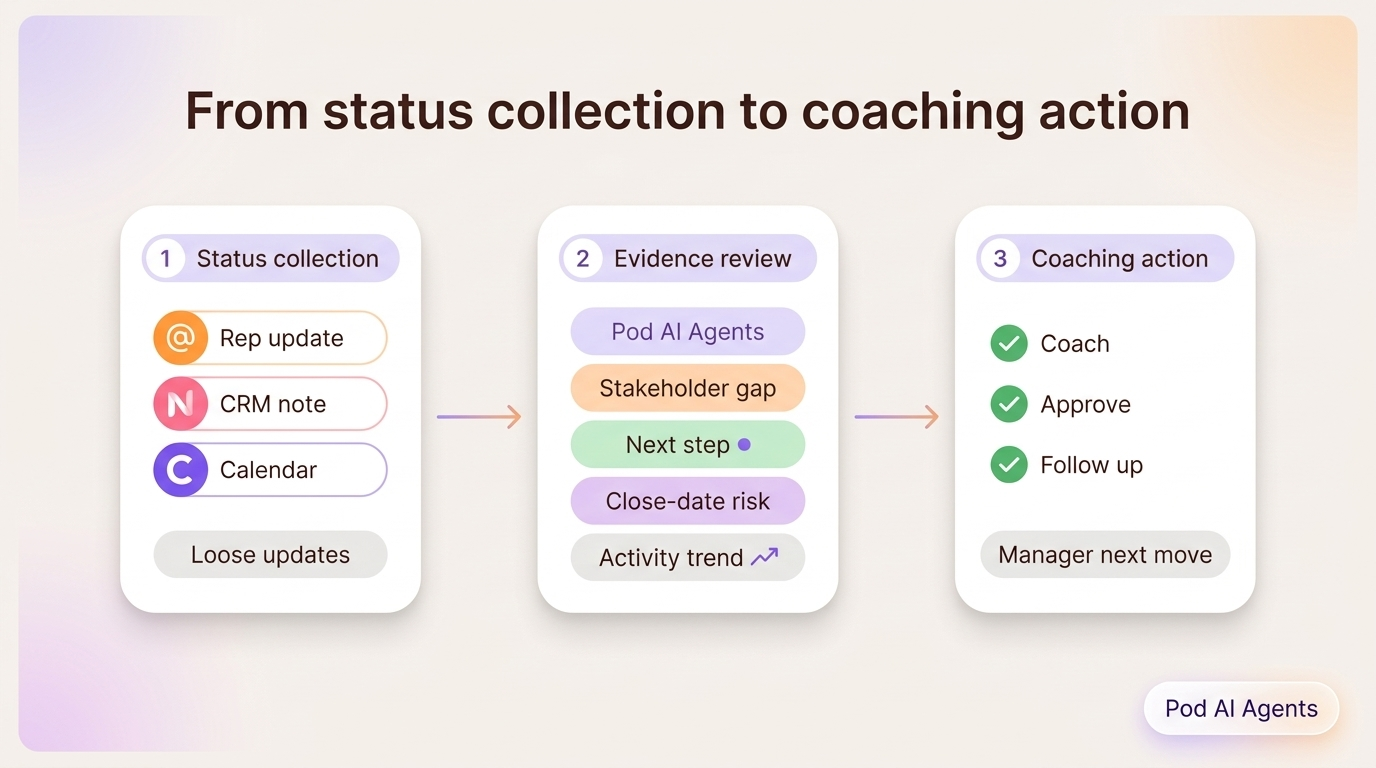
The old manager workflow starts with status collection.
A manager asks each rep what changed, scans a few CRM fields, checks whether the forecast category still feels right, and tries to separate real risk from optimistic narration. Good managers develop strong instincts here, but the process is uneven. It depends on which deals get discussed, how honest the CRM is, and how much context the manager can hold in their head.
AI agents change the starting point.
Instead of asking each rep for a subjective update, the manager can start with an evidence-backed view of the pipeline. The agent can flag deals with weak stakeholder coverage, low touchpoint density, stale activity, unrealistic close dates, or missing methodology evidence. It can group those risks by rep, stage, segment, or close date.
That does not remove the manager from the process. It changes the manager's work from assembling the picture to judging the picture.
A manager still has to decide whether a deal is truly at risk. They still need to understand account politics, rep skill, executive pressure, and customer nuance. But they no longer have to spend the first half of the pipeline review discovering basic facts.
This matters because pipeline management is not valuable by itself. Pipeline management is valuable when it changes action. The faster a manager can move from "what is happening?" to "what are we doing about it?", the more useful the review becomes.
Forecast calls often suffer from a familiar pattern. A rep commits a deal because the champion sounds positive. A manager asks a few questions. The CRM says the close date is still this month. Everyone moves on.
Two weeks later, the deal slips because procurement was never engaged, the economic buyer was not aligned, or the buying committee had a concern that never made it into the forecast conversation.
AI agents can help managers catch those issues earlier. They can inspect the deal record against signals that usually matter in complex B2B sales:
The best use of AI here is not to replace forecast judgment with a black-box score. It is to give managers a better evidence base for judgment.
Salesforce's 2026 State of Sales announcement reported that 87% of sales organizations use some form of AI, and 94% of sales leaders with agents say agents are critical for meeting business demands. That does not mean every agent output is right. It does mean sales leaders are already moving AI from side project to operating system.
Managers who use agents well will not ask, "What does the model predict?" and stop there. They will ask, "What evidence supports this forecast, what evidence contradicts it, and what action would increase confidence before the next review?"
Most managers want to coach more than they do. The constraint is not intent. It is visibility.
If a manager can only review a handful of calls, coaching becomes anecdotal. The rep who asks for help gets more attention. The loudest deal gets inspected. The most recent call shapes the feedback. Patterns are easy to miss because the manager is working from a tiny sample.
AI agents can review far more context than a manager can manually inspect. They can summarize recurring rep behaviors across calls, emails, notes, and deal outcomes. That gives managers a better starting point for coaching.
For example, an agent might surface that a rep:
Those patterns are more useful than a generic coaching reminder. They help the manager turn a 1:1 into a specific skill conversation.
Instead of asking, "How are things going?", the manager can say, "Three late-stage deals have similar symptoms: strong champion engagement, weak executive coverage, and no mutual close plan. Let's work on the executive outreach sequence."
That is a different kind of coaching. It is not surveillance. It is targeted development, grounded in real deal evidence.
When agents take on more inspection work, the manager's value does not disappear. It moves up the stack.
The manager becomes responsible for deciding which agent findings matter, where to intervene, how to coach the rep, and when to escalate. That requires stronger judgment, not weaker judgment.
In practice, the manager's job shifts in five ways.
First, managers spend less time collecting status and more time interpreting risk. An AI agent can prepare the pipeline brief. The manager decides what to challenge.
Second, managers move from reactive coaching to planned coaching. The agent can identify patterns before the 1:1. The manager turns those patterns into practice, feedback, and accountability.
Third, managers become designers of operating rhythms. They decide which agent checks should run daily, weekly, or after key events such as a stage change, executive meeting, or missed next step.
Fourth, managers become quality reviewers of AI output. They need to know when an agent is missing context, overstating confidence, or recommending an action that is technically correct but politically wrong.
Fifth, managers become adoption leaders. Reps will not trust AI just because leadership bought a tool. They trust it when managers use it consistently, explain the reasoning, and show how it helps reps win.
This is why the best sales managers in the agent era will not be the ones who automate the most work. They will be the ones who build the clearest human-in-the-loop process around the work.
AI agents are strongest when the task has enough context, a clear decision frame, and a repeatable output. Sales management still includes work that should stay deeply human.
Performance conversations should stay human. An agent can prepare evidence, but it should not deliver sensitive feedback, manage morale, or interpret the personal context behind a rep's performance.
Deal politics should stay human. Agents can flag missing stakeholders or weak engagement, but managers still need to read organizational dynamics, coach tone, and decide when executive involvement helps or hurts.
Judgment calls should stay human. A deal may look risky in the data but be strategically worth pursuing. Another may look healthy while a manager knows the champion is losing influence. AI can inform that call. It should not own it.
Customer-facing actions need oversight. Drafting an email, creating a task, or preparing a CRM update can be agent-assisted. Sending, publishing, or changing external records should require human review when the stakes are high.
This human boundary is not a weakness in agentic sales workflows. It is what makes them usable. Managers are more likely to trust agents when they can see the evidence, understand the recommendation, and approve important actions before they happen.
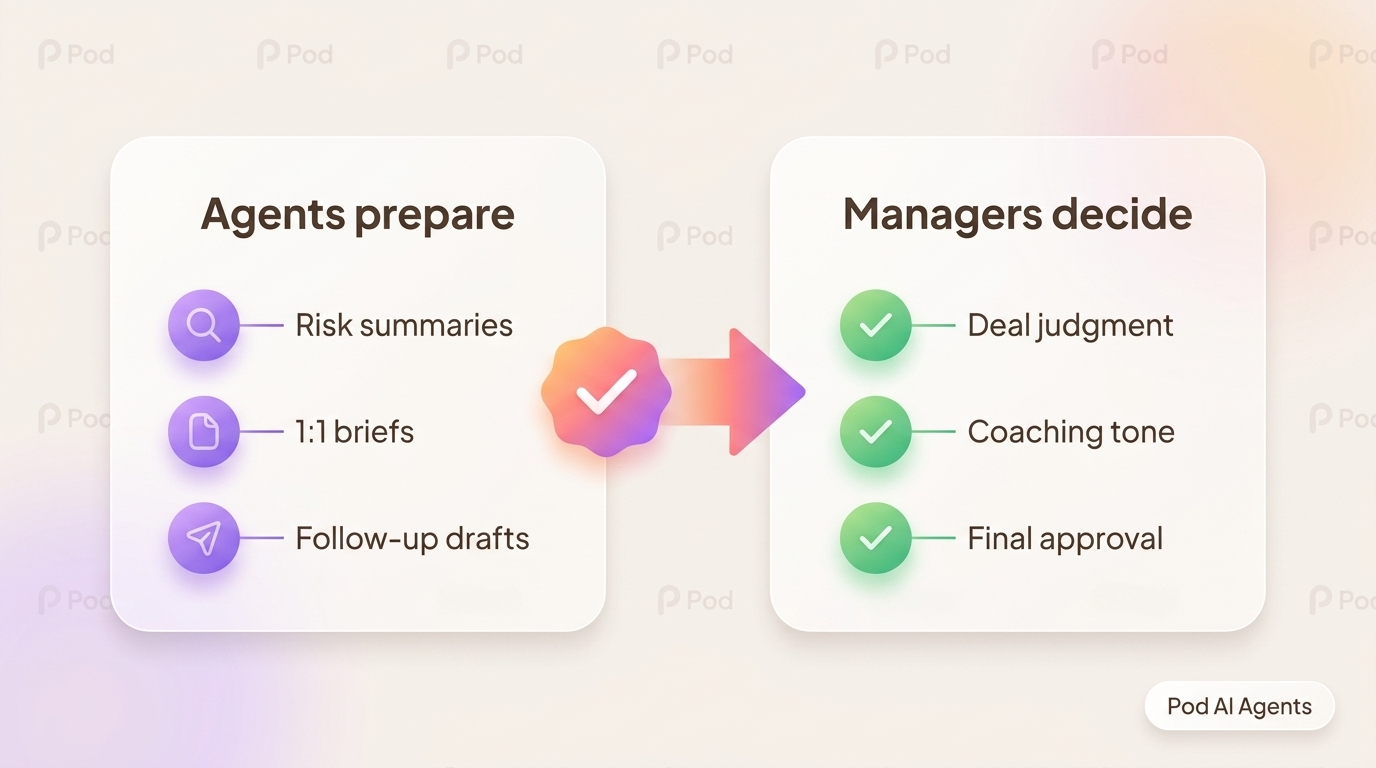
The easiest mistake is trying to apply agents everywhere at once. Better rollouts start with a narrow workflow where the pain is clear and the output can be reviewed.
For most sales managers, three starting points make sense.
Ask the agent to review active pipeline and flag deals with concrete risk signals: no recent activity, missing next steps, weak stakeholder coverage, repeated close-date movement, or incomplete methodology evidence.
The manager reviews the summary before the team meeting and chooses which deals deserve discussion. This keeps the meeting focused on exceptions, not status recitation.
Ask the agent to prepare a coaching brief for each rep. The brief should include deal risks, recent wins, recurring gaps, and one suggested coaching topic.
The manager should not read it as a verdict. They should use it as prep. The goal is to walk into the 1:1 with a sharper hypothesis.
After pipeline reviews or coaching meetings, agents can draft recap notes, action items, CRM updates, or follow-up messages. The manager reviews and approves the output.
This is where insight turns into action. A risk flag does not help unless someone follows up, updates the plan, or changes the deal strategy.
Pod AI Agents are designed for this kind of workflow thinking: agents should operate against real deal context, respect the team's process, and create outputs that humans can inspect before acting.
Trust is the main adoption barrier for AI agents in sales management. If managers or reps see agents as inaccurate, intrusive, or disconnected from the real sales process, they will work around them.
A practical rollout should follow four principles.
Start with read-only analysis. Use a library of reviewed skills in Pod AI Agents to summarize pipeline risk, coaching patterns, or methodology gaps before giving agents permission to draft actions.
Show sources. Managers should be able to trace a recommendation back to CRM fields, meetings, emails, notes, transcripts, or deal history. An unexplained score is hard to coach from.
Keep approvals explicit. If an agent drafts a CRM update, rep message, or customer-facing email, a human should review it before anything changes.
Measure behavior, not just usage. Adoption is not "how many people clicked the agent." Better questions are: Did pipeline reviews get more focused? Did managers coach from evidence more often? Did risky deals get surfaced earlier? Did reps leave 1:1s with clearer next steps?
HubSpot's 2025 State of Sales coverage reported that only 8% of surveyed sales reps were not using AI at all, while 84% said AI saves time and optimizes processes. The adoption curve is already here. The management challenge is turning usage into a better operating rhythm.
AI agents are not turning managers into passive reviewers. They are making the manager role more operationally precise.
The new sales manager job has a different center of gravity:
That is a better job, but it is not an easier one.
Managers will need to learn how to ask better questions of their tools, pressure-test agent output, coach reps on AI-assisted workflows, and decide where automation belongs in the sales process. They will also need to protect the parts of management that cannot be automated: trust, accountability, motivation, and judgment in messy human situations.
The winners will be sales teams that treat AI agents as operating partners, not magic boxes. Let agents do the repetitive inspection. Let managers do the human work with better evidence, better timing, and fewer blind spots.
For sales leaders, the next step is simple: choose one manager workflow where better context would change action this week. Start there. Run the agent. Review the evidence. Coach from the pattern. Then expand only when the team trusts the result.
If you want to see how Pod helps sales managers turn deal intelligence into focused coaching and pipeline action, book a demo.