

Want to close more deals, faster?
Get Pod!
Fill out the form and book your demo today.
Thank you for subscribing!
Oops! Something went wrong. Please refresh the page & try again.

Stay looped in about sales tips, tech, and enablement that help sellers convert more and become top performers.
.png)
Every sales org has adopted AI. Almost none of them operationalized it.
The pattern is remarkably consistent. A few reps start using AI assistants for email drafts or meeting prep. Results look promising. Leadership encourages broader adoption. Six months later, forty reps are running forty different prompts, none of them version-controlled, none of them aligned to your sales methodology, and none of them producing output you can measure at the pipeline level.
This is prompt sprawl, and it is the single biggest obstacle between your AI investment and actual pipeline impact. McKinsey reports that 88% of organizations now use AI in some capacity, yet only 39% see measurable impact on enterprise EBIT. The gap is not a technology problem. It is an operations problem, and that makes it a RevOps problem.
This article is for RevOps and Sales Operations leaders who are past the “should we use AI?” conversation and deep into the “how do we make this work at scale?” question. You will walk away with a governance framework built for sales workflows, a 30-day operationalization sprint, and a metrics hierarchy that connects agent activity to pipeline outcomes.
If your team is already exploring AI agents for sales, Pod’s AI Agent Builder gives RevOps the workspace-level controls to manage agents as operational infrastructure, not individual experiments.
Prompt sprawl does not announce itself. It accumulates quietly until the operational debt becomes visible in inconsistent outputs, confused reps, and unreliable data.
Here is what it typically looks like across a 30-person sales team:
A top-performing AE builds a custom prompt for generating deal summaries. It works. She shares it in Slack. Three teammates copy it and modify it slightly. Within a month, four versions exist, each producing subtly different output structures. Meanwhile, another pod is using a completely different prompt for the same task. The manager cannot compare deal summaries across the team because the format and depth vary wildly.
Multiply this across meeting prep, follow-up emails, competitive research, account planning, and CRM updates. You now have dozens of unmanaged prompt templates producing ungoverned output flowing into your CRM, your forecast, and your pipeline reviews.

The cost of prompt sprawl is not that the AI produces bad output. Often, the output is fine in isolation. The cost is threefold:
Inconsistency. When every rep runs a personal prompt, the quality and structure of AI-generated artifacts varies across the org. CRM fields get populated with different levels of detail. Deal summaries emphasize different qualification criteria. Managers lose the ability to compare apples to apples.
Ungovernability. RevOps cannot audit what it cannot see. If prompts live in personal browser histories, individual AI tool accounts, or scattered documents, there is no version control, no approval workflow, and no ability to update instructions org-wide when the process changes.
Zero measurement. You cannot measure the pipeline impact of AI agents if you cannot even catalog which agents are running, what they are doing, and whether their output is being used. Forrester estimates that ungoverned generative AI will cost B2B companies more than $10 billion, and most of that cost is not from dramatic failures but from the slow bleed of inconsistency and waste.
The instinct in most organizations is to treat AI agents as a tool decision: evaluate vendors, pick a platform, roll it out. But the vendors that get selected and the platforms that get deployed are not the hard part. The hard part is the operational layer that sits on top.
Consider the analogy to CRM adoption. Salesforce or HubSpot is a tool decision. But CRM governance (field definitions, required data entry, stage criteria, automation rules, permission sets) is an operations decision. The CRM is only as good as the operational framework around it.
AI agents follow the same pattern. The agent platform is infrastructure. The operational layer, who can create agents, what prompts they use, which methodology they enforce, what trust boundaries they operate within, and how their impact is measured, is what determines whether the org gets value.
Salesforce’s State of Sales report shows that 87% of sales organizations use some form of AI, and top performers are 1.7x more likely to use AI agents specifically. But adoption alone is not the differentiator. Operationalization is.
This reframe matters because it shifts ownership. If AI agents are a tools problem, they belong to Sales Enablement or IT. If they are an operations problem, they belong to RevOps — the team that already governs every other system, process, and data flow in the revenue stack.
Most AI governance frameworks are written for chief information officers worried about data privacy, model bias, and regulatory compliance. Those concerns are real, but they are not the governance framework a RevOps leader needs to operationalize agents across a sales team.
RevOps needs a governance framework built around four layers: standardize, enforce, control, and measure.
The first operational move is to shift prompts from personal artifacts to managed templates. Think of this the way you think about email templates or sequences. Individual reps should not be writing the core logic from scratch every time.
In practice, this means creating workspace-level agents that RevOps and sales leadership design, test, and distribute to the team. These shared agents replace the scattered personal prompts with a standard set of instructions that reflect the org’s methodology, terminology, and output expectations.
The key distinction is between personal agents (created by individual reps for their own use) and workspace agents (created by admins and shared across the team). Personal agents still have a role, reps need flexibility for niche tasks, but the core workflows that drive pipeline execution should be standardized at the workspace level.
Your organization already invested in a sales methodology. Whether it is MEDDPICC, BANT, NEAT, ALIGN, or a custom framework, the methodology represents the team’s shared language for qualifying and advancing deals.
AI agents should reinforce that language, not ignore it. When an agent generates a deal summary, it should structure the output around your chosen qualification framework. When it prepares a meeting brief, it should highlight gaps in your methodology fields. When it coaches a rep on next steps, it should reference the same criteria the manager uses in deal reviews.
This is not about rigidity. It is about consistency. Agents that enforce methodology do not restrict how reps sell — they ensure that the information flowing into your pipeline reviews, forecasts, and coaching sessions uses the same structure everywhere.
The operational move: configure your playbooks at the admin level and connect them to the agents that generate deal intelligence. This way, when a methodology changes or a new framework is adopted, the update propagates through every agent in the workspace automatically.
Not every agent should have the same permissions. A read-only agent that summarizes deal context is fundamentally different from an agent that updates CRM fields or drafts emails on a rep’s behalf.
The operational principle here is incremental trust. Start agents in a read-only mode where they analyze and recommend, but never write. Once RevOps validates the output quality and reps build confidence in the agent’s judgment, selectively expand permissions to low-risk write actions, like populating a CRM field with a suggested value that the rep confirms. Higher-risk actions, like sending outbound communication, stay behind a human approval step.
This graduated trust model matters because it reduces the blast radius of mistakes during early adoption and gives RevOps a controlled path to expand agent capabilities over time. KPMG’s research on “boundary-first architecture” for enterprise AI reinforces this approach: define what the agent cannot do before defining what it can. (For more on the governance and ethics dimension, see AI Ethics in Sales: Transparency, Attribution, and Human Oversight.)
The final governance layer is measurement, and it is the one most organizations skip entirely. Usage metrics — logins, prompt runs, agent activations — tell you adoption, not impact. RevOps needs a measurement framework that connects agent activity to pipeline outcomes.
This means tracking: Are deals where agents are active moving faster through stages? Is qualification data more complete in CRM for agent-assisted deals? Are forecast accuracy and pipeline coverage improving in teams that use governed agents versus teams that do not? Is the time reps spend on administrative tasks declining in ways that show up in activity metrics?
The measurement layer is what transforms AI agents from a cost center (“we’re paying for this tool”) into a documented operational advantage (“governed agents improve stage velocity by X% in pilot teams”).
The biggest mistake RevOps teams make when operationalizing agents is treating it as a top-down rollout that replaces what reps are already doing. This creates friction and resistance.
A better approach acknowledges the reality: reps already have AI habits. Some are productive. Some are chaotic. The goal is not to eliminate personal experimentation but to create a managed layer that handles the high-value, high-consistency workflows while leaving room for individual flexibility on lower-stakes tasks.
The progression looks like this:
Personal phase (where most orgs are today). Reps use AI tools individually. No shared templates, no governance, no measurement. Output quality varies widely.
Shared phase. RevOps identifies the 5-8 highest-impact use cases (deal summaries, meeting prep, follow-up drafts, CRM updates, competitive research) and builds workspace agents for each. Reps adopt the shared agents for these workflows while keeping personal agents for everything else.
Managed phase. Workspace agents are governed, measured, and continuously improved. RevOps treats agents like any other managed system in the stack, with version control, performance tracking, and regular optimization cycles.
The shift from personal to managed does not happen overnight. It happens through demonstrated value: when the workspace agent produces better deal summaries than the rep’s personal prompt, adoption is organic.
Every RevOps leader knows the pattern. You roll out MEDDPICC. You build custom CRM fields. You train the team. Adoption is strong for two months. Then it decays. Fields go stale. Reps revert to freeform notes. Managers stop enforcing because the enforcement cost is too high.
AI agents change this equation. When an agent is designed to structure its output around your methodology framework, enforcement happens as a byproduct of using the tool rather than as an additional compliance burden on the rep.
A rep asks the agent for a deal summary. The agent returns a summary structured around MEDDPICC fields, highlighting where qualification data is strong and where gaps exist. The rep did not fill out a form. They did not update seven custom fields. They asked a question and got a useful answer that happens to be methodology-compliant.
This is the difference between enforcement-by-form (which creates friction) and enforcement-by-design (which reduces it). RevOps teams that configure sales methodology playbooks at the workspace level and connect them to agents effectively automate methodology adherence without adding to the rep’s workload.
A common objection to AI agents in sales is the garbage-in, garbage-out problem: if CRM data is messy, agent output will be unreliable. This is true, but it misses the more interesting dynamic.
Well-designed agents do not just consume CRM data. They improve it. An agent that generates a deal summary by pulling signals from emails, meetings, and CRM records will surface gaps: “No economic buyer identified,” “Last stakeholder contact was 45 days ago,” “Close date has slipped twice with no stage change.”
Each of these observations is an implicit CRM hygiene prompt. The rep sees the gap. The agent suggests a correction. The data improves. Over time, the aggregate effect is measurably better CRM hygiene across the team. Not because RevOps ran another data cleanup campaign, but because agents made data quality a byproduct of everyday deal execution.
Platforms that integrate deeply with CRMs like Salesforce and HubSpot amplify this effect by pushing agent-generated insights directly into the CRM context where reps already work — via a Chrome extension embedded in the CRM, for example — reducing the friction between insight and action to nearly zero.
Theory is useful. Timelines are more useful. Based on patterns from early-mover organizations and Outreach’s research suggesting realistic agent deployments take approximately 30 days, here is a concrete sprint for moving from prompt chaos to a governed agent system. (For a longer-horizon view, see our 90-day sales AI rollout plan.)
Catalog every AI tool and prompt pattern currently in use across the sales org. Interview 5-8 reps and 2-3 managers to understand what is working, what is chaotic, and what is missing. Establish baseline metrics: current stage velocity, CRM field completion rates, forecast accuracy, and rep time allocation.
Deliverable: an agent inventory, a list of the 5-8 highest-impact use cases, and a baseline measurement snapshot.
Select 2-3 high-impact use cases from the audit. Build workspace-level agents for each, configured with your methodology framework and connected to your CRM integration. Deploy to a pilot group of 8-12 reps across different segments or pods.
Deliverable: live workspace agents for pilot use cases, admin-configured playbooks, and a pilot measurement plan.
Gather feedback from the pilot group. Refine agent instructions based on output quality and rep experience. Expand the pilot to additional teams. Connect agent activity to your pipeline coaching and deal review workflows so managers see agent-assisted intelligence alongside their existing dashboards.
Deliverable: refined workspace agents, expanded rollout, and agent output integrated into management workflows.
Compare pilot metrics against the Week 1 baseline. Evaluate stage velocity changes, CRM completeness, rep feedback, and manager adoption. Make a go/no-go decision on full-org deployment with a documented justification.
Deliverable: a measurement report, a go/no-go recommendation, and a phase-two plan for full operationalization.
Not all metrics matter equally in the first 90 days. Here is a hierarchy:
Measure immediately (leading indicators):
Measure at 30-60 days (pipeline indicators):
Measure at 60-90 days (outcome indicators):
Ignore early:
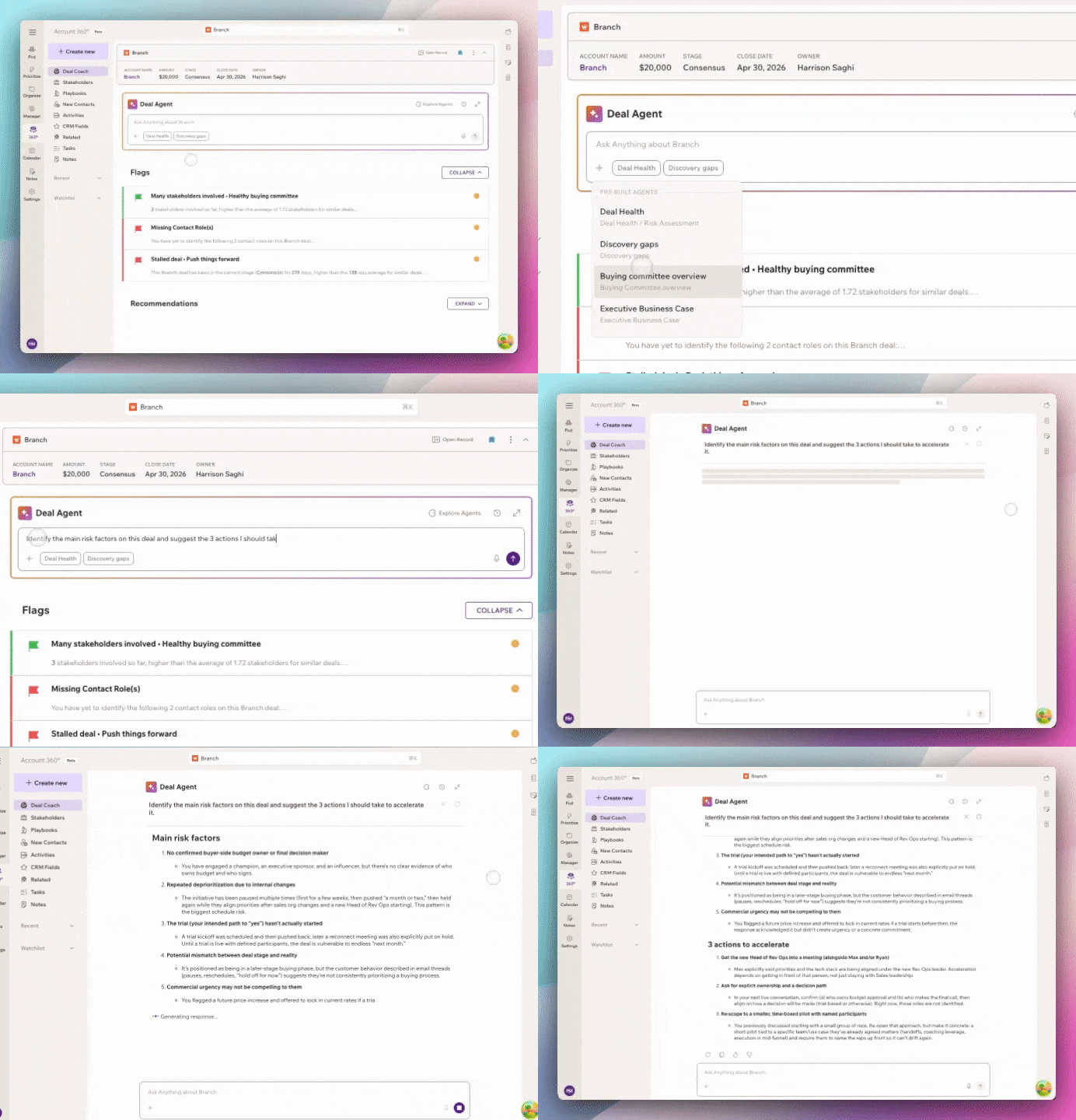
AI agents will become the primary interface for how sales teams interact with their data, their deals, and their processes. Gartner projects that 30% of enterprise application vendors will ship MCP servers by the end of 2026, accelerating the shift toward agent-driven workflows across the entire revenue tech stack.
This is not a future-state prediction. It is happening now. And the question for RevOps leaders is not whether agents will matter, but who will govern them.
If RevOps does not own agent operationalization, the alternatives are worse: IT governs agents with compliance frameworks that do not understand pipeline workflows. Enablement governs agents with training programs that do not include version control or measurement. Individual managers govern agents inconsistently, recreating the prompt sprawl problem at the team level instead of the individual level.
RevOps is the natural owner because agents are, at their core, process automation with intelligence. They sit at the intersection of tools (CRM, integrations), process (methodology, stage definitions), and data (pipeline, forecast, activity), the exact intersection RevOps already manages.
The teams that move fastest will be the ones where RevOps claims this seat early, builds the governance framework now, and treats AI agents as the next system in the stack to be operationalized, with the same rigor applied to CRM, CPQ, and every other revenue system before it.
The gap between AI adoption and AI impact is not a technology problem. It is an operations problem. And operations problems are what RevOps was built to solve.
Ready to operationalize AI agents across your sales org? Request a trial of Pod and see how workspace-level agent management, methodology playbooks, and CRM-native intelligence give RevOps the controls to move from prompt chaos to a pipeline system.


