


Want to close more deals faster?
Get Pod!
Fill out the form and book your demo today.
Thank you for subscribing!
Oops! Something went wrong. Please refresh the page & try again.

Stay looped in about sales tips, tech, and enablement that help sellers convert more and become top performers.
Most sales forecasts are not wrong because RevOps picked the wrong spreadsheet formula.
They are wrong because the inputs are soft, the process rewards confidence, and the model usually treats CRM stage as if it were buyer truth. Anyone who has built a forecast model, rebuilt it after a bad quarter, and then rebuilt it again with more fields knows the feeling. The math gets cleaner. The meetings get tighter. The forecast still slips.
This is for RevOps leaders, sales managers, and revenue teams that are tired of treating forecast misses like a reporting problem when the real problem is deal reality. The fix starts before AI. It starts with a better question: what signals prove this deal is actually moving?
AI matters because it can read those signals across CRM data, emails, meetings, transcripts, notes, stakeholder activity, and rep behavior. But if the underlying forecast logic is still stage plus close date plus rep opinion, AI only makes the old problem faster.
The standard B2B forecast model starts with CRM stages. A deal in stage three gets one probability. A deal in stage four gets another. Late-stage opportunities get pulled into commit conversations. Early-stage opportunities sit in pipeline coverage.
That sounds reasonable until you look at how deals actually move.
Buyers do not progress in neat CRM stages. They form a problem definition, compare options, bring in stakeholders, build internal consensus, get blocked by budget, reopen the business case, disappear for two weeks, return with procurement, then ask the same security questions again. Meanwhile, the CRM says "Proposal" because the rep sent a deck.
Stage is useful as a process marker. It is not reliable as a forecast signal by itself.
The gap gets wider in complex sales cycles. A rep may move a deal forward because a required exit criterion was technically met, not because buying intent improved. The demo happened. The proposal was sent. The procurement form was received. Those events matter, but they do not always mean the customer is closer to buying.
Forecasting breaks when the model treats seller activity as buyer commitment.
A better forecast starts by separating internal process from external proof. Did the buyer engage after the demo? Did the economic buyer respond? Did the champion confirm the business impact? Did the next meeting include new stakeholders? Did the deal gain momentum after pricing was shared? Those signals say more than the stage label.
Stage-based forecasting gives teams a comforting sense of precision. If stage two is 25 percent, stage three is 50 percent, and stage four is 75 percent, the pipeline rollup looks mathematical. The problem is that the percentages are often a historical average pasted onto a live deal with different facts.
Two opportunities can sit in the same stage and have completely different forecast quality.
One stage-four deal has a responsive champion, a confirmed executive sponsor, active technical validation, a mutual action plan, and a close date tied to a board meeting. Another stage-four deal has one friendly contact, no recent email response, a close date that has moved twice, and procurement "starting soon" with no named owner.
The CRM may value them the same way. A manager will not.
This is why stage probability creates arguments during forecast calls. RevOps asks why a deal is still in commit. The manager says the stage supports it. The rep says the buyer is "still engaged." Nobody has a shared signal model that answers whether the deal is healthy.
Stage logic is not useless. It helps define where the team believes a deal is in the sales process. But it cannot carry the forecast alone. When it does, the team ends up with a model that is technically consistent and operationally wrong.
That is the part that makes RevOps people sigh into their coffee. You can enforce exit criteria, lock down fields, and build stricter stage rules. Those changes may improve discipline. They still do not prove the buyer is moving.

Close dates should be one of the cleanest forecasting inputs. In practice, they are often one of the messiest.
Reps learn how close dates affect inspection. Push a deal too early, and it gets questioned. Keep it too late, and it may disappear from the quarter. Move it too often, and the deal looks risky. Leave it alone, and the forecast might stay intact long enough to survive the next meeting.
That does not mean reps are dishonest. It means the system gives them a field that carries political weight. Close dates become a mix of buyer timeline, seller hope, manager pressure, and quarterly math.
The common failure modes are familiar:
The date is not the problem. The absence of supporting evidence is the problem.
A signal-based forecast asks what proves the close date. Recent executive engagement. Procurement steps completed. Mutual action plan confirmed. Legal review underway with named owners. Champion activity after commercial terms. A meeting scheduled with decision makers before the deadline.
Without those signals, a close date is just a calendar entry with quota pressure attached.
The forecast call is supposed to improve judgment. Too often, it becomes a ritual for defending a number.
Managers ask, "Will this close?" Reps answer with confidence. The team inspects the big deals. Everyone focuses on what must happen for the quarter to work. The conversation naturally tilts toward the path to close because that is the job. Sales is an optimistic profession by design.
Optimism is useful in customer conversations. It is dangerous in forecasting.
A rep says the champion is strong. What does strong mean? A manager says the deal has momentum. Compared to what? A VP says the buyer has budget. Who confirmed it, and when? The forecast process often accepts these claims as narrative unless someone has the time to pull emails, transcripts, meetings, CRM changes, stakeholder maps, and past activity.
Most managers do not have that time. RevOps definitely does not have that time for every deal.
So the review process becomes selective. The loudest risks get attention. The biggest deals get inspected. The most confident reps get more trust. The cautious reps get more questions. The forecast becomes less about deal evidence and more about who can tell the most believable story under pressure.
This is one reason a forecast can feel good right up until it fails. The process has been filtering for confidence instead of proof.
Signal-based reviews change the posture. The question is no longer "Do we believe the rep?" It becomes "What does the deal behavior support?" That is a healthier conversation for everyone involved.
Most forecast models underweight buyer engagement because engagement data is scattered.
The CRM has stage, amount, owner, next step, and close date. The real deal motion lives elsewhere. It lives in email response times, meeting attendance, call transcripts, calendar invites, stakeholder changes, note quality, mutual action plans, and silence after pricing.
That data is hard to use manually. A manager can open a few records and inspect the activity history, but they cannot do that across every commit deal every week. RevOps can build reports on activity counts, but activity count is a blunt instrument. Ten emails with one coordinator may be less meaningful than one reply from the CFO.
This is where forecasts miss the shape of the buying committee.
A deal might look active because the rep and champion are exchanging messages. Under the surface, no economic buyer has engaged, procurement has not responded, and the technical evaluator stopped attending meetings. Another deal might look quiet in CRM, but the buyer is internally circulating the business case and adding stakeholders to the next meeting.
Forecasting needs to know the difference.
Engagement signals should answer questions like:
These questions are hard to answer from stage fields. They are easier to answer when the system can read the full deal context and turn scattered activity into deal-level insight.
That is where Pod's deal intelligence becomes useful. Deal Coach can surface the flags, risks, and recommendations that are hard to spot from a stage report alone. Contact Sentiment helps show whether stakeholder engagement is strengthening, cooling, or concentrating around the wrong person. Framework Analysis can check whether the deal has real methodology evidence behind the forecast, such as decision criteria, business impact, economic buyer coverage, and paper process.
Those signals are not side notes. They are often the forecast. If the champion is cooling, the economic buyer is absent, the methodology gaps are unresolved, and legal is unresponsive, the quarter does not care that the opportunity is in a late stage.
Forecast calls tend to focus on the opportunity. Real buying decisions happen across people.
That is a structural mismatch. A forecast model may know the account, amount, stage, owner, and close date. It may not know whether the right people are involved. It may not know that the champion changed jobs, the technical evaluator has objections, the CFO has never seen the business case, or the procurement owner is still unnamed.
Complex B2B deals rarely slip because one field was wrong. They slip because the internal buying system was misunderstood.
Stakeholder visibility is not only about contact count. A deal with eight contacts can still be single-threaded if one person controls the conversation. A deal with three contacts can be healthy if the economic buyer, champion, and technical evaluator are aligned and active.
This is why signal-based forecasting needs stakeholder context, not only engagement volume. The team needs to know who is engaged, what role they play, what sentiment they show, and whether the buying committee is complete enough for the deal stage.
Pod's Pipeline Intelligence and deal-level coaching are built around this idea: sales teams need daily guidance on where deals are at risk, what changed, and what action should happen next. Forecast quality improves when those signals are visible before the forecast call, not after the miss.
AI does not fix forecasting by magic. It fixes forecasting when the team first agrees on what evidence matters.
Signal-based forecasting means the forecast is informed by actual deal behavior, not only rep-reported stage. The model still cares about stage, amount, close date, and manager judgment. It just stops pretending those inputs are enough.
A signal-based forecast looks for proof across several categories:
The important word is evidence.
Signal-based forecasting does not remove human judgment. It gives human judgment better material. A manager can still override a model. A rep can still explain context the system missed. RevOps can still tune the process. The difference is that the debate starts from observed behavior instead of memory and confidence.
That alone changes the forecast meeting. Instead of asking every rep to narrate the deal from scratch, the team can inspect the exceptions:
That is a better operating rhythm. It is less theatrical and more useful.
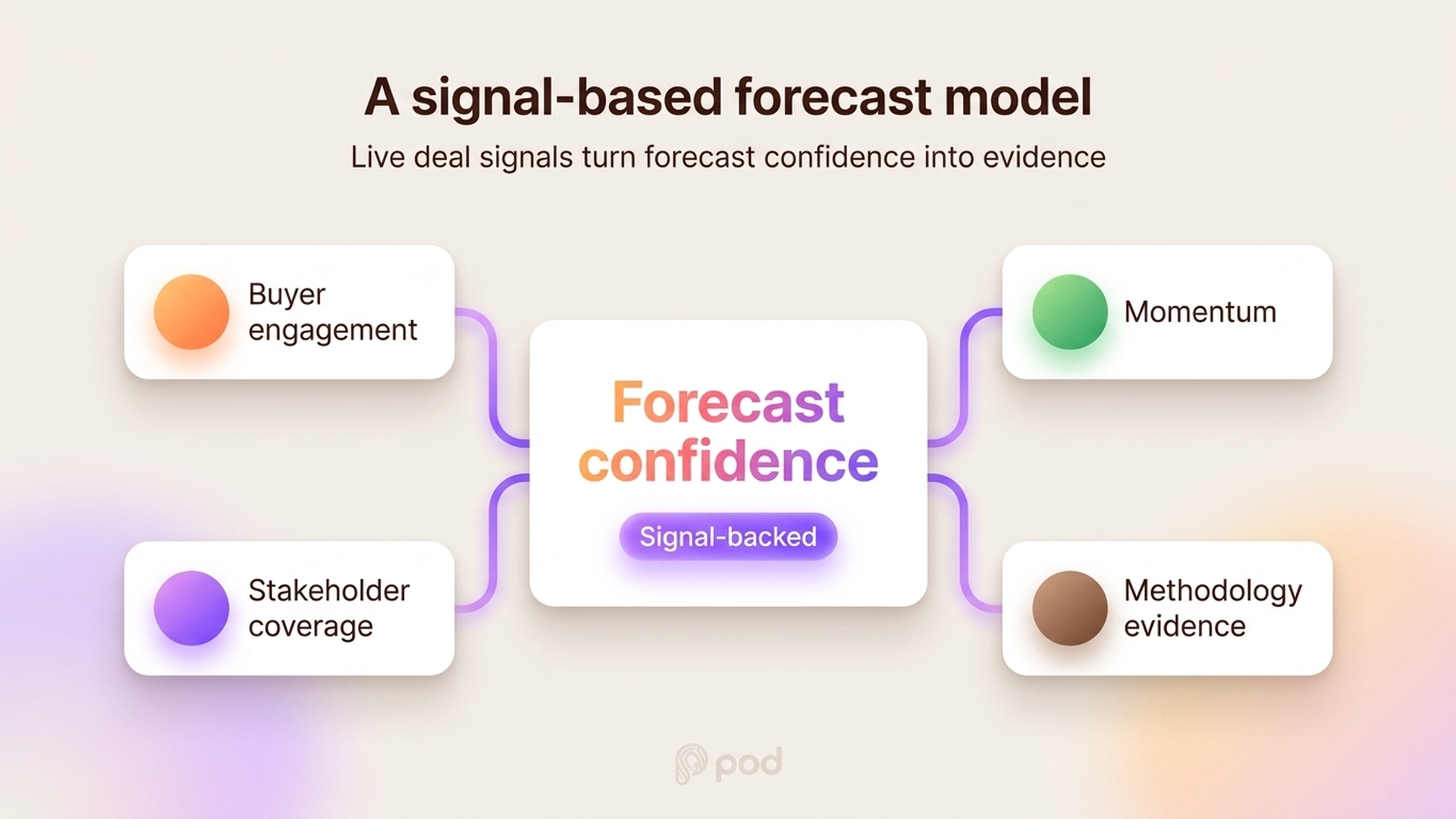
AI becomes valuable when the signal set is too large for humans to inspect manually.
No RevOps team can read every email thread, meeting note, transcript, CRM update, and stakeholder interaction across the open pipeline every week. No front-line manager can deeply inspect every deal before every forecast call. Even excellent reps miss patterns because they are inside the deal.
AI can do the boring, necessary inspection work at scale.
It can summarize engagement changes. It can flag deals with stale activity. It can identify weak stakeholder coverage. It can detect whether the buyer has discussed decision criteria, business impact, or procurement steps. It can compare the close date against actual buyer behavior. It can surface the deals where the forecast category and deal signals disagree.
It can also navigate nuance that a spreadsheet usually flattens. A deal may have high activity but low executive engagement. A champion may sound positive while the broader buying committee is cooling. A close date may look aggressive in isolation, but credible if legal, procurement, and executive review are all moving in sequence. Another deal may look calm until the system notices a pattern of missed next steps, shrinking stakeholder participation, and weakening methodology evidence.
That early signal reading matters because forecast accuracy is not only about calling the number at the end of the quarter. It is about understanding the relevant forecast data while there is still time to act. The sooner the team can see risk forming, the sooner a rep or manager can change the plan, re-engage a buyer, test a champion, or downgrade a deal before it distorts the forecast.
That last point is where forecasting gets interesting.
The most useful AI forecast support is not "this deal is 63 percent likely to close." That can be helpful, but it often turns into another number to argue about. The more useful output is a clear explanation of why the deal looks healthy or risky:
That is the difference between AI as a prediction gadget and AI as an operating layer.
Pod's Deal Coach supports this kind of deal-level inspection by surfacing flags, risks, and recommended actions for individual opportunities. For forecasting, that matters because the team does not only need a rollup. It needs to know which deal behaviors explain the rollup.
The best forecast meeting is not a heroic live investigation. It is the end of a week where the risks were already visible.
If AI is checking deal health continuously, reps do not wait for Thursday's inspection to learn that a commit deal has no recent buyer engagement. Managers do not discover in the forecast call that a close date moved without a real plan. RevOps does not have to chase every field update manually.
The workflow changes:
That is a more honest use of everyone's time.
It also changes rep behavior. When reps know the system looks at buyer engagement, stakeholder coverage, and close date evidence, there is less room for vague optimism. They can still make a case. They just need to make it with evidence.
That is good for managers too. A manager can coach the deal instead of cross-examining the rep. "You are missing the economic buyer" is a better conversation than "I do not believe this commit." "The buyer went quiet after pricing" is more useful than "This feels risky."
For RevOps teams, this is the practical path out of spreadsheet maintenance theater. The forecast process becomes a feedback loop. Which signals predicted slipped deals? Which warnings were false alarms? Which stage criteria need to be tightened? Which manager reviews are still too subjective?
AI gives RevOps a way to keep improving the model without forcing reps to become data entry clerks.

If your forecast is consistently wrong, resist the urge to add five more required fields and call it governance. That may improve CRM hygiene, but it will not fix the core issue if the forecast still depends on rep-reported stage and close date optimism.
Start with the signal model.
Pick the five to seven signals your team believes are most predictive of deal health. For many B2B teams, the list will include recent buyer engagement, economic buyer involvement, champion strength, next-step quality, close date movement, stakeholder coverage, and decision process clarity.
Then audit your forecast process against those signals:
That is the foundation. AI makes it scalable, but the operating philosophy comes first.
Pod helps revenue teams bring this signal-based view into daily selling, deal coaching, and pipeline inspection. For RevOps teams trying to improve forecast quality without creating more admin work, Pod gives reps and managers a clearer view of where deals are healthy, where they are risky, and what to do next.
If you are rebuilding the forecast model again, it may be time to stop asking for more confident guesses and start asking for better signals. RevOps teams can see how Pod supports signal-based pipeline inspection on the RevOps page, or book a demo to walk through the workflow.


