


Want to close more deals, faster?
Get Pod!
Fill out the form and book your demo today.
Thank you for subscribing!
Oops! Something went wrong. Please refresh the page & try again.

Stay looped in about sales tips, tech, and enablement that help sellers convert more and become top performers.
In complex sales environments, the highest performing sellers are often not the most specialized experts in the room. They are the generalists. They connect ideas across functions, understand multiple perspectives, and adapt quickly as deals evolve.
As buying processes grow more complex and involve more stakeholders, sales increasingly reward breadth of understanding over narrow expertise. Generalists are uniquely positioned to navigate this reality because they see patterns, communicate across audiences, and synthesize complexity into clarity.
Generalists are exposed to a wide range of problems, industries, and conversations. Over time, this exposure builds strong pattern recognition.
Rather than relying on deep expertise in a single domain, generalists recognize similarities across different situations. They see how budget concerns in one industry mirror risk concerns in another. They notice how decision bottlenecks repeat across companies, even when the surface details differ.
In sales, this pattern recognition is invaluable. Deals rarely fail for unique reasons. They stall because of common issues such as unclear value, missing stakeholders, or internal misalignment. Generalists are often faster to spot these signals because they have seen them before in different forms.
This allows them to anticipate challenges instead of reacting to them. They guide conversations toward resolution earlier, often without making it obvious that they are doing so.
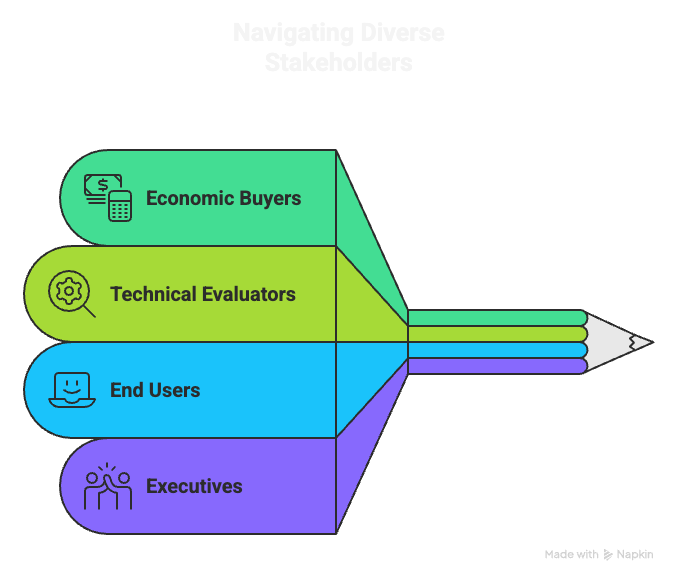
Modern B2B deals involve many stakeholders. Economic buyers, technical evaluators, end users, and executives all view the same purchase through different lenses.
Specialists often excel with one audience but struggle to adjust beyond it. Generalists, by contrast, are comfortable shifting context.
They know how to speak in outcomes with executives, implementation details with operators, and risk mitigation with finance or legal. This does not mean they know more than everyone else. It means they know how to translate value in a way each audience understands.
This adaptability builds trust. Buyers feel heard because the seller meets them where they are rather than forcing a single narrative.
As buying committees grow larger and more cross-functional, this ability to communicate across audiences becomes a decisive advantage.
Complex deals rarely move in straight lines. Priorities change. New stakeholders appear. Assumptions get challenged.
Generalists are comfortable operating in this ambiguity. They do not need every variable defined before moving forward. Instead, they synthesize information as it emerges and help buyers make sense of it.
This synthesis is critical. Buyers are often overwhelmed by their own internal complexity. They may understand their problem in pieces but struggle to connect them into a coherent decision.
Generalists act as sense makers. They help buyers see how individual concerns relate to broader outcomes. They reduce noise and create clarity without oversimplifying the situation.
In this way, generalists add value beyond product knowledge. They help buyers think.
This does not mean specialists are unimportant. Deep expertise matters in many sales environments, particularly when products are highly technical or regulated.
The difference is how that expertise is used.
Generalists know when to bring in specialists and how to position their input. They understand enough to ask the right questions and translate answers back to the broader buying group.
Rather than trying to be the smartest person in every room, generalists act as connectors. They ensure expertise is applied at the right moment and in the right way.
This balance between breadth and selective depth is what makes them effective.
Many of the best revenue leaders started as generalists. This is not accidental.
Leadership requires understanding how systems interact. Sales does not exist in isolation. It connects to marketing, product, customer success, finance, and operations.
Generalists are naturally inclined to think in systems rather than silos. They consider how decisions in one area affect outcomes elsewhere. This perspective helps them make better tradeoffs and align teams around shared goals.
As sellers, this shows up in how they manage deals. As leaders, it shows up in how they design processes and coach teams.
Organizations often promote generalists into leadership because they already operate with a broader lens.
The modern sales environment changes quickly. Buyer expectations evolve. Technology shifts. New competitors emerge.
In this context, curiosity becomes a performance driver. Generalists tend to ask more questions, explore new ideas, and challenge assumptions. They are less attached to a single way of doing things.
Adaptability follows naturally. When conditions change, generalists adjust without needing to unlearn rigid frameworks. They update their understanding and move forward.
This flexibility helps them stay effective over long careers, not just in a single role or market.
.png)
Teams built around generalists often experience stronger collaboration and knowledge sharing. Because generalists are comfortable learning and teaching across domains, information flows more freely.
Deals are less dependent on individual heroes. Context is shared. Decisions improve because more perspectives are considered.
For leaders focused on scalability and consistency, this matters. Generalists help create resilient teams that perform even as conditions change.

Generalists thrive when they have access to context. They perform best when information is centralized, searchable, and connected across conversations.
Pod empowers generalists by turning scattered deal data into a shared understanding. It centralizes deal knowledge, surfaces key insights, and helps sellers connect patterns across accounts and stakeholders.
Instead of relying on memory or fragmented notes, sellers using Pod can see what matters most in each deal and act with confidence.
In complex sales environments, generalists already have the mindset to win. Pod gives them the system to execute consistently. Book a demo to learn more.


