
Want to close more deals, faster?
Get Pod!
Fill out the form and book your demo today.
Thank you for subscribing!
Oops! Something went wrong. Please refresh the page & try again.

Stay looped in about sales tips, tech, and enablement that help sellers convert more and become top performers.
Most sales teams believe they are using AI. Few are using the kind that actually moves deals.
Walk into any B2B sales org in 2026, and you will find something that counts as "AI" on at least three slides in the next board deck. It might be a CRM automation rule that triggers a task when a deal hits Stage 3. It might be a chatbot on the pricing page. It might be a lead score or an AI that drafts follow-up emails after calls. All of this is real. Almost none of it does the rep's job for them.
That gap matters more than it did a year ago. Gartner expects at least 15% of day-to-day work decisions to be made autonomously through agentic AI by 2028. Its more recent forecast says AI agents will outnumber human sellers by ten to one in the same timeframe, with fewer than 40% of sellers reporting that those agents actually improved their productivity. In other words: the category is real, the spend is coming, and most implementations miss. The winners will be those who understand what kind of AI they are actually buying and what job it is supposed to do.
This post is for sales leaders trying to make that call cleanly. We will walk through the five types of AI that appear in modern sales stacks, give each a quick sales-specific example, and name its failure mode. Four of them share the same one. The fifth is the category most teams have not yet standardized on.
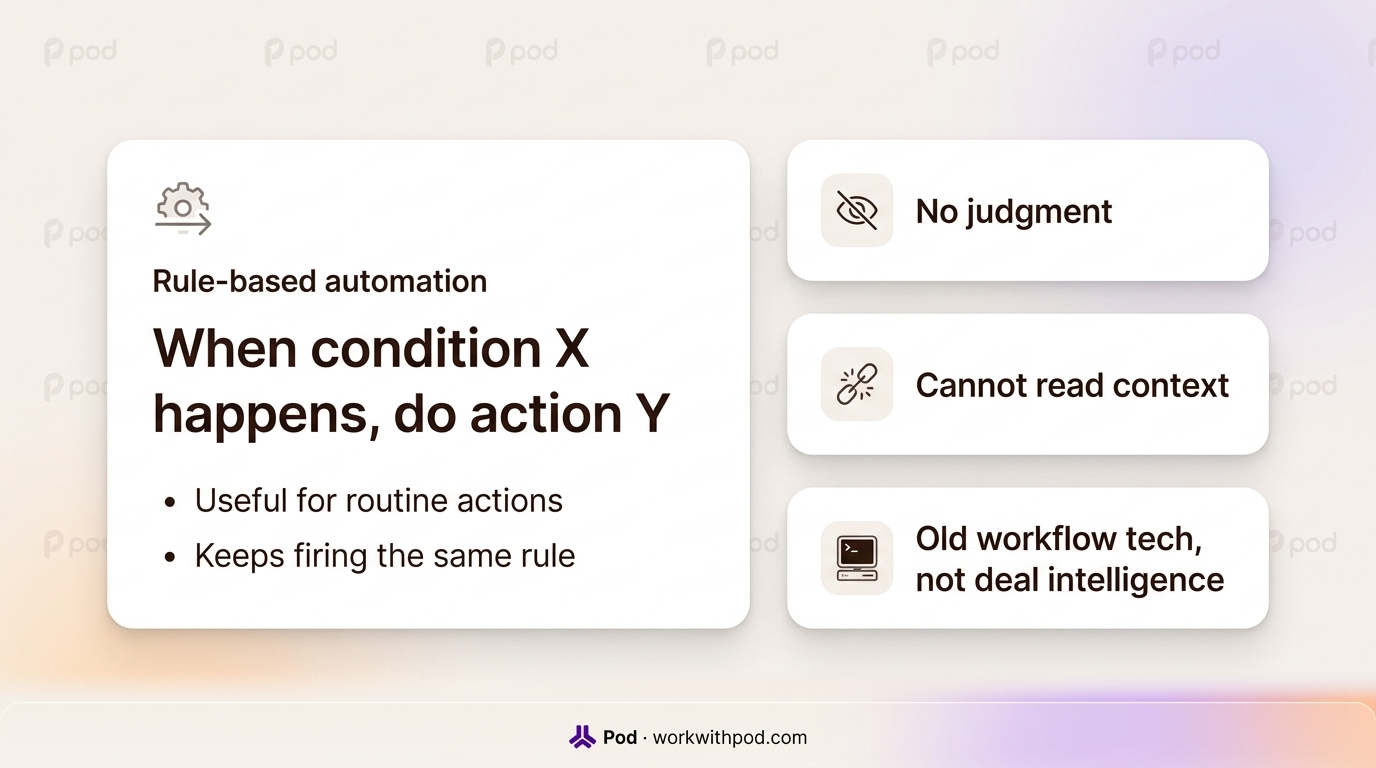
Rule-based automation is the oldest member of the family. It is what the industry called "workflow" before AI became a marketing word. It is a deterministic system: when condition X happens, do action Y. Send the welcome email when a lead fills in the form. Mark the opportunity as stale after 14 days of inactivity. Create a task on the AE when the close date moves.
In a sales context, this shows up as CRM workflow rules, sequence cadences in engagement tools, and round-robin lead routing. It is useful. It is also the definition of stupid software: it has no idea what the deal is about, it cannot read the last email, and it will keep firing the same rule whether the context is a routine renewal or a major escalation.
Key limitation: no judgment. Rule-based automation multiplies actions; it does not choose them. The moment the situation is even slightly non-standard, the rule either fires when it shouldn't or fails to fire when it should. That is fine for a welcome email. It is not fine for a deal worth hundreds of thousands of dollars.
Conversational AI is the category that includes most chatbots, voice bots, and "ask me anything" assistants embedded in product UIs. Technically, it is a language system tuned to turn a user's question into a response based on a library of content or a retrieval step on top of it.
In sales, the clearest example is the website chatbot that answers, "What's the difference between your Team plan and your Enterprise plan?" A more sophisticated version sits inside a CRM and answers, "What happened on the last call with Acme?" It reads like a cleaner version of search.
Key limitation: single-turn and context-poor. A good chatbot answers one question well. It does not know that the rep has a meeting with the same account tomorrow, that the champion went quiet three weeks ago, or that it should take action on anything. It replies, then goes back to sleep. For a rep, that means it answers questions they remembered to ask, not the questions they did not think to ask.
Predictive AI is the family of machine learning models that look at historical data and produce a probability: how likely is this lead to convert, this deal to close, this contact to become a champion, this account to churn. It is typically supervised learning trained on past won and lost deals.
In sales, the best-known form is lead scoring, followed by deal risk scoring and churn prediction. You see a number between 0 and 100 next to a record, and a color that tells you if it is green, yellow, or red. Some of it is genuinely useful. A good risk score will flag the silent champion earlier than a human scan.
Key limitation: it tells you what might happen, not what to do about it. Predictive scores describe the probability distribution. They do not write the recovery email, do not schedule the outreach to the economic buyer, and do not know whether the rep is already handling it. A number by itself is not a plan. And if the score is wrong in one direction, it quietly misleads the team in that direction for months before anyone notices.
Generative AI is the category most people think of first in 2026. Large language models, trained on enormous text corpora, can generate new text, code, images, or summaries based on a prompt. In sales, it is the engine inside every "write me a follow-up email," "summarize this call," "give me three talking points for this meeting" feature on the market.
The sales example is easy to picture. The rep finishes a call, a generative AI summary appears in the CRM, and a draft follow-up email is waiting. That saves real time. A good generative model also makes the rep look sharper: cleaner summaries, better-written emails, faster rebuttals to a difficult question mid-call.
Key limitation: it is a tool, not a coworker. Generative AI produces outputs on demand. It does not decide which email to send, which deal to worry about, which stakeholder to chase, or which follow-up is overdue. The rep is still the one who has to open the tool, ask the right thing, review the output, and carry the work forward. When it is good, it is faster writing. When it is bad, it is faster wrong-writing. Either way, the rep is still doing the thinking.
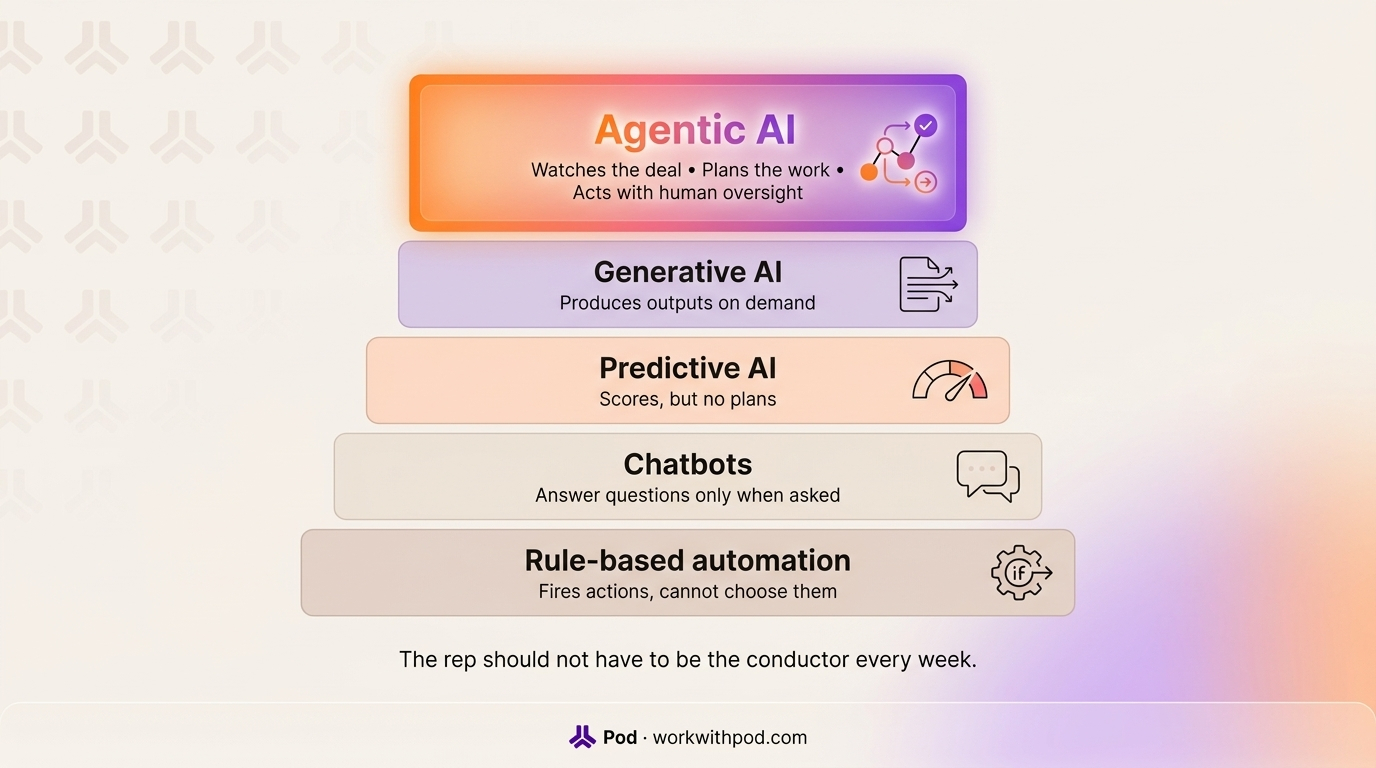
Look at those four categories together, and the pattern becomes obvious.
Rule-based automation fires actions but cannot choose them. Chatbots answer questions but only when asked. Predictive AI gives scores but not plans. Generative AI produces outputs but only on demand. None of them watches the deal. None of them owns the outcome. All of them expect the rep to be the conductor: to notice the problem, pick the tool, form the prompt, review the result, take the action, and remember to do it again next week.
That is not a minor flaw. This is why AI has not meaningfully changed how B2B reps spend their time, even after several years of investment. Salesforce's most recent State of Sales survey still has sales reps spending roughly 30% of their time actually selling, with the rest going to admin, CRM updates, prep, meetings, and coordination. The first four AI categories help at the edges of that 70%. They do not remove the 70%. They hand it back, a little faster.
That is also why Gartner's 10x-agents-versus-humans forecast comes paired with the uncomfortable corollary that fewer than 40% of sellers will say those agents actually improved their productivity. Most "AI" being rolled into sales stacks right now is still one of the first four categories in a more polished wrapper.
To get something fundamentally different, you need AI that acts, not just informs. That is the fifth category.
Agentic AI is a different architecture, not a more enthusiastic name for generative AI. The shortest honest definition: a system that takes a goal, plans multiple steps to achieve it, uses tools (CRM, email, search, calendar, internal systems) to take real actions, observes the result, and keeps going until the goal is met or escalated. Generative AI is a component inside it, not a substitute for it. IBM's own category explainer makes the same distinction: generative AI responds to prompts, agentic AI pursues goals.
In a sales context, that looks very different from a chatbot or a copilot.
An agent can watch a deal across all its signals (emails, meetings, CRM updates, transcripts) and flag that the champion has gone silent since the last pricing conversation, then draft a targeted re-engagement sequence and queue it for the rep's review. It can run before every upcoming meeting, pull relevant deal context and stakeholder history, and deliver a pre-meeting brief to the rep's inbox or Slack without being asked. It can run nightly across the pipeline and find the three deals that changed risk profile, not the 300 that did not.
The important word is "acts." Agents do not stop at "here's the information." They propose the next step and, where the team allows it and the action is reviewable, execute it. Pod's approach, for example, surfaces per-deal flags and recommendations through deal-level signals and recommendations, and lets teams build custom agents on top of that deal context through the AI Agent Builder. The common thread is that the seller is reviewing work, not inventing it from scratch.
If an "AI agent" in a vendor demo does not meet those three bars, it is almost always a generative assistant or a rule engine wearing the agent label. For a deeper unpacking of that specific distinction, see the next post in this series on what an AI sales agent actually is.
Consider a realistic mid-market deal. An AE owns a $180,000 opportunity with a 90-day cycle, a VP-level champion, an economic buyer who has been referenced but never met, a procurement contact introduced at the last meeting, and two competitors in the evaluation. The last call was three weeks ago.
Without agentic AI, the rep's workflow looks roughly like this. They remember the deal is important, open the CRM on Monday, skim the last few emails, feel vaguely uneasy about the silence but cannot place why, draft a generic check-in email with a generative tool, send it, and move on. Predictive AI may have flipped the deal's risk score to yellow a week ago. The chatbot has not proactively told anyone. The rule engine has fired a "stale activity" task that the rep has already dismissed twice. Nothing has actually gotten better.
With an agentic AI watching the deal, the shape of the week is different. The agent has already noted that the champion's engagement dropped sharply after the pricing call, that the procurement contact has opened the SOW three times without replying, and that competitor messaging has appeared in one of the stakeholder's public activities. It drafts a two-touch sequence: a short, stakeholder-specific message to the champion that references the exact objection from the pricing call, and a crisper procurement-facing message that preempts the likely compliance question.
It files a draft CRM update, flipping the economic buyer field to a specific named contact based on the last meeting transcript. It sends a Slack alert to the rep at 8:02 a.m.: "Three things on Acme. Review?"
The rep reviews and approves in under five minutes. The deal is not saved yet, but the clock is running again, and the rep spent five minutes instead of forty. That is the difference between AI that informs and AI that acts. That is the only category of AI that materially changes how the week feels.
If you want to see what this looks like in a working B2B sales environment, including how agents plug into deal signals, framework coverage, and the CRM you already use, book a demo of Pod. It is built for sales leaders who want the category of AI that actually does the work, not the one that hands it back.
The next post in this series unpacks the specific difference between a chatbot, a copilot, and an agent, and what to ask any vendor claiming to offer the third one.
By default, no. ChatGPT is a generative AI interface. When it is wired into tools, memory, and multi-step planning with the ability to take actions on real systems, the combined system starts to behave like an agent. In most sales stacks, a plain LLM chat interface is still generative AI, not agentic AI.
Usually not. A typical sales or support chatbot is conversational AI: it answers a question, then stops. An agent pursues a goal across multiple steps, uses tools, and takes action. If the "agent" in a vendor demo only answers questions and never does anything, it is a chatbot.
No, and vendors who imply otherwise are selling you hype. What agentic AI can do is take the operational load off the rep: deal monitoring, stakeholder tracking, pre-meeting prep, CRM updates, follow-up drafts. The human part of the job (trust, politics, negotiation, judgment on strategy) stays with the AE. The point is to give the AE more of their week back to do that work well.