

Want to close more deals faster?
Get Pod!
Fill out the form and book your demo today.
Thank you for subscribing!
Oops! Something went wrong. Please refresh the page & try again.

Stay looped in about sales tips, tech, and enablement that help sellers convert more and become top performers.
Most B2B sales teams already have a CRM. They have accounts, contacts, opportunities, activities, stages, notes, and fields. The data exists.
The problem is that data does not automatically become action.
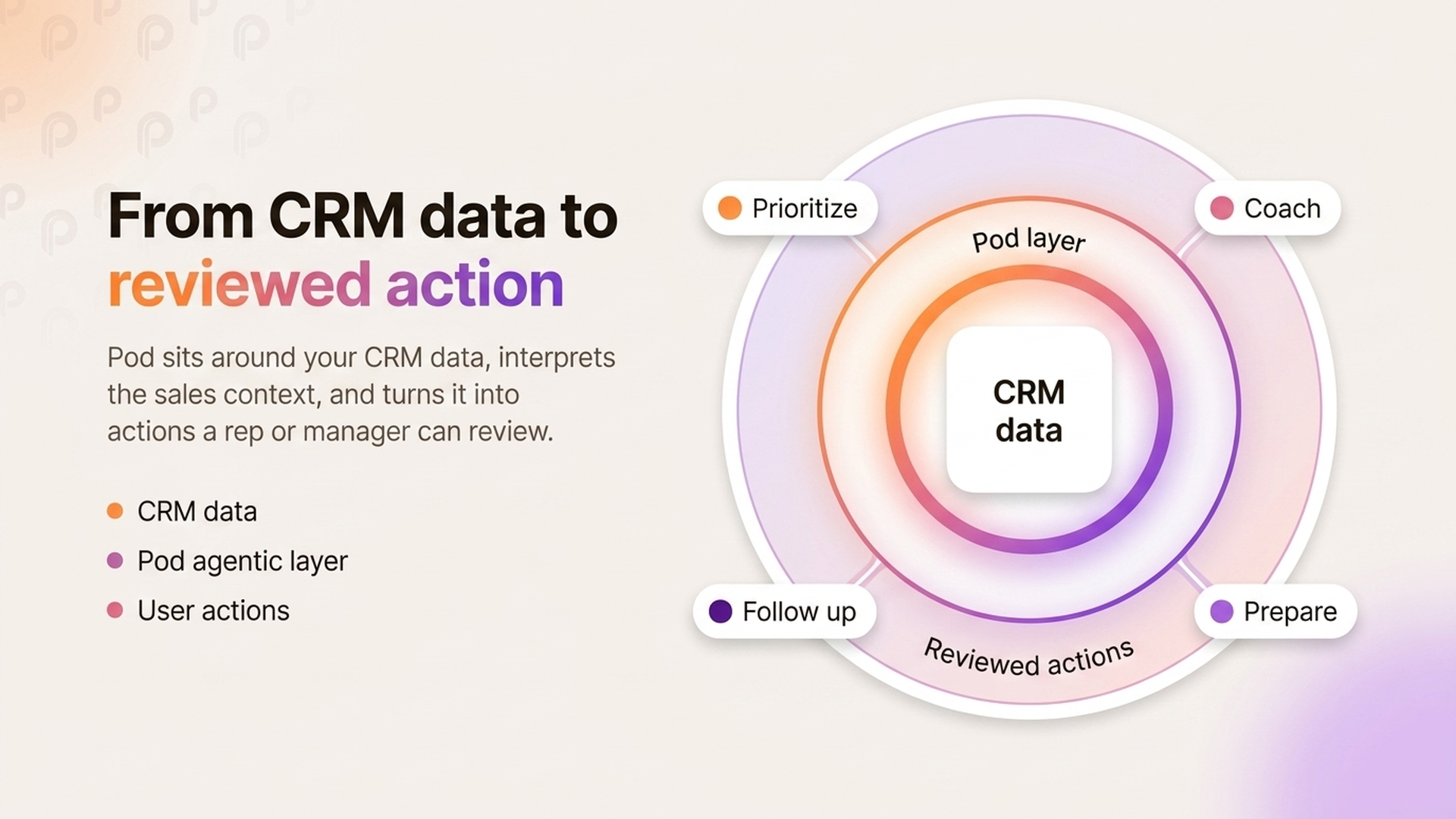
That is where Pod fits. Pod is an agentic AI platform for B2B sales teams. It sits on top of your CRM, reads the context around active deals, and helps reps and managers decide what should happen next.
The point is not to replace HubSpot or Salesforce. The point is to make the CRM actionable.
A CRM is still essential.
Revenue teams need one trusted place for pipeline data, ownership, customer history, and reporting fields. Finance, RevOps, leadership, and reps need it.
HubSpot and Salesforce are strong at that job. They organize customer data, track pipeline movement, and create a shared account and opportunity record.
That is why Pod connects to both HubSpot and Salesforce. The CRM keeps the record. Pod helps the team act on it.
That is the core value proposition: HubSpot or Salesforce tells you what is in the CRM. Pod helps you decide what to do about it.
HubSpot and Salesforce can be the right CRM and still leave execution gaps. Pod improves the CRM by adding the agentic action layer that handles those gaps.
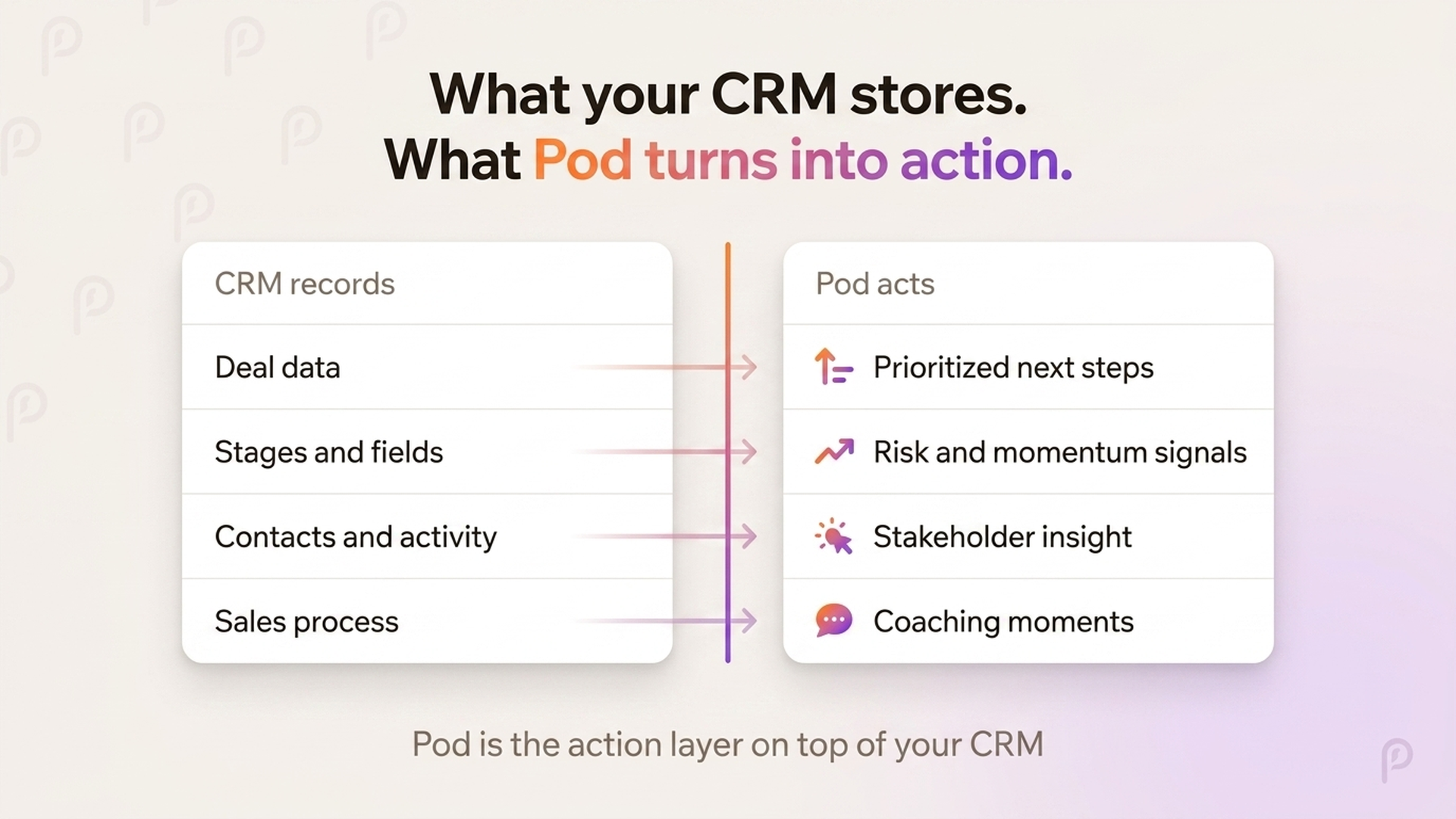
The CRM can tell you that a deal is in proposal. Pod can help identify that the economic buyer has not engaged, the close date is aggressive, and the next step is too vague.
The CRM can tell you that a rep has ten open opportunities. Pod can help identify which ones need attention today.
The CRM can tell you that the team follows MEDDPICC, BANT, or another methodology. Pod can surface where the evidence is missing from live deals.
That is not a failure of HubSpot or Salesforce. It is a category boundary. A system of record organizes truth. Sales teams also need a system that interprets it quickly enough to change behavior.
Pod's role is to turn CRM-connected context into action.
Instead of asking reps to inspect every field, note, email, and meeting before deciding what to do, Pod analyzes deal context and surfaces practical guidance. It helps the team answer the operational questions that matter:
A system of record answers, "What do we know?"
A system of action answers, "What should happen next?"
In a sales workflow, that second question is where the work lives. Reps need the right follow-up. Managers need to intervene on risky deals. RevOps needs methodology to show up in real behavior.
Imagine a rep opens HubSpot and sees ten active deals. Some have stale next steps. Some look healthy by stage but have weak engagement.
The CRM gives the rep the source data. Pod helps interpret it.
Pod can show that one late-stage deal has no recent economic buyer activity. It can surface that another deal is moving faster than the stage suggests. It can recommend stakeholder follow-up, meeting prep, or a better next step. Through the Chrome Extension, that intelligence can show up where reps work.
For managers, the same pattern applies. They need to know where coaching is required, which deals are drifting, and what evidence supports the concern.
For RevOps, the value is consistency. The team can operationalize methodology, pipeline inspection, and deal coaching without relying only on manual CRM hygiene.
Without an action layer, the team depends on reps and managers to notice every risk manually. With Pod, the important signals are easier to see, prioritize, and turn into reviewed action.
Comparing Pod against HubSpot or Salesforce misses the operating model.
If you need a CRM, use a CRM. HubSpot and Salesforce are built for customer records, pipeline structure, reporting, and revenue operations.
If you need reps and managers to act more consistently on the context inside and around that CRM, that is where Pod fits.
Keep HubSpot or Salesforce as the system of record. Add Pod as the agentic AI platform that helps the team prioritize, coach, prepare, follow up, and move deals forward.
The result is not another place for reps to maintain data. It is a layer that helps them use the data they already have. A good record is necessary, but it is not enough to run a high-judgment sales motion.
When you evaluate sales technology, ask one simple question: does this product create another system to maintain, or does it help the team act on the systems it already has?
For CRM, the answer should be record quality and shared visibility.
For Pod, the answer should be action: better deal prioritization, clearer coaching, stronger meeting prep, consistent methodology, and agentic workflows that turn sales context into reviewed next steps.
That is how the stack should work. The CRM keeps the truth. Pod helps the team do something with it. If your team already trusts HubSpot or Salesforce but still struggles with focus, coaching consistency, stale deals, or unclear next steps, the missing layer is Pod.
If you already run your sales motion in HubSpot or Salesforce and want to see what an agentic system of action looks like on top, book a demo.


