Want to close more deals, faster?
Get Pod!
Fill out the form and book your demo today.
Thank you for subscribing!
Oops! Something went wrong. Please refresh the page & try again.

Stay looped in about sales tips, tech, and enablement that help sellers convert more and become top performers.
.png)
Most sales managers already know their pipeline has problems. The data is right there: stalled deals, single-threaded accounts, close dates that keep sliding to the right. What they lack is not visibility. It is a system for turning that visibility into behavior change.
That is the real promise of AI deal intelligence for sales coaching. Not another dashboard. Not another weekly pipeline review where the manager asks “what’s the latest on Acme?” and the rep says “I’m waiting to hear back.” Instead, a structured coaching cadence where signals drive the conversation, questions are specific, and every 1:1 moves the rep closer to better habits, not just a better forecast.
This article is for sales leaders, frontline managers, and revenue managers who want to build a coaching practice that actually works. If you have already invested in deal intelligence tools and still feel like your coaching conversations are shallow, this is for you. We will walk through a concrete framework for using AI-generated deal signals to design better coaching questions, run better 1:1s, and track whether coaching is actually landing.
The shift is not about technology adoption. It is about management behavior change, and ironically, that is the part nobody writes about.
There is a structural problem with how most sales organizations approach coaching, and it starts with a conflation: managers treat pipeline reviews as coaching sessions.
They are not the same thing. A pipeline review is an inspection. The manager scans the forecast, asks about deal status, and flags risks. The conversation is backward-looking and deal-centric. “What happened with that proposal?” “Why did the close date move?” “Are we going to hit the number?”
Coaching is forward-looking and rep-centric. It asks: what skill, behavior, or judgment gap caused this pattern, and how do we close it? The goal is not to audit a deal. Iit is to improve the person running the deal.
The problem is that most managers default to review because it is easier. Review has a natural agenda (the pipeline), a clear deliverable (updated CRM), and a sense of productivity. Coaching requires preparation, pattern recognition, and hard questions. Without a system for generating those inputs, managers revert to inspection every time.
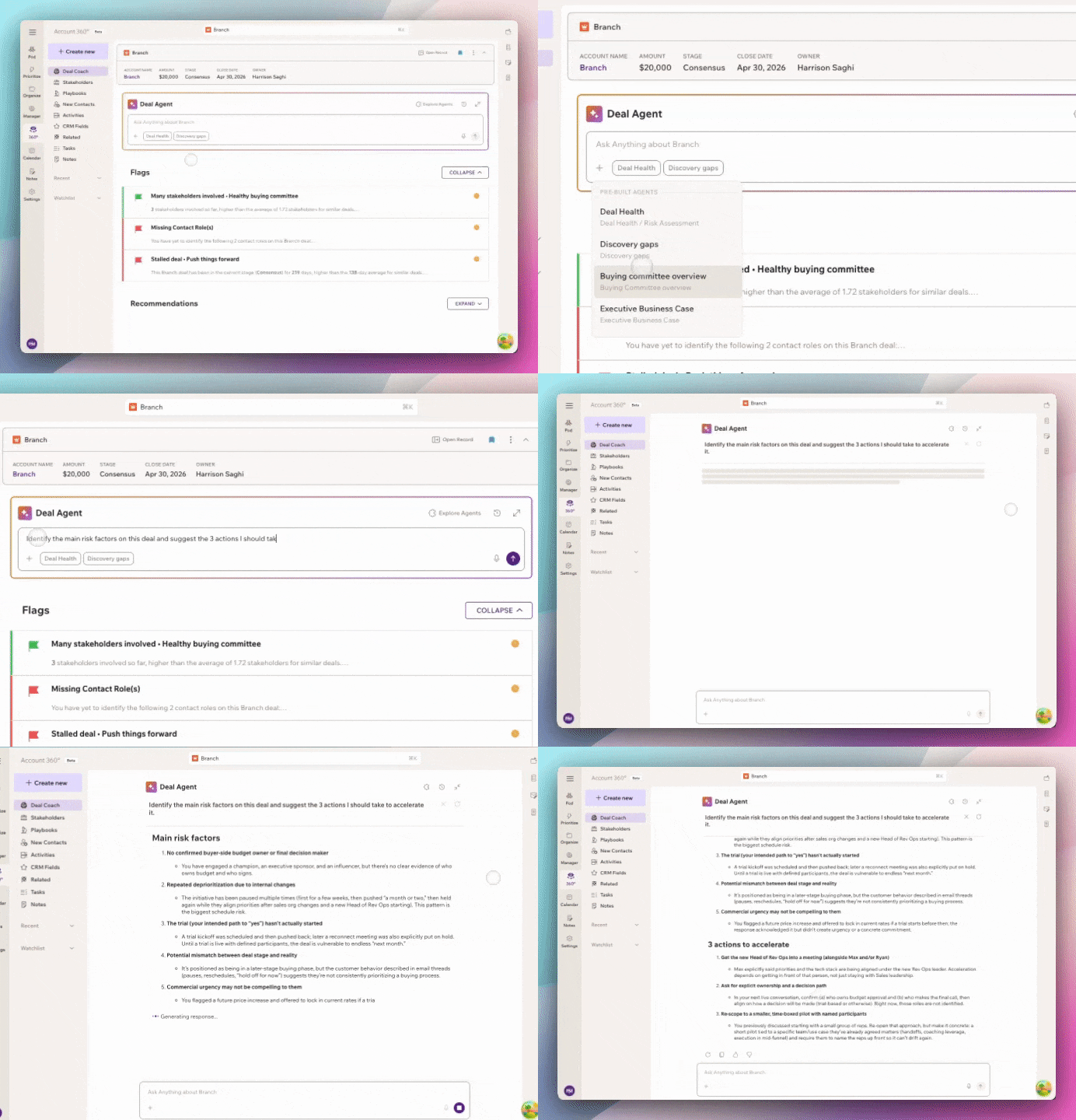
AI deal intelligence changes the input layer. Instead of walking into a 1:1 and asking the rep to self-report, the manager arrives with a set of signals: which deals have gone quiet, where stakeholder coverage is thin, which opportunities have been stuck at the same stage for too long. These signals are the raw material for coaching questions — not for interrogation.
AI deal intelligence is the practice of using machine learning and data analysis to evaluate deal health, surface risk patterns, and recommend actions across a pipeline. For managers, it means the system does the pattern-matching work that used to require hours of CRM spelunking.
The specific signals vary by platform, but the categories that matter most for coaching include:

Activity signals: Is the deal being worked? Frequency and recency of emails, meetings, calls, and CRM updates tell you whether a deal is alive or coasting on momentum from a month ago.
Stakeholder signals: Who is involved? Single-threaded deals are fragile. AI can flag when a deal lacks executive engagement, when a key contact has gone silent, or when the contact map is too narrow for the deal size.
Velocity signals: How fast is the deal moving? Days in stage, time since last stage change, and comparison to historical benchmarks reveal whether a deal is progressing or stalling.
Engagement quality signals: Not just volume, but substance. Are meetings happening with decision-makers or only champions? Is the deal advancing through discovery, proposal, and negotiation, or repeating the same stage activities?
Process compliance signals: Is the rep following the team’s methodology? Whether you run MEDDPICC, BANT, or a custom framework, AI can track topic coverage and flag where the qualification story is incomplete.
The value for a manager is not in any single signal. It is in the combination. A deal with high activity but no stakeholder breadth tells a different coaching story than a deal with great contacts but no recent engagement. AI deal intelligence reads the full picture so the manager can focus on the right question.
One of the most consequential distinctions a manager can make, and one that AI deal intelligence makes dramatically easier, is the difference between motion and momentum.
Motion is activity. Emails sent, calls made, meetings held. It shows up in CRM dashboards as busyness. For a rep who is struggling, motion is comforting: “I’m doing a lot of things.”
Momentum is progression. The deal is moving through stages. New stakeholders are entering the conversation. Technical validation is happening. Procurement is engaged. The close date is holding or pulling in.
The danger of pipeline reviews without deal intelligence is that motion masquerades as momentum. A rep with forty logged activities on a stalled deal can look productive in a traditional review. AI deal intelligence exposes the gap by looking at what those activities actually produced: did the deal advance? Did engagement deepen? Did the buying committee expand?
For coaching, this distinction shapes the conversation. If a deal has motion but no momentum, the coaching question is not “work harder” — it is “what is the next concrete milestone, and what is blocking you from reaching it?” That is a fundamentally different conversation, and one that AI deal signals make possible by default rather than by accident.
The word “cadence” matters. Ad hoc coaching, where the manager jumps in when something goes wrong, is reactive. A cadence is proactive. It happens on a rhythm, with preparation, and it compounds over time.
Here is a concrete framework for building a weekly coaching cadence around AI deal intelligence:
Start the week by reviewing your team’s deal signals in aggregate. Most AI deal intelligence platforms offer a manager-level view that rolls up deal health, risk flags, and activity trends across the roster. Spend twenty to thirty minutes scanning for patterns:
This is not a forecast exercise. It is a coaching preparation exercise. You are looking for the two or three themes you want to explore in 1:1s this week.
Pod’s Manager Hub gives you this view. It’s roster-level performance, deal risk, and coaching playbooks in one place →
This is the step most managers skip, and it is the one that separates review from coaching.
For each signal pattern you identified, translate it into a coaching question. Not “why is this deal stalled?” that triggers defensiveness. Instead:
The signal provides the evidence. The question provides the coaching. The combination ensures the conversation is specific, evidence-based, and forward-looking.
A signal-driven 1:1 does not need to be long. Thirty minutes is enough if the preparation is done. A simple structure:
The key principle: the 1:1 is about the rep, not the deal. Deals are the vehicle for coaching, not the destination.
Abstract frameworks are useful but insufficient. Here are five specific scenarios where AI deal signals change what a manager can say in a coaching conversation.
1. The stalled enterprise deal. The signal: a deal has been in the same stage for three weeks with declining touchpoint frequency. The old conversation: “What’s going on with this deal?” The new conversation: “This deal has been in evaluation for three weeks and engagement has dropped. Let’s talk about what a decision timeline looks like and whether we have the right access to move it forward.”
2. The single-threaded account. The signal: only one contact is engaged on a deal above $50K. The old conversation: nothing — the manager might not notice. The new conversation: “You’re running this deal through one champion. What happens if they change roles or go on leave? Let’s map the rest of the committee.”
3. The serial close-date slider. The signal: a rep has pushed the close date on four deals this quarter. The old conversation: “We need more accuracy in the forecast.” The new conversation: “I see a pattern where close dates are moving. Let’s look at how you’re setting expectations with buyers early in the process and whether our qualification is catching timeline risk.”
4. The overloaded rep with a shallow pipeline. The signal: high deal count, but most opportunities show weak engagement signals. The old conversation: “You need more pipeline.” The new conversation: “You’re carrying thirty deals, but only six show real buying signals. Let’s talk about which ones deserve your time this week and which ones we should deprioritize.” Pod’s Prioritize feature helps reps focus on the deals that matter most →
5. The multi-threaded deal going dark. The signal: a deal had strong multi-stakeholder engagement that dropped off sharply two weeks ago. The old conversation: “Have you followed up?” The new conversation: “This deal had great momentum with three stakeholders. Something changed two weeks ago. What do you think happened, and what’s your re-engagement plan?”
Each of these conversations is only possible because the manager has signal-level context. Without it, they are guessing, or worse, relying entirely on what the rep volunteers.
The most powerful use of AI deal intelligence for coaching is not at the deal level. It is at the team level.
When you review deal signals across your entire roster, patterns emerge that no single 1:1 would reveal. Maybe three out of eight reps have stakeholder breadth problems. Maybe your team consistently stalls at the proposal stage. Maybe close date accuracy is strong for mid-market deals and weak for enterprise.
These patterns are coaching themes. They tell you where to invest team-level enablement, where to adjust your methodology, and where to focus your own time as a manager.
A team-level coaching cadence might look like this:
Platforms that provide manager playbooks and performance tracking make this kind of team-level pattern recognition practical rather than aspirational.
Here is the uncomfortable truth: the hardest part of building a coaching cadence with AI deal intelligence is not the technology. It is the manager’s own behavior change.
Most managers were promoted because they were great individual contributors. They closed deals. They know how to sell. But coaching is a different skill. It requires asking questions instead of giving answers. It requires patience when a rep is working through a problem. It requires preparation — the Monday signal review, the question design, the structured 1:1.
Common resistance patterns:
The shift requires practice. Start with one or two signal-driven 1:1s per week. Notice how the conversation quality changes when you arrive with evidence instead of questions. Build from there.
How do you know your coaching cadence is actually working? Not by win rate alone. That is a lagging indicator with too many confounding variables. Look for these leading indicators:
Rep behavior shifts within the quarter. If you coached on stakeholder breadth in January, are your reps showing broader contact engagement by March? AI deal intelligence lets you measure this directly.
Coaching themes evolve. If you are still coaching the same issue six months later, the coaching is not landing. A working cadence produces visible progression — from foundational issues (deal hygiene, activity consistency) to more advanced ones (negotiation strategy, executive engagement).
1:1 preparation time drops. As you build the habit, the Monday signal review gets faster. You know where to look. Your questions become sharper. This is the compounding effect of a real cadence.
Reps start self-diagnosing. The ultimate signal: reps begin identifying their own deal risks before you bring them up. They internalize the pattern recognition that AI deal intelligence provides.
Forecast accuracy improves. Not because you pressured reps to commit more accurately, but because coaching improved their judgment about deal health and timing.
According to Salesforce’s State of Sales research, 83% of sales teams using AI reported revenue growth, compared to 66% without, and top-performing teams were 1.7 times more likely to use AI agents than struggling teams. The gap is not about having the tool. It is about using it to change how the team operates.
You do not need a perfect system to start. You need a signal source, a rhythm, and the discipline to prepare.
This week:
This month:
This quarter:
AI deal intelligence does not replace the manager. It raises the floor of what every coaching conversation can be: specific, evidence-based, and tied to the behaviors that actually move deals forward. The managers who win the next five years will not be the ones with the best dashboards. They will be the ones who turned signals into coaching, and coaching into consistent team performance. (For more on building an effective sales coaching program, see our deep-dive guide.)
Ready to see how AI deal intelligence powers a real coaching cadence? Book a Demo and see how Pod gives managers the signals, playbooks, and team-level visibility to coach reps on what matters, every week.