


Want to close more deals faster?
Get Pod!
Fill out the form and book your demo today.
Thank you for subscribing!
Oops! Something went wrong. Please refresh the page & try again.

Stay looped in about sales tips, tech, and enablement that help sellers convert more and become top performers.
The sales automation conversation has spent too much time on the wrong metric.
Most teams talk about hours saved. Save five hours a week on CRM updates. Save two hours on meeting prep. Save another hour on follow-up emails. That framing is easy to understand, but it undersells the real point.
The better question is what happens to revenue when reps get that time back.
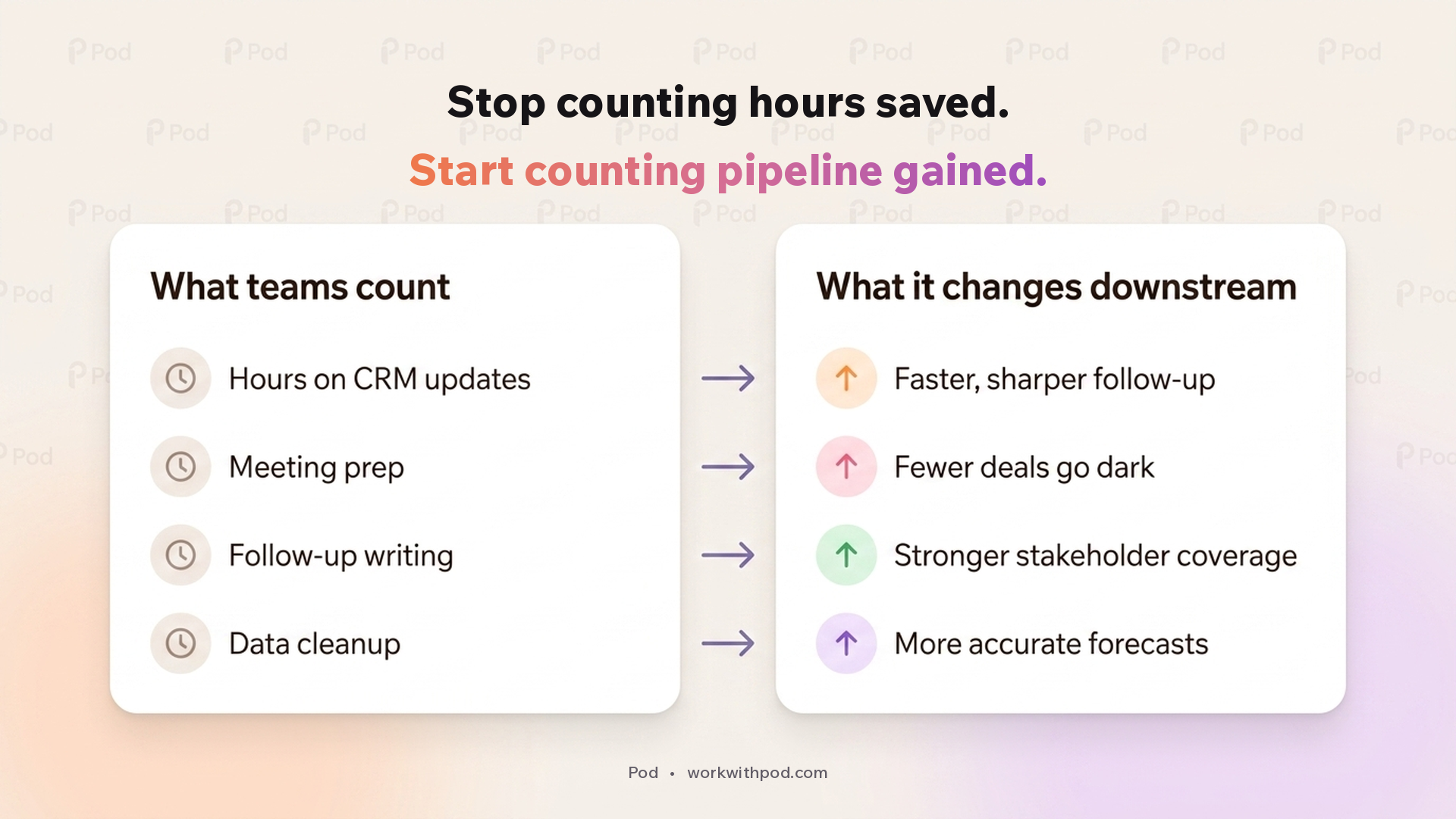
Admin work is not only annoying. It changes pipeline quality. A follow-up goes out two days late because the rep was cleaning up CRM fields. A champion goes quiet because nobody had time to personalize the next touch. A manager discovers a deal risk in the pipeline review that the rep could have caught earlier with better prep.
The "how" of automation matters, and we covered that in 9 Tasks B2B Sales Reps Should Be Automating Right Now. This post is about the "why": what actually changes in the pipeline when reps spend less time on admin and more time on the work that moves deals.
Deals do not usually go dark because reps forget they exist. They go dark because the rep is juggling too many updates, notes, tasks, meeting recaps, and internal asks to notice the silence early enough.
When admin load drops, reps can respond to weak engagement faster. A quiet champion gets a thoughtful re-engagement message before the account fully stalls. A missed next step turns into a same-day follow-up instead of a Friday cleanup item.
The pipeline impact is simple: fewer deals drift from "active" to "maybe still alive" without anyone noticing.
Fast follow-up is useful. Specific follow-up is better.
When reps are buried in manual prep and CRM work, follow-ups become generic because there is not enough time to make them precise. The buyer gets a polite recap, a few bullets, and a vague next step. The message is fine, but it does not advance the deal.
When reps have more time, follow-up can reflect what actually happened: the CFO's concern, the champion's internal deadline, the technical evaluator's question, the procurement step that needs an owner. That kind of follow-up makes the buyer feel heard and keeps the deal anchored to real next steps.
Admin-heavy teams often confuse activity with quality. Reps send more messages because they are trying to keep motion alive, but the messages are not always tied to what the buyer cares about.
When AI agents handle more of the operational work, reps have more room to personalize the moments that matter. A stakeholder does not need another generic "checking in" email. They need a message that connects to their role, their concern, and the deal's current blocker.
That is where tools like Pod AI Agents help. Agents can pull context from the deal, prepare a draft, and surface the evidence behind the recommendation. The rep still owns the message, but they start from a much better first version.
Complex B2B deals are rarely won through one person. They require champions, economic buyers, technical evaluators, finance, legal, procurement, and often a few hidden skeptics who never appear in the CRM until late.
Admin work steals time from multi-threading. A rep knows they should map the buying committee, but they have calls to log, fields to update, and pipeline notes to prepare. Stakeholder work gets pushed because it is important but not always urgent.
When reps spend less time on admin, they can identify missing roles earlier, tailor outreach by persona, and ask champions for the right introductions before the deal reaches a fragile late stage.
Better stakeholder coverage means fewer single-threaded deals pretending to be healthy.
Pipeline quality improves when reps stop treating every open opportunity as equally urgent.
Admin-heavy workflows make prioritization harder because reps are stuck maintaining the pipeline instead of reading it. They spend time on whatever is loudest: the deal with a meeting today, the manager's latest request, the CRM field that needs cleanup, the account that just sent an email.
When admin load drops, reps can ask better questions: which deal changed risk profile today? Which opportunity has momentum? Which late-stage deal is missing a real next step? Which account is worth an executive touch this week?
Deal Coach is useful here because it surfaces deal-level flags, risks, and recommended actions. The rep's time shifts from finding the signal to acting on it.
A pipeline review should be about judgment and action. Too often, it becomes a status collection meeting.
Reps arrive with partial updates. Managers ask what changed. Everyone spends too much time reconstructing the deal from memory. The meeting ends with a few action items, but the real work was discovering basic facts that should have been visible before the call.
When reps spend less time on admin, pipeline reviews get cleaner. The CRM is less stale. Deal notes are easier to trust. Risks are identified earlier. Reps can show up ready to discuss what they believe, what evidence supports it, and where they need help.
That changes the manager's role. Less interrogation. More coaching.
Admin overload hides risk.
If reps are busy cleaning up old data, preparing recaps manually, or updating fields after the fact, managers often see deal issues after they have already become obvious. The close date moved. The stage stalled. The champion stopped replying. The forecast category no longer feels credible.
When routine work is handled faster, managers get more timely deal signals and cleaner rep judgment. They can intervene while there is still time to change the outcome.
That does not mean every risk disappears. It means the team gets more room to act before risk turns into a slip.
Forecast accuracy is not only a RevOps problem. It is a time-allocation problem.
If reps do not have enough time to inspect deal evidence, forecast calls become story-driven. The rep explains why the champion is still positive. The manager asks whether the close date is real. RevOps looks at stage, amount, and activity data. Everyone is trying to infer buyer commitment from incomplete context.
When reps spend less time on admin, they can prepare a better forecast point of view. They can check whether the economic buyer is engaged, whether the next step is buyer-owned, whether legal or procurement has started, and whether recent engagement supports the close date.
The result is not a perfect forecast. It is a more evidence-based one.
The highest-value parts of selling are rarely administrative.
They are the moments where a rep reads hesitation on a call, protects a champion relationship, negotiates a tradeoff, earns access to the economic buyer, reframes the business case, or asks a hard question at the right time.
Those moments require attention. They require preparation, judgment, and emotional energy. A rep who has spent the afternoon cleaning up CRM and writing summaries from scratch has less of that energy available.
When admin work drops, reps can spend more time on the human work that actually changes outcomes. That is where automation turns from a productivity story into a win-rate story.
The goal is not to make reps move faster for the sake of speed. The goal is to remove the avoidable delays that slow good deals down.
Late follow-ups slow deals down. Missing stakeholder outreach slows deals down. Vague next steps slow deals down. Manual meeting prep slows deals down. CRM cleanup that happens after the fact slows the manager's ability to coach.
When admin load drops, the deal motion gets tighter. Buyers receive relevant follow-up sooner. Reps catch gaps earlier. Managers intervene before the next forecast call. RevOps gets cleaner signals without creating more work.
That is healthy deal velocity: not pressure, not shortcuts, but fewer preventable stalls.
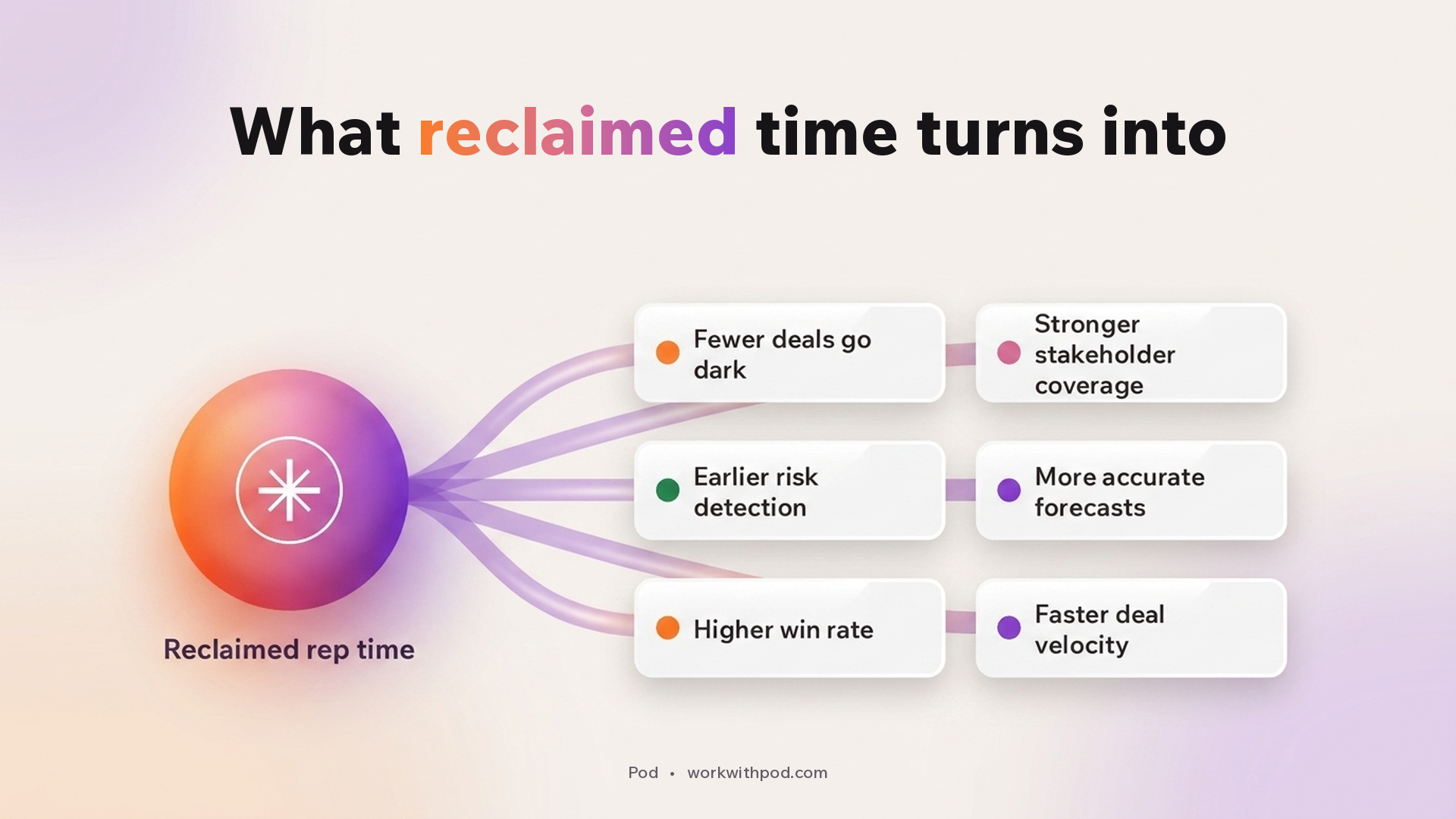
Sales leaders should stop treating admin reduction as a rep comfort project.
Yes, reps appreciate getting time back. But the bigger point is what that time does for the pipeline. It improves follow-up quality, stakeholder coverage, prioritization, risk detection, forecast accuracy, win rate, and deal velocity.
That is why automation investments should be evaluated by more than hours saved. The better questions are:
For Sales Leaders, the mandate is to turn rep time into better execution. For RevOps, the mandate is to remove operational drag without creating another process reps avoid.
AI agents make that possible when they are grounded in real deal context and designed for human review. They do not just save time. They give teams a way to convert time into pipeline quality.
If you want to see how Pod helps reps spend less time on admin and more time moving deals forward, book a demo.


.png)


