.png)

Want to close more deals?
Get Pod!
Fill out the form and book your demo.
Thank you for subscribing!
Oops! Something went wrong. Please refresh the page & try again.

Stay looped in about sales tips, tech, and enablement that help sellers convert more and become top performers.
If You're Still Doing This Manually, You're Already Behind
The average B2B sales rep spends less than 30% of their time actually selling. The rest disappears into CRM updates, meeting prep, pipeline reviews, and email follow-ups (Salesforce, State of Sales, 2026, accessed 2026-04-08). That stat has barely moved in five years.
What has changed is the technology available to fix it. B2B sales automation has evolved beyond simple triggers and templates. Today, AI agents can analyze your deals, pull context from your CRM and calendar, and take action on your behalf. They don't just remind you to do something. They do it.
This post covers nine specific tasks that eat into your selling time every week and shows you what it looks like when an AI agent handles each one. Some of these you've heard before (CRM entry, email drafting). Others, like pipeline review prep and stakeholder tracking, almost never show up in automation conversations, even though they cost you just as much time.
If you're evaluating where to start, look at the AI Agent Builder approach: agents that are customizable to your workflow, not one-size-fits-all bots.
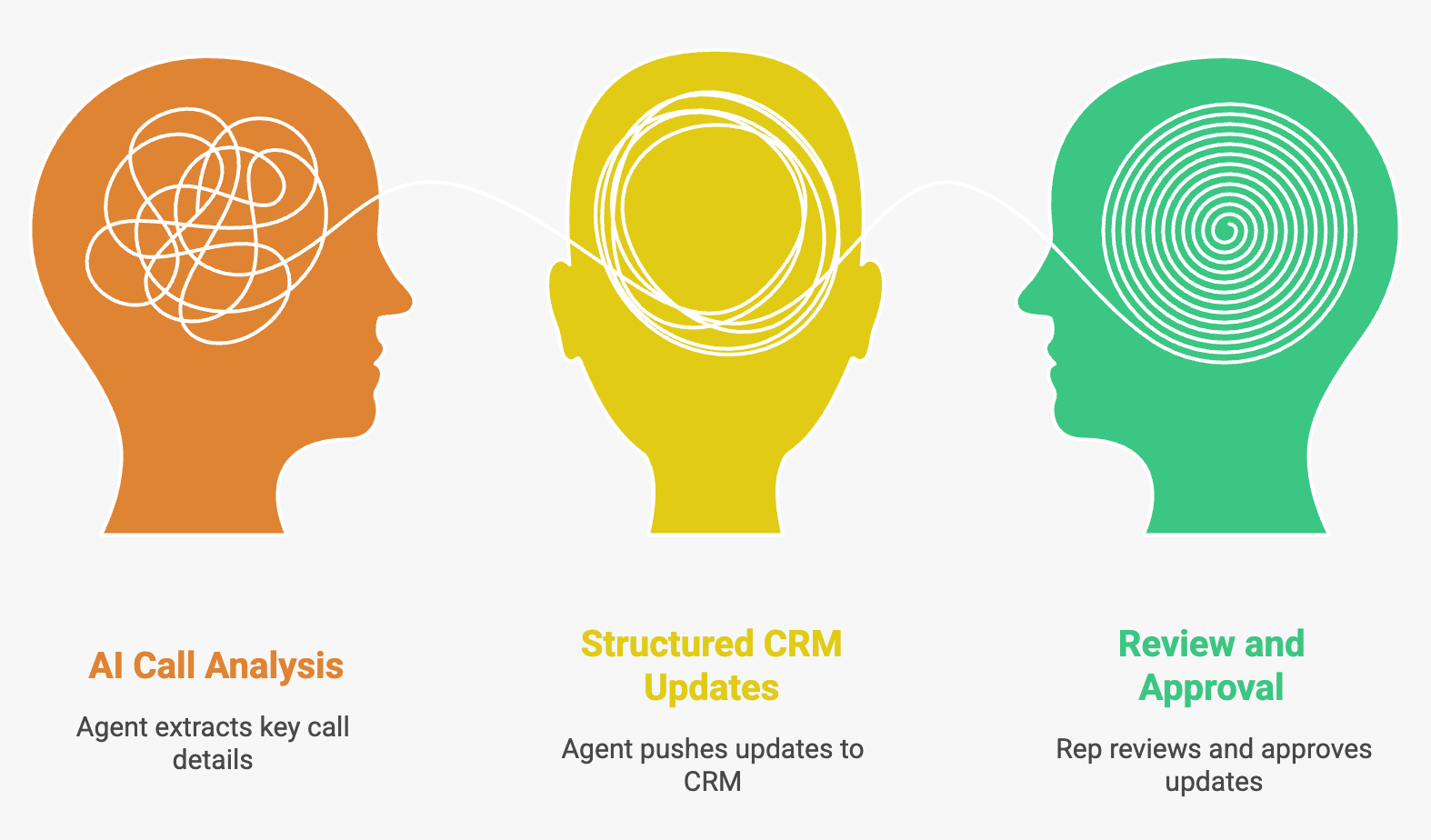
The time kill: Reps spend an average of 3.4 hours per week manually entering customer information into their CRM (EverReady, 2026, accessed 2026-04-08). After every call, that means tabbing over to Salesforce or HubSpot, logging notes, updating fields, and double-checking that nothing was missed. Multiply that across 8-12 calls a day, and you've lost your most productive hours to data hygiene.
The problem isn't just the time. It's the quality. When entry happens hours after a conversation, details get lost. Close dates stay stale. Next steps don't get recorded. Your CRM becomes less trustworthy, which makes everything downstream (forecasting, pipeline reviews, coaching) less useful.
The agent-powered fix: An AI agent can listen to your call recordings, extract the relevant details (next steps, objections raised, stakeholder mentions, timeline updates), and push structured updates to your CRM fields automatically. The agent doesn't just transcribe. It understands your deal context, knows which fields matter, and logs the right information in the right place. You review and approve instead of doing the data entry yourself.
The time kill: Before every external meeting, you're pulling up LinkedIn profiles, scanning recent emails, reviewing the deal stage, checking what was discussed last time, and trying to remember which stakeholders care about what. Good reps spend 15-30 minutes on prep per meeting. With 4-6 meetings a day, that's easily 1-2 hours gone before you've spoken to anyone.
And most of that work is just gathering context that already exists in your systems. It's scattered across your CRM, email inbox, calendar, and call transcripts.
The agent-powered fix: An agent that runs before every meeting on your calendar, pulling together attendee context, prior conversation history, deal status, framework gaps, and suggested talking points into a single brief. Pod's AI-generated meeting briefs do exactly this: they synthesize CRM data, email threads, and transcripts into a prep doc that's ready when you are. After the meeting, the same system generates a structured summary with next steps, so you don't lose momentum.
The time kill: Every rep knows the post-call routine: open Gmail, stare at the blank compose window, try to remember what was discussed, write something that sounds personal but professional, and hope you didn't miss a key point. A thoughtful follow-up takes 10-15 minutes. A rushed one risks losing the deal thread.
The irony is that most follow-up emails draw from the same source material: what happened in the meeting, what the prospect cares about, and what the next step is. That's context an AI agent already has.
The agent-powered fix: An agent that drafts follow-ups using the actual conversation context: transcript summaries, deal stage, stakeholder concerns, and agreed next steps. You choose the tone, review the draft, and send. Pod's AI email assistant works this way. It doesn't generate generic templates. It writes emails grounded in your specific deal, so the prospect reads something that reflects what actually happened.
The time kill: Every morning, you open your pipeline and try to figure out where to spend the day. Which deals are moving? Which ones are stalling? Which ones need a push before the quarter ends? Most reps do this by gut feel, scrolling through their pipeline and checking dates, stages, and recent activity. It works until you're carrying 30-50 deals and can't keep them all in your head.
The cost isn't just the 20-30 minutes of morning triage. It's the opportunity cost of spending time on a deal that was never going to close while a winnable one quietly slips.
The agent-powered fix: An agent that ranks your deals by priority using real signals: activity levels, stakeholder engagement, velocity through stages, close date realism, and buying committee coverage. Pod's AI-powered deal prioritization surfaces your top deals, flags at-risk opportunities, and plots your pipeline in a visual matrix so you can see where to spend your time in seconds, not in a 30-minute CRM scroll.
The time kill: The average enterprise B2B deal now involves 6 to 10+ stakeholders (Gartner, 2026, accessed 2026-04-08). That's 6 to 10 people with different priorities, concerns, and engagement levels. Tracking who's involved, who's been silent, who's the champion, and who's the blocker is a full-time job on top of your actual full-time job.
Most reps track this in their heads or in a spreadsheet tab they stop updating after week two. The result: single-threaded deals that stall when your one contact goes dark. Research shows that deals engaging three or more stakeholders in parallel close at two to three times the rate of single-threaded ones (Corporate Visions, 2026, accessed 2026-04-08).
The agent-powered fix: An agent that maps the buying committee for each deal, recommends which roles should be involved based on similar won deals, and tracks sentiment for each contact over time. Pod's stakeholder mapping and recommendations surface exactly this: which departments and titles are missing, who's engaged, who's gone cold, and where you need to multi-thread. You get a living map instead of a mental model that breaks under deal load.
The time kill: A mutual action plan (MAP) is supposed to keep both sides of a deal aligned on timelines, milestones, and responsibilities. In practice, it's a Google Doc or spreadsheet that the rep builds once, updates inconsistently, and eventually forgets to share. Building a good MAP takes 30-45 minutes. Keeping it current across a multi-month enterprise cycle? That's where most reps give up.
The real cost is lost alignment. When the MAP goes stale, close dates slip, procurement steps get missed, and the deal stalls without either side noticing until it's too late.
The agent-powered fix: An agent that generates a draft MAP based on your deal's stage, methodology framework, and historical patterns from similar won deals. It tracks progress against milestones and flags when action items go stale. Instead of building the plan from scratch, you refine what the agent produces and keep it synced with your deal's real-time context.
The time kill: Every week (or every other week), you sit down with your manager to walk through your pipeline. The prep usually involves pulling up each deal, rehearsing the narrative, updating stale fields so nothing looks bad, and predicting which questions your manager will ask. For many reps, this takes 30-60 minutes of prep for a 30-minute meeting.
Pipeline reviews are valuable. The prep work to make your data presentable is not. And when managers ask about deals you haven't touched in a week, you're improvising, not informing.
The agent-powered fix: An agent that pre-builds your pipeline review summary: deal status, recent activity, risk flags, next steps, and methodology gaps, all pulled directly from live data. Pod's pipeline intelligence delivers a daily action plan organized into "Today" and "Next 7 Days" buckets, so your pipeline review prep isn't a weekly scramble. It's an always-current snapshot your manager can see too.
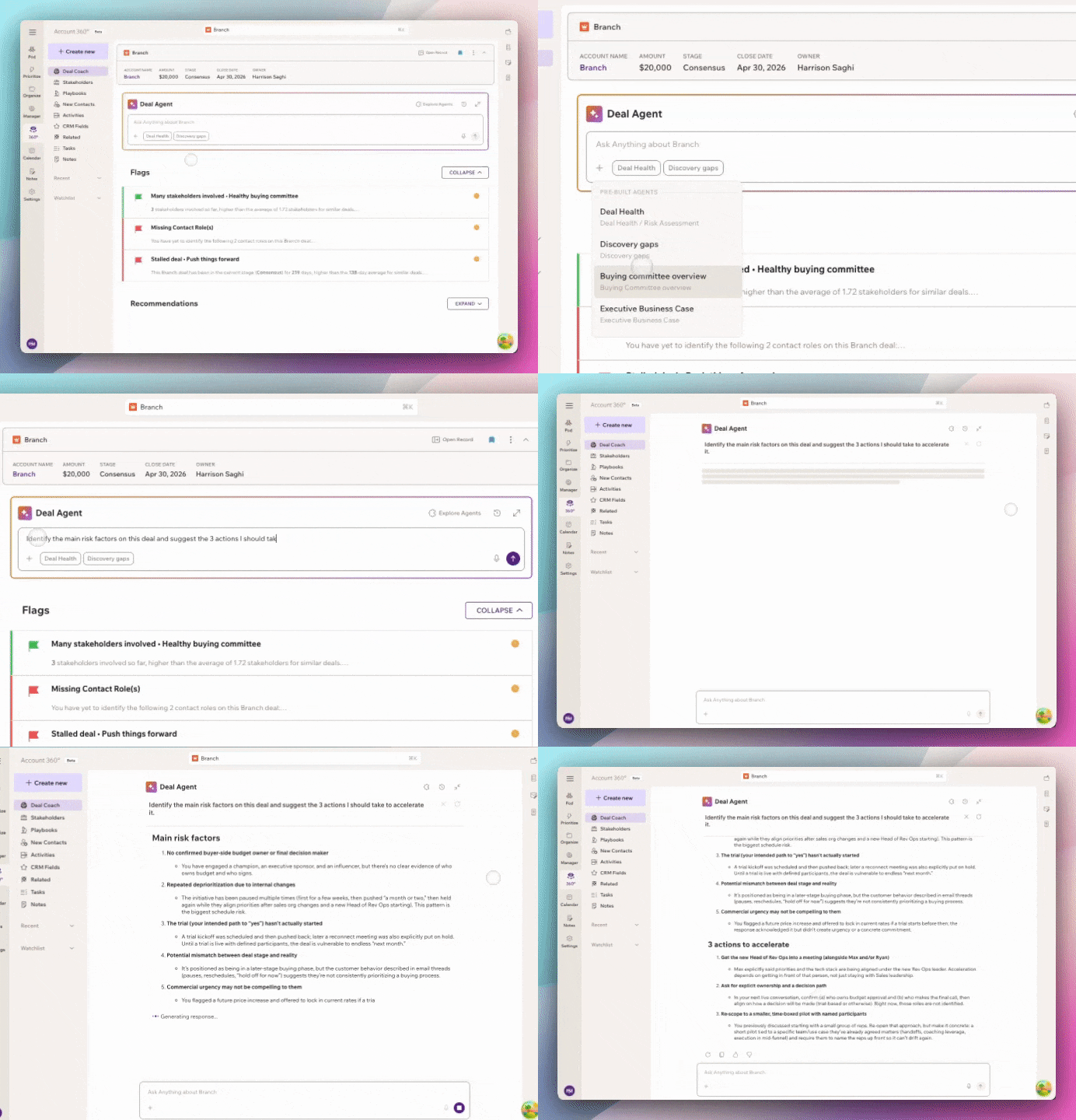
The time kill: Before reaching out to a new account, you need to know who they are, what they care about, and why they might need what you sell. That means LinkedIn, the company website, recent news, tech stack data, and whatever you can find in your CRM from prior interactions. Salesmotion estimates that sales teams spend 5+ hours per week on manual account research (Salesmotion, 2026, accessed 2026-04-08). Most of that time produces a few bullet points you could have gotten in seconds from the right system.
The agent-powered fix: An agent that compiles account intelligence on demand: company overview, recent news, tech stack, org chart signals, and prior engagement history from your CRM. Instead of 20 minutes of tab-switching per account, you get a structured brief in seconds. The agent does the gathering; you do the thinking about how to approach the account.
The time kill: Large deals generate internal friction. Discount approvals, legal reviews, security questionnaires, custom pricing requests, and executive sponsor introductions all require chasing people inside your own company. None of this is selling. But a deal can't close without it. Reps often lose days waiting on internal responses, sending reminder emails, and escalating through Slack.
The agent-powered fix: An agent that tracks internal approval workflows, sends reminders when steps go stale, and surfaces what's blocking deal progression. Instead of manually checking whether legal has reviewed the redlines, the agent monitors the process and alerts you when something needs your attention. The deal keeps moving while you focus on the buyer.
You don't need to automate all nine tasks at once. Pick the one that wastes the most time this week and let an AI agent handle it. For most reps, that's CRM data entry or meeting prep. Both have the highest time-to-value ratio because the pain is daily and the fix is immediate.
The shift happening right now isn't about adding another tool to your stack. It's about deploying agents that work inside your existing workflow: your CRM, your calendar, your inbox. They analyze your deals, pull the right context, and act, so you spend your time on the conversations that close revenue.
If you want to see what this looks like in practice, book a demo and walk through the tasks that matter most to your team. Start with one agent. See the time come back. Then expand from there.