

Want to close more deals faster?
Get Pod!
Fill out the form and book your demo today.
Thank you for subscribing!
Oops! Something went wrong. Please refresh the page & try again.

Stay looped in about sales tips, tech, and enablement that help sellers convert more and become top performers.
AI agent adoption usually fails before the agent ever runs.
Not because the technology cannot help. In many sales teams, agents can prepare meetings, summarize deals, flag risk, draft follow-ups, and help reps act on pipeline context faster. The problem is that teams often buy into the promise before they have the data, process, ownership, and trust needed to make agents useful.
That does not mean your team needs to be perfect before starting. If perfection were the bar, no sales organization would ever adopt new technology. But there is a difference between "messy but ready" and "too underprepared to get value."
Use this as a readiness checklist, not a verdict. If you see most of the green-light signs, your team may be ready to pilot AI agents. If you recognize the red flags, fix the foundation first.
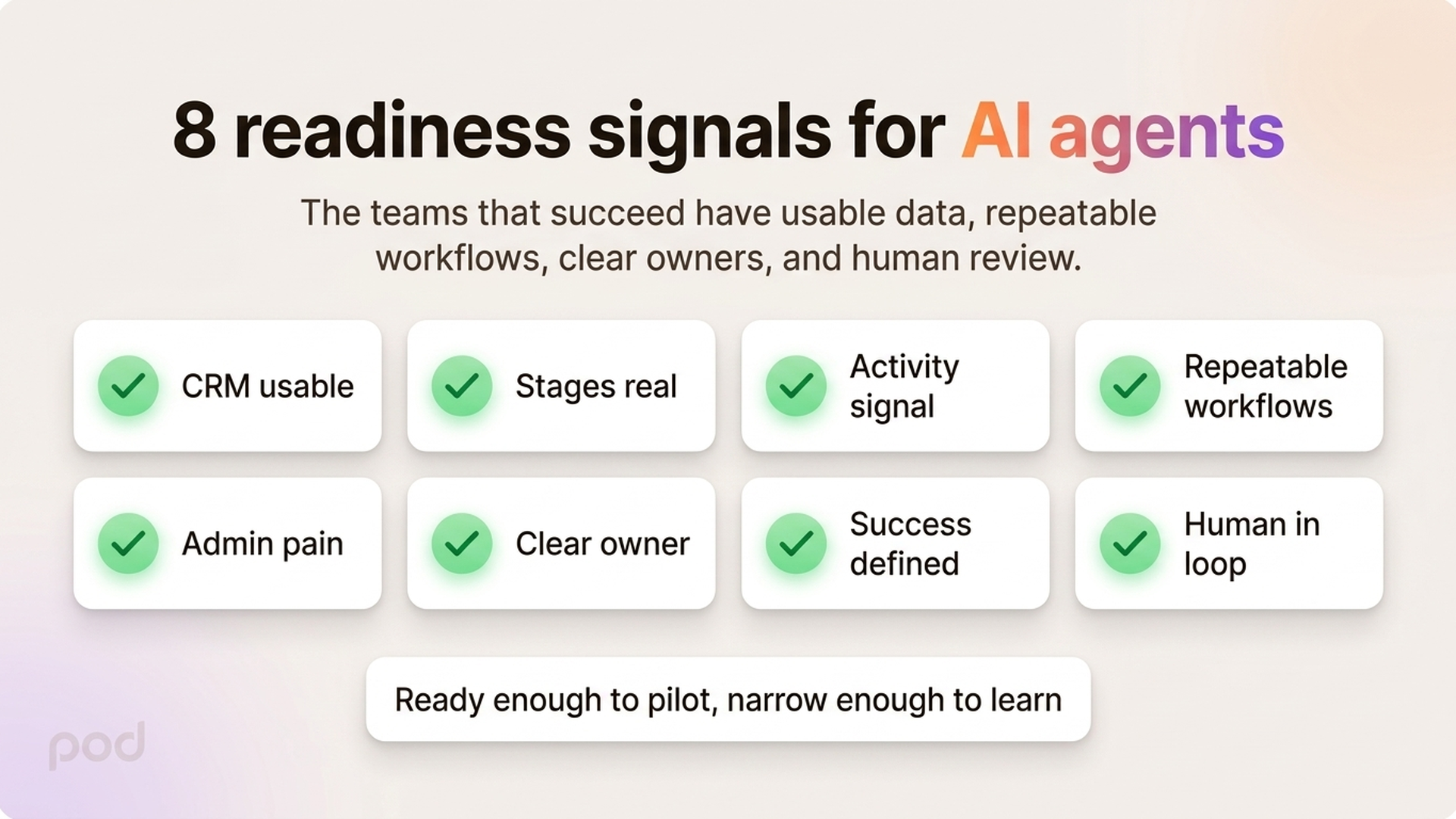
AI agents do not need a flawless CRM. They do need enough reliable deal context to reason from.
That means opportunities have owners, stages, amounts, close dates, contacts, activity history, and enough field consistency for an agent to understand what is happening. Some gaps are normal. A CRM that is consistently stale, incomplete, or disconnected from real selling activity is different.
The readiness signal is not "our CRM is clean." It is "our CRM is good enough that reps and managers can usually trust the basic shape of a deal."
If your CRM cannot answer who owns the opportunity, which stage it is in, when it is expected to close, who is involved, and what happened recently, agents will spend too much time reasoning from bad inputs.
AI agents become more useful when stage data means something.
If stage names are aspirational, political, or wildly inconsistent across reps, agents will struggle to distinguish real momentum from CRM theater. A deal in proposal should not mean "the rep hopes to send a proposal soon." A deal in negotiation should not mean "the buyer once asked about price."
You do not need perfect stage governance. You do need a shared understanding of what each stage means and what evidence should exist before a deal moves forward.
This matters because many agent workflows depend on stage context. A late-stage risk check should evaluate different signals than an early discovery deal. A post-demo follow-up agent should know what already happened and what should happen next.
Agents are strongest when they can read motion across emails, meetings, calls, transcripts, notes, and CRM changes.
If activity data is missing, the agent has to guess. If meetings are not connected, emails are incomplete, and call notes live in personal docs, the agent may understand the CRM record but miss the actual deal behavior.
A ready team has enough activity capture to answer basic momentum questions:
The standard is not perfect documentation. The standard is enough signal for an agent to detect change.
AI agents work best when the job is specific.
"Help reps sell better" is not a workflow. "Prepare a pre-meeting brief from CRM, recent emails, calendar attendees, and open methodology gaps" is a workflow. "Review late-stage deals every Monday morning and flag missing economic buyer engagement" is a workflow. "Draft a follow-up after a call and queue it for rep review" is a workflow.
If your team already has repeatable sales motions, agents can make them faster and more consistent. If every rep runs a completely different process and leadership has not defined what good looks like, agents will amplify that inconsistency.
The readiness sign is simple: you can name three to five workflows where a better prepared first draft, summary, risk check, or recommendation would immediately help the team.
AI agent adoption is easier when reps recognize the pain the agent is meant to solve.
If reps are spending hours on CRM updates, meeting prep, manual follow-ups, pipeline review notes, account research, or stakeholder tracking, they will understand why an agent matters. The value is not abstract. It shows up in their week.
The strongest first use cases are usually high-frequency and easy to review:
These workflows let the agent earn trust without taking over the customer relationship.
AI agents do not operationalize themselves.
Someone needs to own which workflows to start with, which reps are in the pilot, what data the agents can access, which outputs require approval, how feedback gets collected, and what success means.
That owner is often RevOps, sometimes a sales operations leader, and sometimes a sales leader with strong operational support. The title matters less than the mandate.
If everyone is interested but nobody owns the rollout, adoption will drift. Reps will experiment inconsistently. Managers will coach from different assumptions. RevOps will inherit cleanup after the pilot has already produced confusion.
For RevOps teams, AI agent readiness is partly a governance question: who decides what agents do, how they are measured, and when they are allowed to act?
Teams struggle when AI adoption is measured only by usage.
Usage matters, but it is not the outcome. A rep can run an agent ten times and still not improve pipeline execution. A better readiness sign is that leadership can define the business behavior they want to change.
Examples:
Those goals are measurable enough to guide a pilot. They also keep the team focused on pipeline behavior, not novelty.
For Sales Leaders, the question is not "are reps using AI?" It is "is AI changing how the team executes?"
The best early AI agent rollouts do not start with full autonomy.
They start with read-only analysis, summaries, recommendations, and drafts. The agent prepares work. The rep or manager reviews it. Over time, the team learns which outputs are consistently useful and which ones need tighter instructions, better data, or stronger approval gates.
That human-in-the-loop habit is a green light. It means the team is thinking about trust, not only automation.
Pod's AI Agent Builder is designed around this kind of workflow thinking: agents should operate against real deal context, respect the team's process, and create outputs people can inspect before acting. Paired with Pod's broader deal intelligence platform, agents become part of the operating rhythm rather than a side experiment.
The teams that do this well do not ask agents to replace judgment on day one. They ask agents to prepare better work for humans to judge.
Being "not ready" is not a failure. It just means the next best move is foundation work, not agent rollout.
The danger is pretending the foundation exists when it does not. AI agents can make a strong sales process faster. They cannot rescue a process that nobody owns, a CRM nobody trusts, or an adoption culture that treats every new tool as optional.
Here are the red flags worth taking seriously.
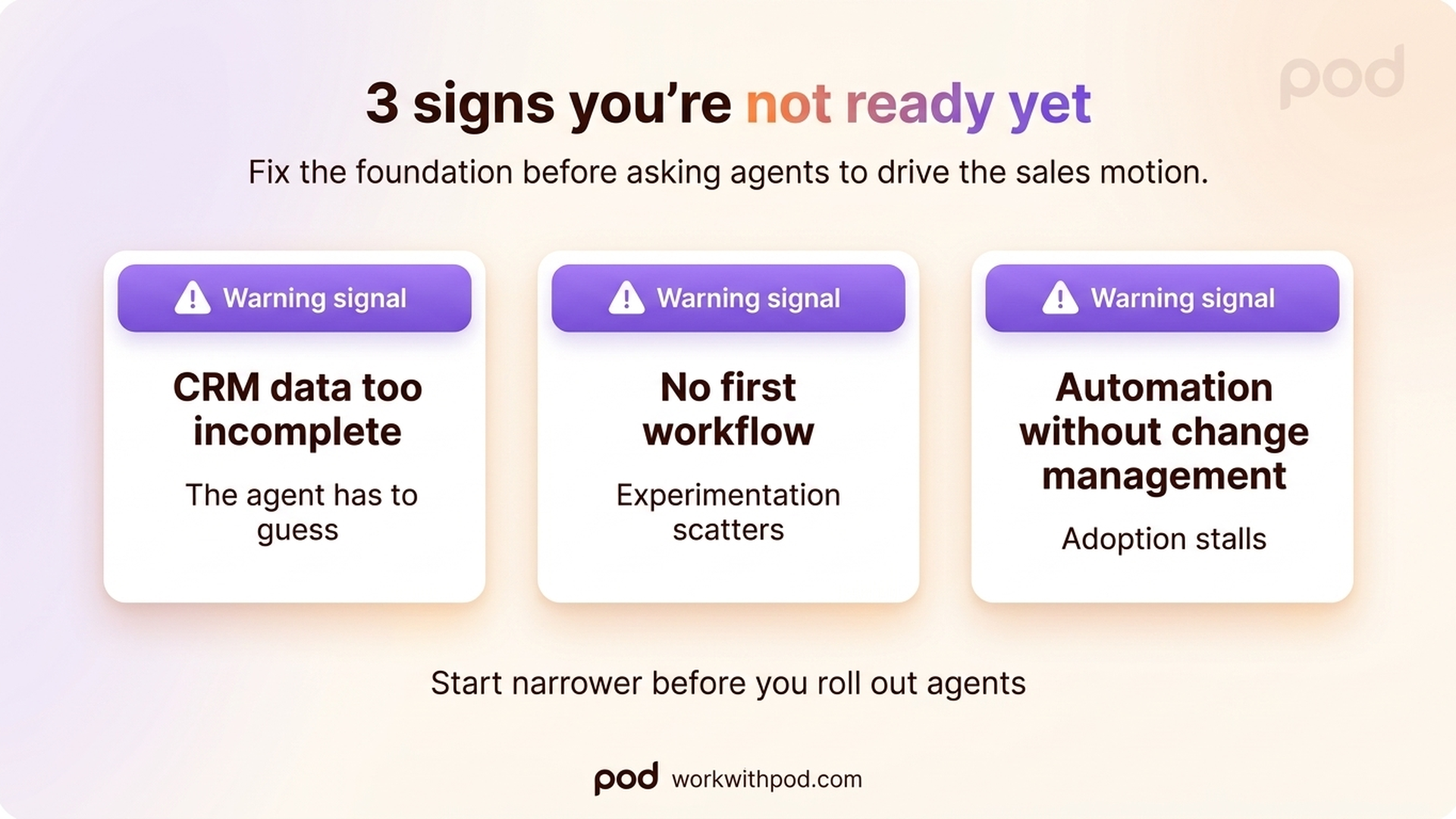
If basic deal context is missing, agents will produce weak work.
This is not about blaming reps for imperfect Salesforce or HubSpot hygiene. CRM data is often dirty because the system asks reps to do low-value manual work, fields are unclear, integrations are incomplete, or managers only enforce updates right before forecast calls.
But the cause does not change the readiness issue. If opportunity records are missing key contacts, stages do not reflect reality, activity data is inconsistent, and close dates are mostly guesses, agents will not have enough truth to work from.
Before rolling out agents, fix the minimum viable data layer. The companion post on why CRM data gets dirty is a useful place to start.
"We want AI agents" is not specific enough.
If the team cannot name the first workflow, the rollout will turn into scattered experimentation. One rep uses an agent for email. Another asks it to summarize deals. A manager wants forecast help. RevOps wants CRM hygiene. None of those are wrong, but the pilot becomes hard to measure and harder to trust.
Start narrower. Pick one workflow that is frequent, painful, and easy to review. Meeting prep, post-meeting follow-up, deal risk review, and pipeline review prep are strong candidates.
The first workflow should have a clear input, a clear output, a clear human reviewer, and a clear success measure.
AI agents are not just another feature to enable.
They change how reps prepare, how managers inspect deals, how RevOps governs workflows, and how the team decides what work should be human-reviewed. If leadership treats the rollout like a switch flip, adoption will stall.
The warning sign is a plan that sounds like this: buy the tool, turn it on, announce it in Slack, and expect reps to figure out how it fits into their week.
That is not a rollout. That is tool sprawl with better branding.
Teams need enablement, manager coaching, feedback loops, approval rules, and a clear explanation of what agents will and will not do. The broader B2B sales tech stack conversation matters here because agents only work if they earn a place in the operating rhythm, not just the software budget.
If the red flags sound familiar, do not start by buying a bigger AI program. Start by making your sales system easier for an agent to understand.
First, clean the minimum data needed for one workflow. If the first agent will prepare meeting briefs, focus on calendar, CRM account data, recent activity, and meeting notes. If the first agent will review deal risk, focus on stages, close dates, contacts, activity, and next steps.
Second, define the workflow in plain language. What should the agent read? What should it produce? Who reviews it? What should happen if the output is wrong or incomplete?
Third, choose a small pilot group. Include reps who will give honest feedback, a manager who will coach from the outputs, and a RevOps owner who can adjust the workflow.
Fourth, measure behavior change. Did reps prepare faster? Did follow-ups improve? Did managers catch risks earlier? Did CRM updates get cleaner without more rep effort?
AI agents are worth adopting when they make the sales motion sharper. That requires enough data to reason from, enough process to guide the work, and enough leadership commitment to make the change stick.
If your team has those ingredients, you do not need to wait for a perfect rollout. Start narrow, keep humans in the loop, and let the agent earn trust.
If you want to see how Pod helps sales teams build AI agents around real deal context and human-reviewed workflows, book a demo.


.png)


