


Want to close more deals faster?
Get Pod!
Fill out the form and book your demo today.
Thank you for subscribing!
Oops! Something went wrong. Please refresh the page & try again.

Stay looped in about sales tips, tech, and enablement that help sellers convert more and become top performers.
Most B2B sales teams do not have a tool problem because they lack software. They have a tool problem because the stack has become harder to operate than the sales process it was supposed to support.
A rep starts the day in the CRM, checks the sequencing tool, reviews call notes, opens a conversation intelligence platform, scans intent data, updates a spreadsheet for the pipeline review, checks Slack for manager feedback, and then asks an AI tool to summarize context scattered across all of it. Every tool may have made sense when it was purchased. Together, they create drag.
That is the sales tech stack problem in 2026. Not whether a tool is useful in isolation, but whether it earns its place in the operating rhythm of the team.
The right audit is simple: what should you keep, what should you cut, and what should you add? For Sales Leaders and RevOps teams, the answer is not another list of vendor names. The answer is a sharper way to think about the layers of the stack in an era where AI agents can read context, surface deal signals, and prepare the next action.
The biggest shift is this: the intelligence layer is becoming the most important investment in the sales stack. CRM still matters. Engagement still matters. Conversation data still matters. But the layer that turns all of that context into deal judgment, coaching moments, and next best actions is where the stack starts to pay back the rest of the investment.
Sales technology decisions often start in the wrong place. A team feels pain, finds a point solution, runs a pilot, and adds another tool. Over time, the stack becomes a record of past pain rather than a designed system.
That is how teams end up with overlapping tools for enrichment, routing, sequencing, meeting notes, pipeline inspection, coaching, reporting, and AI assistance. The individual contracts may be defensible. The workflow is not.
A better audit starts with three questions.
If a tool cannot answer one of those questions clearly, it belongs in the cut discussion.
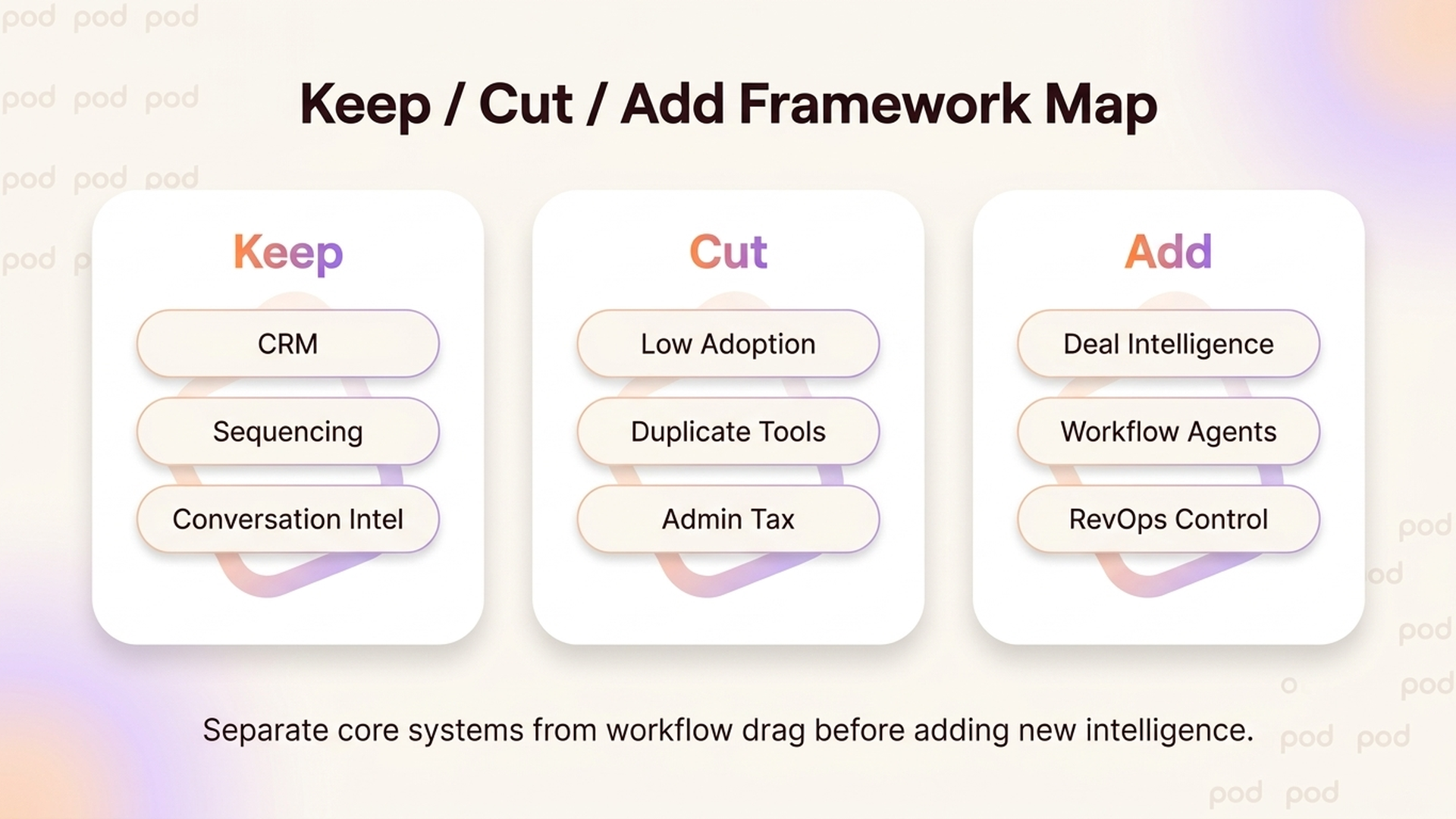
The keep/cut/add framework is useful because it separates emotional attachment from operational value. Some tools should stay because they are foundational. Some should go because the team has outgrown them or never adopted them. Some new categories should be added because the sales motion has changed and the old stack cannot cover the gap.
The goal of stack consolidation is not to strip the team down to nothing. A modern B2B sales team still needs a handful of core systems. The question is whether each one is doing a job that cannot be done better elsewhere.
The CRM is non-negotiable. Salesforce or HubSpot remains the source of record for accounts, opportunities, contacts, stages, ownership, and pipeline history. Finance, RevOps, leadership, and customer teams all depend on it.
But the CRM is not the whole sales operating system. It is the database of the sales motion, not the intelligence layer that tells a seller what changed, which deal is at risk, or what action should happen next.
That distinction matters because many teams expect the CRM to solve problems it was not designed to solve. A CRM can store the next step. It does not always know whether the next step is real. It can store a close date. It does not always know whether the date has become fantasy. It can show the buying committee. It does not always know whether the right people are engaged.
Keep the CRM. Then be honest about what has to sit on top of it.
Conversation intelligence is valuable when it captures customer reality that would otherwise disappear. Calls, transcripts, objections, competitor mentions, next steps, stakeholder concerns, and coaching moments are all useful inputs for managers and reps.
But the key phrase is "if it is actually used."
If conversation intelligence is only a call library that managers visit before performance reviews, it is underused. If reps never read the summaries, managers never coach from the patterns, and RevOps never connects transcript insights to process improvement, then the tool may be recording activity without improving execution.
Keep conversation intelligence when it feeds coaching, deal strategy, or the broader intelligence layer. Cut or consolidate it when it is just an expensive archive.
For teams with a serious outbound motion, a sequencing tool still earns its seat. Reps need a way to manage structured outreach, maintain follow-up discipline, and coordinate high-volume prospecting.
The mistake is letting the sequencing tool become the center of the sales stack. Sequencing is an action layer. It helps send the right message at the right time, but it should not be the only place a rep understands account context.
In 2026, the sequencing tool should connect cleanly to the CRM and intelligence layer. It should receive better inputs, not become another silo. If reps are copying context from one tool into a sequence because the stack cannot pass context forward, the process is broken.
The easiest tools to cut are not always the least loved. They are the ones that create hidden labor: admin, duplicate data entry, conflicting recommendations, fragmented reporting, and another interface reps have to remember.
Most mature stacks contain overlap. Two enrichment tools. Multiple meeting note tools. Separate point products for intent, routing, coaching, and forecasting. A rep may not know which system to trust, so they stop trusting all of them.
Duplication creates two problems. The first is cost. The second is decision conflict. If one tool says a deal is healthy and another says it is risky, the manager now has to reconcile the tools before coaching the rep.
That is not intelligence. That is homework.
Cut tools where another system already performs the same job well enough. A point solution has to be much better than the platform alternative to justify the extra contract, admin, and workflow cost.
Every RevOps leader has seen this pattern. A tool looks great in the buying process, launches with energy, gets used by a few champions, and then disappears from the daily workflow.
Low adoption is data. It may mean the rollout was weak. It may mean the tool solved a leadership problem but not a rep problem. It may mean the value was real but not frequent enough to become a habit.
Whatever the reason, a low-adoption tool should not get renewed because the team still believes in the category. It should earn its place through usage tied to an operating moment: pipeline review, meeting prep, forecast inspection, coaching, prospecting, or deal execution.
If no one can name when the tool gets used each week, it probably does not belong in the stack.
Many sales tools promise visibility. The cost is often more rep admin.
That tradeoff used to be acceptable because managers had few other ways to understand what was happening. In 2026, it is harder to defend. If a tool requires reps to enter more fields, update another status, tag another record, or maintain another dashboard before it creates value, it has to clear a high bar.
Visibility should increasingly come from captured activity, connected systems, and AI-assisted analysis, not more manual reporting. The rep should not have to maintain the system that was purchased to make their work easier.
Cut tools that turn visibility into a tax.
The "add" category is the most important part of the audit because it reflects what has changed. Three years ago, most sales stacks were organized around systems of record and systems of action: CRM, sequencing, call recording, enablement, forecasting, routing, enrichment.
Those still matter. But they do not solve the central problem: sellers and managers are surrounded by data and still do not know what to do next.
The missing layer is sales intelligence that operates on live deal context. Not static dashboards. Not generic AI prompts. A layer that reads CRM, email, meetings, transcripts, notes, stakeholders, and methodology context, then surfaces what changed and what action should happen next.
That is where deal intelligence and agentic AI belong.
Deal intelligence turns raw sales data into a point of view. Which deals are getting colder? Which ones lack stakeholder coverage? Which close dates are slipping? Which reps need coaching on discovery depth or follow-through? Which opportunities deserve manager attention this week?
Without that layer, the CRM becomes a storage system that requires humans to interpret every signal manually. With it, managers and reps can start from a sharper read of the pipeline.
This is where Pod's deal intelligence platform fits naturally. The point is not to replace the CRM. The point is to make CRM, email, calendar, transcript, and methodology data useful in the moments where reps and managers decide what to do.
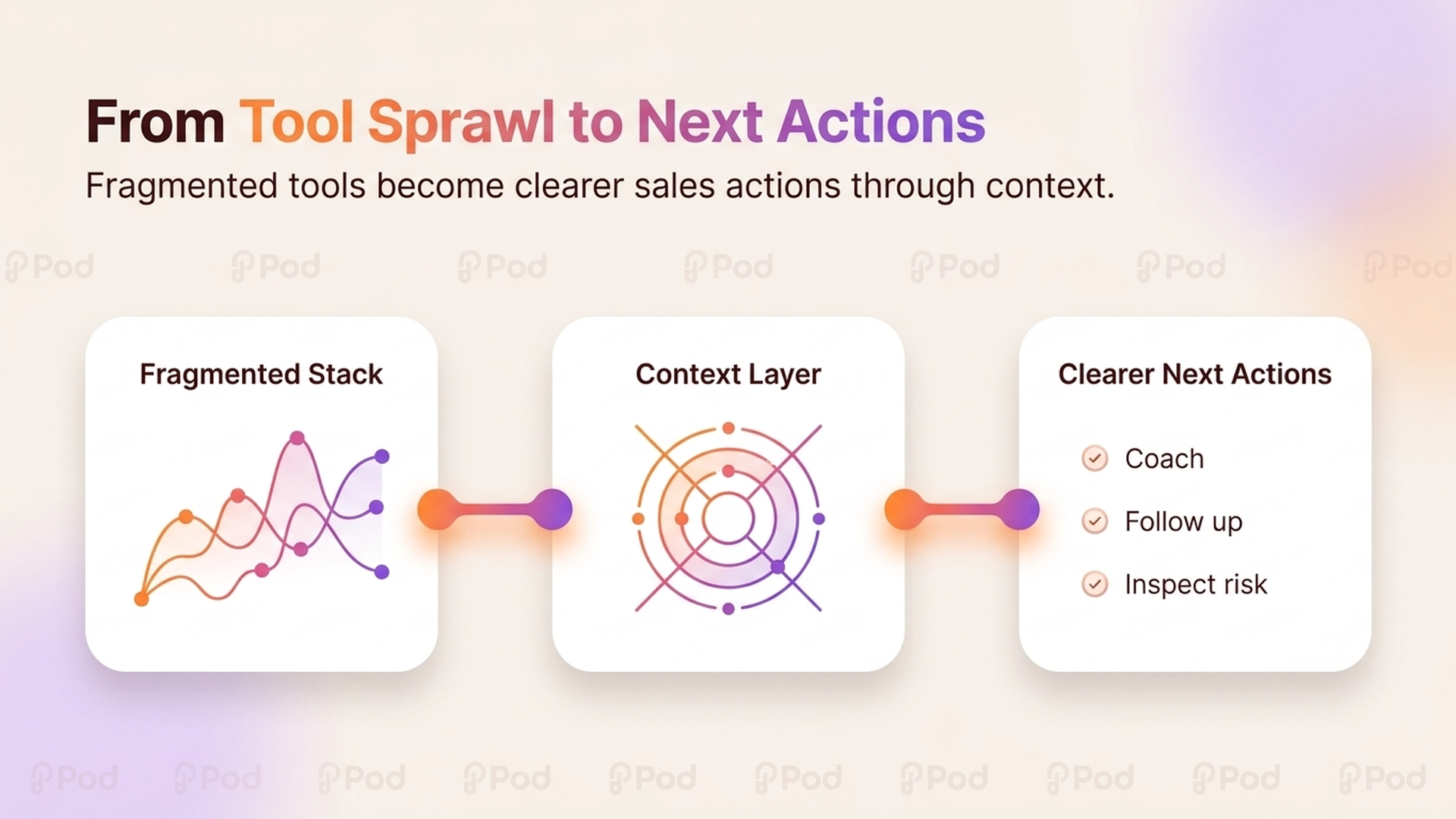
AI agents are not useful because they are novel. They are useful when they can run a repeatable workflow against real sales context.
For example:
That is why Pod AI Agents belong in the "add" discussion. They sit in the intelligence layer and help teams turn deal context into repeatable, reviewable work. They are not another generic prompt box. They are a way to package sales workflows so the same quality of analysis can run every week, across every rep and deal.
For teams thinking through what can be delegated, the companion post on 7 sales workflows you can hand off to an AI agent is a useful next read.
The intelligence layer should not create chaos for RevOps. It should give RevOps more control.
RevOps needs to know which workflows are running, what data they use, where outputs go, and what humans approve before anything changes. The rise of agentic AI makes governance more important, not less.
That is why RevOps should be part of the decision from the start. The right stack does not only help reps move faster. It gives RevOps better process consistency, cleaner inspection, and clearer ownership of what happens across the revenue engine.
Pod's RevOps resources speak to that layer directly: the sales stack should make the process easier to operationalize, not harder to govern.
Here is a simple way to pressure-test the stack.
Keep:
Cut:
Add:
The pattern is clear. Keep systems of record and action that the team uses. Cut point tools that create fragmentation. Add the intelligence layer that makes the whole stack smarter.
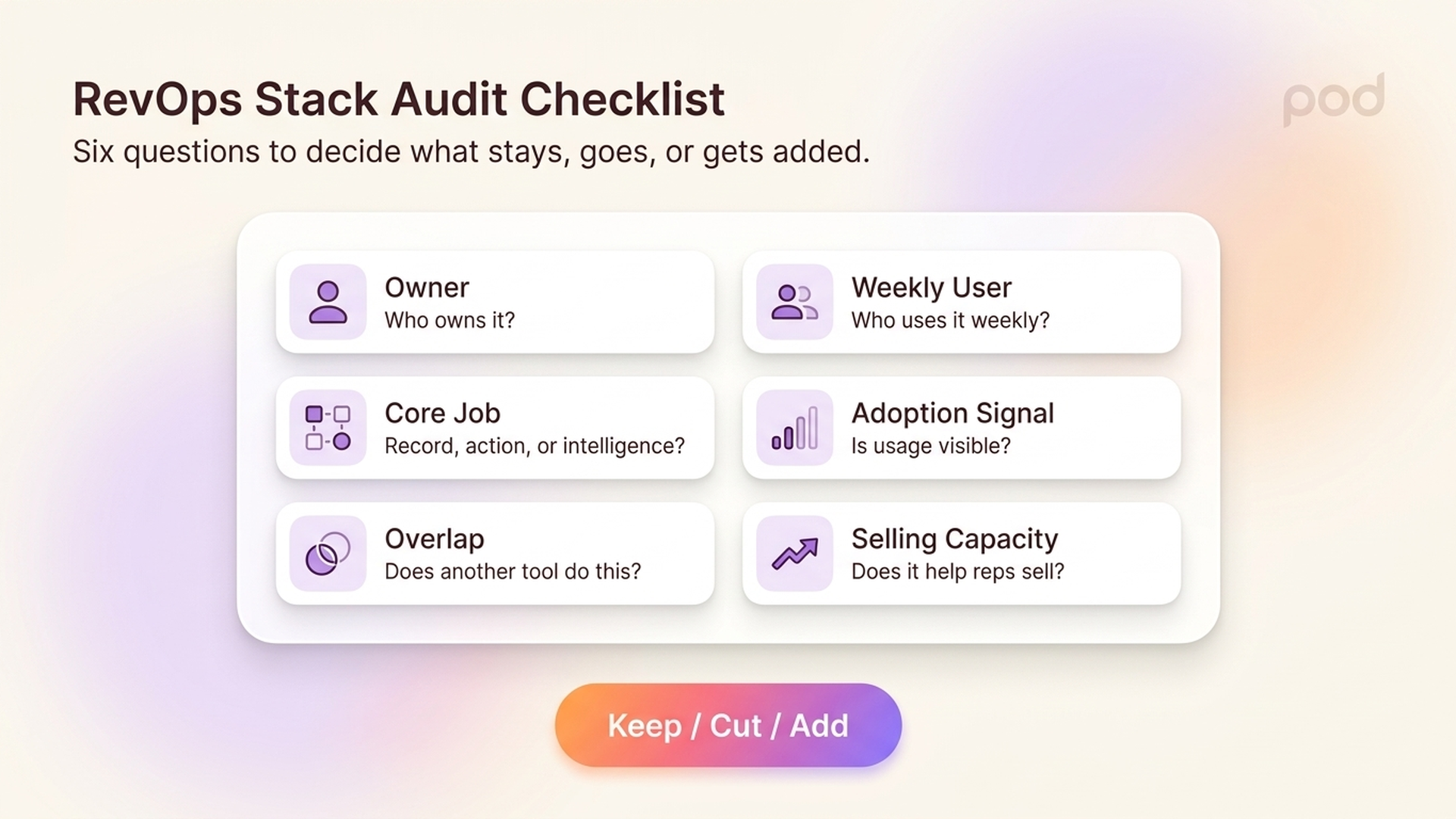
You do not need a quarter-long transformation project to start. Run the first audit in one working session.
That last question is uncomfortable, but it is the point. The best sales stacks in 2026 will not be the biggest. They will be the clearest.
Sales teams should keep the tools that own necessary work, cut the tools that fragment attention, and add the intelligence layer that helps reps and managers act on the context they already have.
If you want to see how Pod helps revenue teams turn CRM, email, meeting, and deal data into focused action, book a demo.


