
Want to close more deals?
Get Pod!
Fill out the form and book your demo today.
Thank you for subscribing!
Oops! Something went wrong. Please refresh the page & try again.

Stay looped in about sales tips, tech, and enablement that help sellers convert more and become top performers.
In your daily workflow as a seller, you ask AI to rewrite a cold email, tighten up a follow-up, or summarize a long thread. And it does. It's fast, it's convenient, and it's become a daily habit.
But here's the problem: almost every B2B seller using AI today does so the same way, which means nobody has an edge. And more importantly, the way most sellers are using AI barely scratches the surface of what it can actually do.
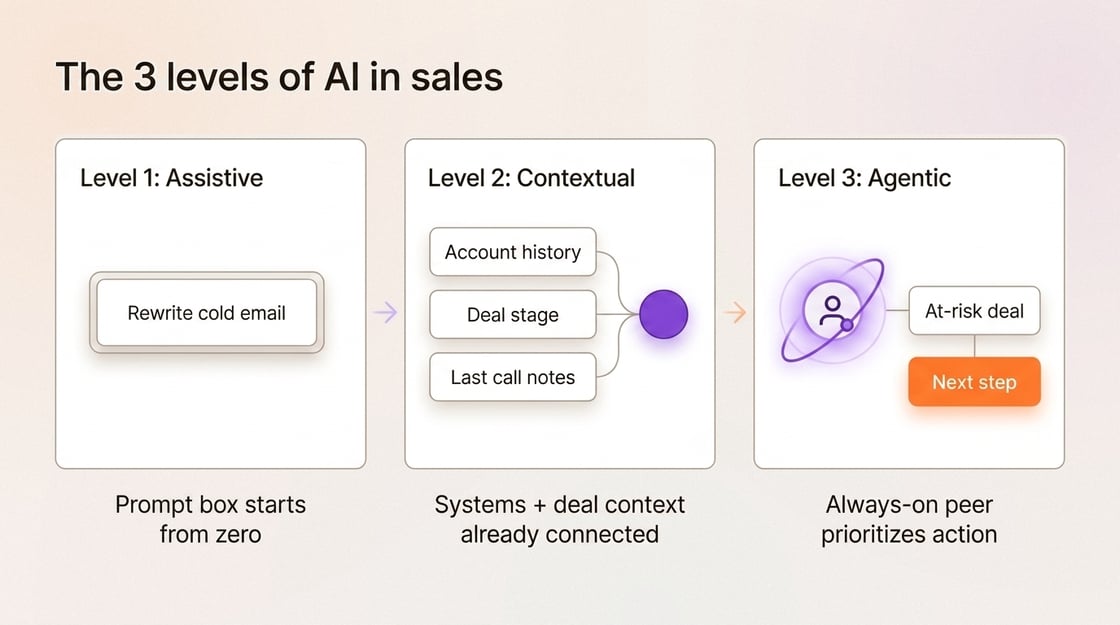
The sellers who figure that out first will be very difficult to compete with. There are three levels of AI use in B2B sales. Most sellers are stuck at Level 1, but here's what it takes to get to the top.
This is the ChatGPT experience.
You open a tab, paste in a prompt, and get something somewhat useful back. It summarizes a long email chain, drafts a cold outreach sequence, or helps you prep talking points before a call. It's genuinely helpful for discrete, one-off tasks, and it sure beats doing things the manual way.
But Assistive AI has a fundamental limitation: it knows nothing about you or your deals. It has no idea who your prospect is, what was said on your last call, where the deal stands, or what's blocking it from closing. Every prompt starts from zero.
You're essentially doing the thinking yourself and using AI to execute it faster.
That's a productivity tool. It's not a true sales advantage.
Contextual AI is what people actually mean when they talk about "AI agents".
And it's a meaningful step up. Instead of answering generic prompts in a vacuum, it connects to your systems and works inside your actual workflows. It can read your CRM, pull up account history, track where deals are in your pipeline, and surface information that's relevant to what you're doing right now.
The difference in day-to-day experience is significant. Instead of you telling AI what the situation is every single time, it already knows. It's the difference between a search engine and a personal intern who's done the research before you even ask. You spend less time providing context and more time acting on it.
This is where AI starts compressing your sales cycle in a real way. Instead of saving you twenty minutes on email, it helps you show up to every conversation better prepared and move deals forward faster.
Now this is where the real competitive gap is going to open up.
Agentic AI doesn't wait to be prompted. It reasons through your pipeline autonomously, identifies what needs attention, and takes action toward goals without you having to ask. It's not a tool you use when you have the time. It's a system running alongside you. Think of it less like software and more like a peer who's always on, never forgets a follow-up, and is constantly working out what the highest-leverage move is for your book of business.
At Level 3, AI isn't helping you do your job faster. It's actively helping you do your job better. It can do everything from flagging at-risk deals before they go cold, to recommending next steps based on deal context, and making sure nothing falls through the cracks. For a seller managing a complex pipeline, that's not a nice-to-have. That's a closer.
Most sellers are at Level 1. The best sellers are actively moving to Level 2. The ones who reach Level 3 first are going to have a serious and compounding advantage. We're talking shorter sales cycles, smarter prioritization, and a pipeline that's actually under control.
Pod is built to get B2B sellers beyond the ChatGPT prompt box and into the levels that actually move deals. It works inside your pipeline, knows your accounts, surfaces what needs your attention, and helps you act. That's the difference between AI that feels useful and AI that actually closes deals.
Book a demo with the Pod team to learn more.