
Want to close more deals faster?
Get Pod!
Fill out the form and book your demo today.
Thank you for subscribing!
Oops! Something went wrong. Please refresh the page & try again.

Stay looped in about sales tips, tech, and enablement that help sellers convert more and become top performers.
The market for AI sales tools is crowded, and most roundups make it harder to choose, not easier. They rank vendors against each other without saying which job each tool is actually built to do, so a forecasting platform ends up next to an outbound bot as if the two were interchangeable.
This guide is written for B2B sales teams. If you are an account executive tired of reconstructing deal context, a sales leader who wants more trustworthy pipeline reviews, or a RevOps lead comparing vendors before a rollout, it is built to shorten your evaluation.
We organized it around the sales job instead of a single ranking. Eleven tools sit across seven categories, from deal execution to forecasting to outbound automation, and the methodology is transparent. Every assessment comes from public vendor product, pricing, and integration materials reviewed in July 2026, and no vendor paid for placement.
Skim the comparison table first to find the category that matches your bottleneck, then read the deep-dives for the tools that solve it.
Use this quick scan to match each product to its primary job. Detailed strengths, limitations, pricing, and CRM fit follow below. Vendor materials were reviewed in July 2026.
Scroll horizontally to compare all columns.
Vendor capabilities, packaging, pricing, and integration claims were checked against first-party product, documentation, pricing, and integration pages on July 15, 2026. Product packaging changes frequently, so buyers should confirm current terms directly with each vendor. “Best for” labels and comparisons with Pod are editorial judgments based on primary workflow emphasis; they are not claims made or endorsed by the vendors.
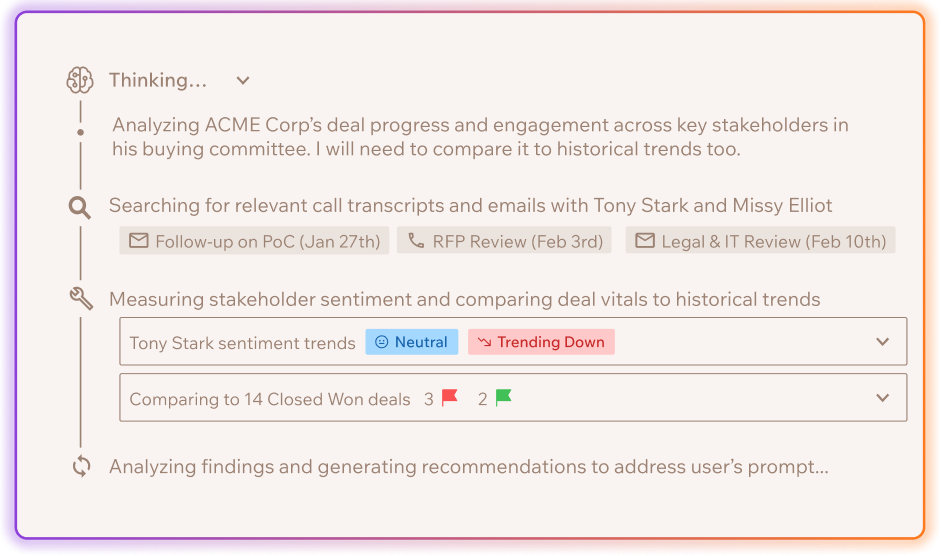
What it does: Pod is the AI deal intelligence and execution layer for complex B2B sales teams. It combines CRM, email, calendar, and transcript context for deal coaching, pipeline inspection, meeting preparation, and follow-through. Agents analyze, recommend, and draft; reps review consequential output.
Best for: AEs, sales managers, and RevOps teams running consultative, multi-stakeholder sales motions.
Pricing: See Pod's pricing page for current plans and packaging.
CRM fit: Pod works with Salesforce and HubSpot. Its Chrome Extension brings deal guidance into the seller's CRM workflow.
Strengths:
Limitations:

What it does: Gong captures, transcribes, and analyzes customer interactions, then applies that data across coaching, pipeline, forecasting, and revenue workflows.
Best for: Revenue teams that prioritize searchable conversation evidence, coaching, and interaction-led insights while also wanting broader pipeline and workflow capabilities.
Pricing: Gong publishes its pricing structure but not dollar amounts. Pricing combines per-user licenses with a platform fee and requires a customized proposal.
CRM fit: Gong documents bidirectional integrations with Salesforce and HubSpot, alongside integrations across the broader revenue stack.
Strengths:
Limitations:
How it differs from Pod: Gong began with conversation intelligence but now spans calls, emails, meetings, CRM records, pipeline, forecasting, coaching, and automated workflows. Compare Pod on its specific rep-facing prioritization, coaching, and active-deal execution experience, not on a claim that Gong lacks broader deal context. Gong exposes call transcripts through its API, and Pod can use Gong as a transcript source when the integration is configured and authorized. See Pod vs. Gong and the Gong integration.
Sources reviewed July 15, 2026: Gong Revenue Graph; Gong call recording and conversation intelligence; Gong pricing; Gong API capabilities.
What it does: Clari is an enterprise revenue orchestration platform spanning forecasting, pipeline inspection, deal health, governance, revenue cadences, and guided execution.
Best for: Enterprise revenue teams that need shared forecasting, pipeline governance, and repeatable operating cadences.
Pricing: Clari does not publish dollar amounts. Pricing is tailored by use case and available by quote.
CRM fit: Clari documents direct Salesforce integration for Forecast and Inspect. HubSpot support is documented for Clari Copilot, so buyers should confirm product-specific CRM compatibility.
Strengths:
Limitations:
How it differs from Pod: Clari remains particularly established in enterprise forecasting and pipeline governance, but its current platform also covers deal inspection, engagement, coaching, mutual action plans, and guided execution. Compare Pod on the seller workflows, recommendations, and CRM-embedded active-deal experience required. See Pod vs. Clari.
Sources reviewed July 15, 2026: Clari Revenue Orchestration Platform; Clari Forecast; Clari Revenue Cadences; Clari pricing.
What it does: Agentforce is Salesforce’s platform for building and deploying agents across CRM and connected workflows using Salesforce data, permissions, Flows, Apex, APIs, and integrations.
Best for: Salesforce organizations that want to configure and govern agents around existing Salesforce data, permissions, automation, and connected systems.
Pricing: Free builder access is available. Production options include Flex Credit consumption, per-conversation pricing, employee licenses, add-ons, and bundled editions.
CRM fit: Agentforce is built into Salesforce and can also connect with external systems and data sources.
Strengths:
Limitations:
How it differs from Pod: Agentforce is an extensible platform in which the organization defines and governs agent workflows. Pod is a packaged deal intelligence and execution layer focused on prioritization, coaching, and action across active Salesforce or HubSpot opportunities. Learn about Pod's Salesforce integration.
Sources reviewed July 15, 2026: Salesforce Agentforce; Agentforce Builder; Agentforce pricing; Agent Script developer guide.
What it does: Breeze is HubSpot’s embedded AI suite for assistance, content, CRM data, and configurable agents across marketing, sales, service, and customer-platform workflows.
Best for: HubSpot teams that want AI assistance and automation inside their existing HubSpot environment.
Pricing: Access varies by feature. Some capabilities are included by plan, while specific agents, automation, seats, and actions require eligible subscriptions or HubSpot Credits.
CRM fit: Breeze is native to HubSpot.
Strengths:
Limitations:
How it differs from Pod: Breeze spans HubSpot’s broader customer platform. Pod is purpose-built around complex active-deal context, prioritization, coaching, pipeline inspection, and seller execution. Learn about Pod's HubSpot integration.
Sources reviewed July 15, 2026: Understand HubSpot Breeze; Breeze Studio documentation; HubSpot Product and Services Catalog; HubSpot Credits and billing.
What it does: Outreach combines multi-channel sales engagement with deal and pipeline management, forecasting, conversation intelligence, coaching, and account workflows.
Best for: Revenue teams that want structured engagement sequences and broader revenue workflows in one platform.
Pricing: Outreach publishes packages and its pricing model but not dollar amounts. Quotes combine seat-based access with consumption-based AI usage.
CRM fit: Outreach documents a deep bidirectional Salesforce connection. HubSpot can connect through HubSpot Data Sync for one- or two-way contact synchronization; confirm required objects and activities before purchase.
Strengths:
Limitations:
How it differs from Pod: Outreach is no longer accurately described as engagement-only. Compare Pod on its specific deal-prioritization, coaching, and CRM-embedded execution experience, not on an engagement-versus-execution split. See Pod vs. Outreach.
Sources reviewed July 15, 2026: Outreach platform; Outreach pricing and packages; Outreach Salesforce CRM connection; Outreach and HubSpot Data Sync.
See Pod on your active deals
See how Pod turns deal context into risks, priorities, and next steps for complex B2B sales teams.
What it does: Apollo combines B2B prospect data, enrichment, sequences, calling, and sales-engagement workflows.
Best for: Outbound teams of different sizes that want prospect data and multi-channel engagement in one platform.
Pricing: Apollo offers a free Starter plan and paid plans. Feature access, record limits, dialing, and credit consumption vary by plan.
CRM fit: Apollo documents Salesforce and HubSpot integrations with configurable synchronization, field mapping, enrichment, and activity handling.
Strengths:
Limitations:
How it differs from Pod: Apollo is primarily oriented toward finding, enriching, and engaging prospects to build pipeline, although it also offers opportunity and deal-management functionality. Pod focuses on prioritization, coaching, and execution across active complex opportunities. See Pod vs. Apollo.
Sources reviewed July 15, 2026: Apollo sales engagement; Apollo pricing; Apollo HubSpot integration; Apollo Salesforce integration.
What it does: ZoomInfo is a broad B2B intelligence and GTM platform combining company and contact data, intent and website signals, CRM enrichment, automated workflows, and optional conversation and deal intelligence.
Best for: Organizations that need external market data, buying signals, CRM enrichment, prospecting, and automated GTM workflows.
Pricing: Pricing is custom and varies with licenses, credit usage, features, integrations, and required data access.
CRM fit: ZoomInfo documents Salesforce and HubSpot support alongside integrations with additional CRM and marketing platforms.
Strengths:
Limitations:
How it differs from Pod: ZoomInfo should not be described as exclusively pre-opportunity or dependent only on external signals. GTM Workspace and Chorus also use CRM and conversation data for pipeline prioritization, deal-risk detection, and coaching. The safer distinction is product emphasis: ZoomInfo offers a broad data and GTM suite, while Pod is purpose-built around active-deal intelligence, coaching, and seller execution. See Pod vs. ZoomInfo Copilot.
Sources reviewed July 15, 2026: ZoomInfo Sales; ZoomInfo pricing; ZoomInfo Enrich integrations; Chorus Revenue Intelligence.
What it does: Artisan’s Ava is an AI BDR that can source and qualify prospects, run personalized email and social sequences, handle replies and objections, and book meetings.
Best for: Teams automating prospecting, qualification, multi-channel outreach, reply handling, and meeting booking.
Pricing: Current pricing is custom-quoted and scoped to usage factors such as lead volume, mailboxes, and optional dialer seats.
CRM fit: Artisan supports native Salesforce or HubSpot synchronization, with one active CRM integration per workspace.
Strengths:
Limitations:
How it differs from Pod: Ava primarily works earlier in the revenue cycle, from prospecting through qualified meeting booking, while also supporting expansion and CRM-reactivation campaigns. Pod focuses on coaching and execution across active CRM opportunities.
Sources reviewed July 15, 2026: Artisan Ava AI Sales Agent; Artisan pricing; Artisan Salesforce setup; Artisan outbound sales automation.
What it does: Salesforge is a multi-channel cold outreach platform for email and LinkedIn campaigns. Teams can run human-led campaigns or add Agent Frank for AI SDR workflows.
Best for: B2B sales, growth, and outbound-agency teams scaling email and LinkedIn prospecting.
Pricing: Salesforge publishes platform and active-contact plans, but current official pages conflict on Agent Frank’s exact price. Do not publish a precise Agent Frank price. Domains, mailboxes, and dedicated email infrastructure may cost extra.
CRM fit: Salesforge offers native HubSpot and Salesforce integrations, but their scope differs. HubSpot includes contact and engagement synchronization plus configurable deal creation; Salesforce focuses on lead import, field mapping, and Lead Status updates.
Strengths:
Limitations:
How it differs from Pod: Salesforge primarily generates pre-opportunity pipeline and booked meetings. Pod focuses on intelligence, prioritization, coaching, and execution across active CRM deals.
Sources reviewed July 15, 2026: Agent Frank; Salesforge pricing; Salesforge HubSpot integration; Salesforge Salesforce integration.
What it does: Docket is an AI Marketing Agent for B2B inbound demand capture. It answers website visitors’ questions from approved company knowledge, qualifies intent, routes buyers, books meetings, and syncs conversation context into Salesforce or HubSpot.
Best for: B2B teams that want to convert inbound website demand through knowledge-grounded conversations, qualification, routing, and meeting booking.
Pricing: Docket uses annual, traffic-based pricing. Growth starts at $3,000 per month for up to 20,000 monthly visitors, Scale starts at $4,000 per month for 20,000–100,000 visitors, and Enterprise pricing is custom above 100,000 visitors.
CRM fit: Docket documents native Salesforce and HubSpot synchronization, including the transfer of conversation history, pain points, qualification answers, and next steps.
Strengths:
Limitations:
How it differs from Pod: Docket’s primary product story concerns inbound conversion before the first sales call. Avoid claiming that its functionality ends there, because its official integration pages also advertise deal updates, pipeline insights, risk detection, and recommendations. Pod focuses on intelligence, coaching, and execution across active opportunities.
Sources reviewed July 15, 2026: Docket AI Marketing Agent; Docket pricing; Docket product and governance information; Docket Marketing Agent for websites.
AI sales software overlaps across several workflows. These categories describe each vendor’s primary entry point rather than an absolute boundary:

These categories overlap. Buyers should evaluate the exact workflow, CRM synchronization depth, packaging, governance controls, and implementation requirements rather than relying on a single category label.
Comparing Pod to a tool on this list?
Pod’s comparison pages break down where it differs from Gong, Clari, and other tools in this guide.
Choose the category that matches the sales job you need to improve, then compare products on CRM fit, human oversight, pricing, and the workflow your team will actually use. A tool built for prospecting will not solve the same problem as one built for forecasting or active-deal execution.
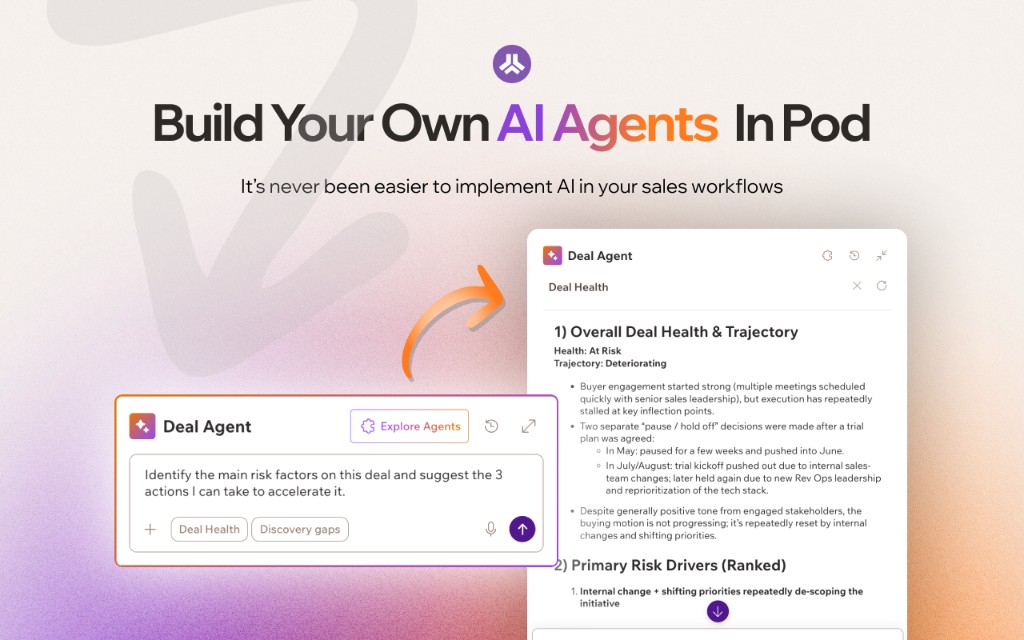
There is no single best tool for every sales workflow. Pod focuses on active-deal intelligence and execution; Gong is strongest as interaction-led Revenue AI but also covers coaching, pipeline, forecasting, CRM data, and automation; Clari is established in forecasting and governance but also supports inspection, engagement, coaching, and execution; Agentforce and Breeze provide CRM-native AI; Outreach combines engagement with broader revenue workflows; Apollo, Artisan, and Salesforge emphasize different prospecting and outbound models; ZoomInfo provides broad GTM intelligence; and Docket emphasizes inbound conversion.
AI sales tools use data from systems such as CRM, email, calendars, calls, websites, and prospecting databases to support a specific job. Depending on the category, they may analyze conversations, rank accounts, prepare forecasts, draft outreach, qualify inbound buyers, or recommend work on active deals.
Pricing depends on the category and billing model. Vendors may charge by seat, credits, usage, platform access, website traffic, or a custom contract. Compare total cost across required licenses, data or action credits, implementation, infrastructure, and the CRM products the tool depends on.
AI can take on analysis, preparation, drafting, and administrative work. Complex B2B sales still requires human judgment, trust, negotiation, and accountability. A practical operating model gives AI bounded work while people review consequential output.
Agentforce is native to Salesforce. Gong, Apollo, ZoomInfo, Docket, and Artisan document Salesforce integrations; Artisan permits one active CRM integration per workspace. Clari support is product-specific, Outreach documents a deep bidirectional Salesforce connection, and Salesforge focuses its Salesforce integration on lead import, field mapping, and Lead Status updates. Pod also works with Salesforce and brings deal guidance into the CRM through its Chrome Extension.
The choice usually follows the CRM ecosystem and required workflow. Agentforce and Breeze are CRM-native but differ in subscriptions, credits, permissions, automation, packaging, and governance. Compare the exact agent workflow, connected systems, entitlement requirements, and human-review controls in your existing environment.
A copilot responds to a person's request and helps with a task. An agent can monitor defined conditions and perform bounded work within configured permissions. In both models, teams should decide which consequential outputs require human review.
Deal intelligence is the combination of deal context, coaching, pipeline inspection, and workflow execution. It is intelligence that is acted on inside the seller's workflow, not a reporting surface that only shows information. Pod is the AI deal intelligence and execution layer for complex B2B sales teams.
They can be when the product addresses a defined bottleneck, fits the team's CRM and sales process, and is measured against an existing business metric. They are less useful when a team buys a broad AI category without a clear workflow, owner, review model, or success measure.
Choose an outbound platform when the main problem is finding prospects and starting conversations. Apollo combines prospect data and engagement, Artisan emphasizes an AI BDR workflow with configurable approvals, and Salesforge combines human-led multi-channel outreach with optional Agent Frank workflows. Choose a sales execution tool when qualified opportunities already exist but sellers need better context, prioritization, coaching, meeting preparation, or follow-through. Some teams need both because the workflows overlap at different stages.
See how Pod turns deal context into risks, priorities, and next steps for complex B2B sales teams.