Want to close more deals, faster?
Get Pod!
Fill out the form below to book your demo.
Thank you for subscribing!
Oops! Something went wrong. Please refresh the page & try again.

Stay looped in about sales tips, tech, and enablement that help sellers convert more and become top performers.
In 2025, many B2B leaders believed their teams needed more data, more tools, and more optionality to perform better. What actually moved performance forward was the opposite.
The leaders who outperformed their peers focused on decision simplicity. They reduced the number of decisions teams had to make each day and made the remaining decisions clearer, faster, and easier to execute.
Fewer decisions led to better outcomes.
Decision overload quietly erodes performance. When teams are forced to make too many choices, even good ones, execution slows down.
Sales reps spend time debating next steps instead of moving deals forward. Managers get pulled into tactical questions that should already have clear answers. Important decisions get delayed because no one is sure which option is best or who owns the call.
Over time, decision fatigue leads to inconsistent execution, stalled pipelines, and burnout. The issue is not a lack of intelligence or effort. It is too much ambiguity in moments that should be routine.
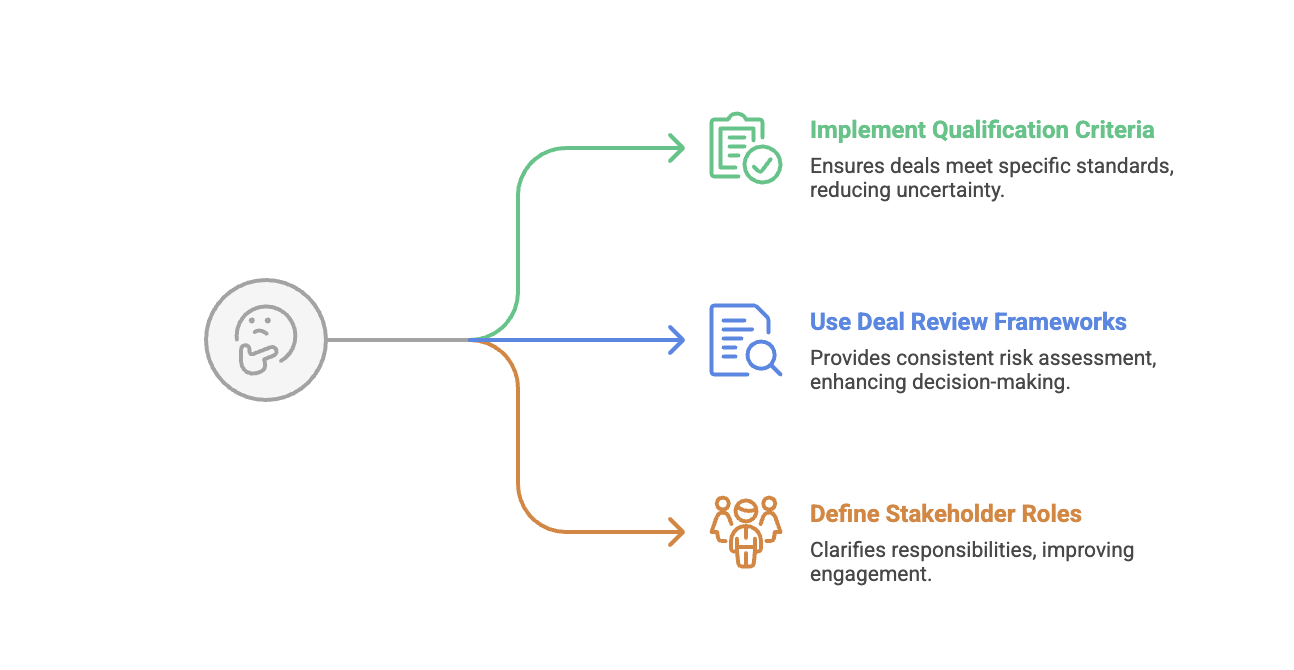
High-performing teams do not eliminate decisions entirely. They design constraints that guide them.
Constraints, frameworks, and defaults reduce cognitive load. They help teams understand what good looks like without requiring constant judgment calls.
Examples include:
These structures do not limit creativity. They free teams to focus their energy on the decisions that actually matter.
Decision simplicity does not come from telling teams to work faster. It comes from designing environments where the right decision is obvious.
This means giving teams shared context, consistent language, and clear ownership. When sellers understand what information matters and where to find it, they move with confidence.
Leaders who design for clarity see fewer escalations, cleaner handoffs, and more predictable outcomes. Teams stop debating the process and start executing against known priorities.
Despite the complexity of modern sales, most deals hinge on the same core decisions. When leaders simplify and standardize these moments, deal velocity improves.
Teams need a shared definition of qualification that goes beyond surface interest. Clear criteria help sellers decide whether a deal deserves time and resources.
A deal cannot progress without a strong business case. Sellers need to understand the buyer’s problem, impact, and urgency, not just the product fit.
Sellers must decide when to pull in executives, technical experts, or customer success. Clear guidance prevents both over-escalation and missed support.
Understanding the full buying committee is essential. This decision clarifies who has influence, who has authority, and who may block progress.
Consensus does not happen automatically. Sellers need a repeatable approach for aligning stakeholders around value and outcomes.
Shortening the cycle requires identifying friction points and removing unnecessary steps. This decision keeps momentum focused on progress, not activity.

Pod reduces decision friction by putting the right context in front of reps and managers at the moment it matters.
By organizing deal information, surfacing risk, and aligning teams around shared frameworks, Pod helps teams move faster without sacrificing quality. Decisions become clearer, coaching becomes more targeted, and execution becomes more consistent.
In a year where simplicity separated strong leaders from struggling ones, decision clarity became a competitive advantage. Book a demo today to learn more.