
Want to close more deals, faster?
Get Pod!
Fill out the form and book your demo today.
Thank you for subscribing!
Oops! Something went wrong. Please refresh the page & try again.

Stay looped in about sales tips, tech, and enablement that help sellers convert more and become top performers.
When sales leaders talk about their best rep, they rarely describe charisma. They describe operating discipline. The best rep always knows where each deal stands. They do the work before the first meeting. They flag a slipping close date before the forecast call, not during it. They remember who has not replied in eleven days and why that matters. They do not win because they are the loudest person in the room. They win because the room always feels more prepared when they are in it.
That edge used to be a function of memory, temperament, and habit. It also used to be rare. You were lucky if a third of the team operated that way consistently. The rest of the team was busy enough with admin that the discipline slid, and you spent half your 1:1s unsticking work that should have been unstuck a week earlier.
The shift that has been building through 2025 and is now arriving in 2026 is that an AI agent for every sales rep is no longer a vendor fantasy. It is a rollout decision. A personal AI agent sits inside the rep's workflow, reads the same signals a top rep reads, and surfaces the next step before the rep has to dig for it. The first time a team runs with one agent per rep for 60 days, three things happen at once: the average rep starts to look more like the top rep, the sales leader's coaching role changes, and the gap between what AI can and cannot do becomes much easier to see.
This is what that looks like in practice, and how to roll it out so the team actually adopts it.
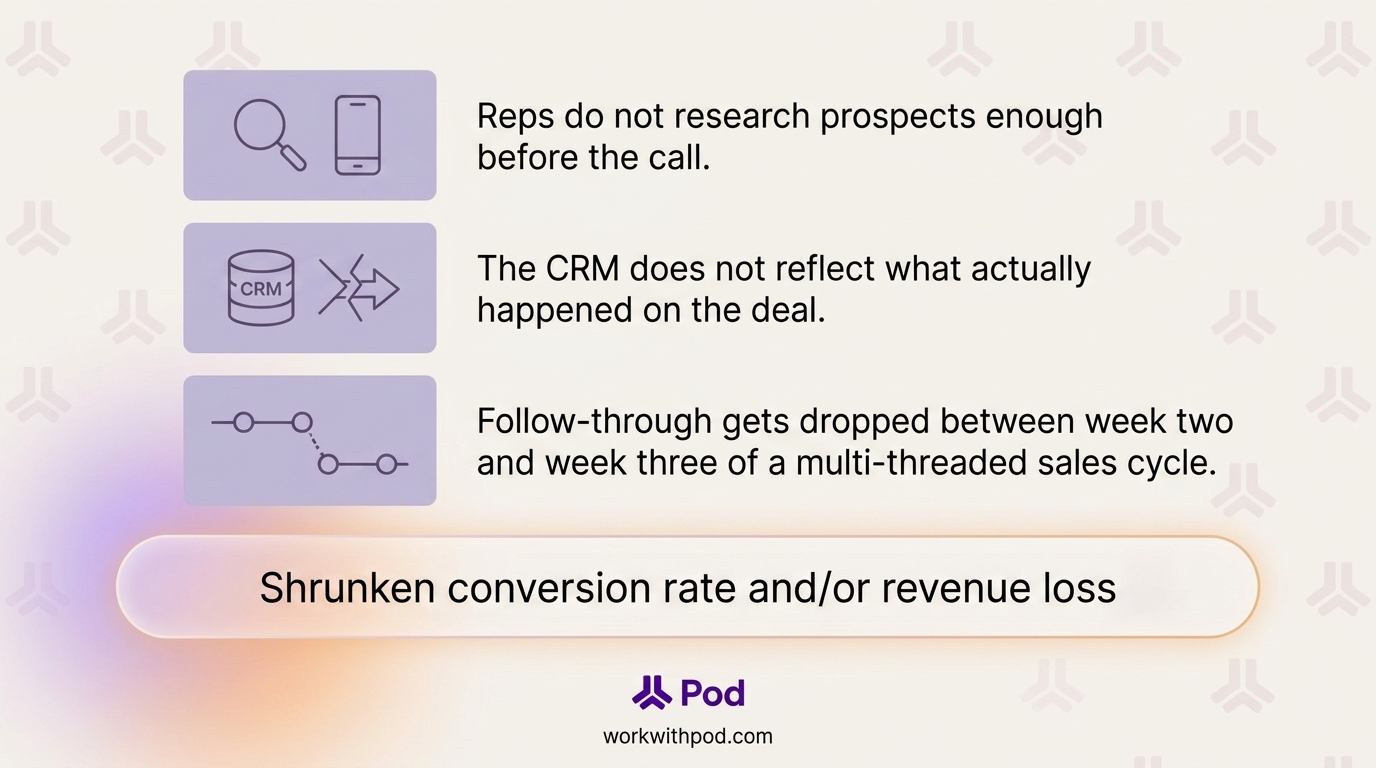
Most sales organizations lose productivity in the same three places. Reps do not research prospects enough before the call. The CRM does not reflect what actually happened on the deal. And follow-through gets dropped between week two and week three of a multi-threaded sales cycle.
The data backs the gut feel. Sales productivity research consistently shows that top-performing reps research before every prospect interaction at a much higher rate than the rest of the team, and that top reps actually spend more time on CRM activity than average ones, not less. Salesforce's State of Sales report also found that sellers spend only about 28% of their week actively selling, with the remainder devoted to admin, data entry, internal meetings, and context reconstruction. The gap between the top quartile and everyone else is mostly a gap in operating discipline, not personality.
This is exactly the territory where an AI agent for every sales rep has the most leverage. You are not trying to teach charisma. You are trying to make the boring, high-value behaviors the default: always prepared, always current, always following up.
Before getting into who benefits, it helps to ground what "an agent per rep" actually means, because the term is used loosely. The sibling piece in this series goes deeper on the category, so this will stay short. A useful working definition: a personal AI agent is scoped to a single rep's pipeline, has read access to their CRM, email, calendar, and meeting transcripts, runs on a mix of triggers and schedules, and surfaces recommendations the rep can approve or execute with one click. For a longer walkthrough of the distinctions, see the sibling post on what an AI sales agent is.
Inside Pod, for example, AI Agent Builder gives the rep and workspace admins the ability to define agents that run against live deal context, while Deal Coach watches each deal for flags like stalled activity, missing stakeholders, or slipping close dates and suggests the next action. The important piece is not any one surface. It is that the agent is doing real work in the background, on every deal, without the rep having to remember to look.
Give a median rep this setup for a full quarter, and the change is less dramatic than the vendor pitch suggests but more durable than a new playbook.
The first thing that disappears is the sludge at the edges of the day. A meeting ends, and the post-call summary, next steps, and CRM update are drafted automatically. The morning starts with a prioritized list of what deserves attention today, not a blank Salesforce view. Emails that are obvious enough to be templated get drafted the moment a meeting ends. The rep is not being replaced in any of these tasks. They are approving, editing, and sending, which takes minutes instead of an hour. Given that B2B reps spend roughly a quarter of their week on manual data entry alone, even a modest dent here compounds quickly across a month.
Newer reps feel the change the hardest. A first-year rep with a personal agent gets the same kind of pre-call briefing, stakeholder map, and risk callout that a senior rep builds from memory after ten years. Meeting Briefs, framework gaps, and contact sentiment are available before the call, so the rep doesn't have to assemble them. Ramp time shortens not because training is better but because the operating tools are the same for everyone. A month-three rep can walk into a discovery call looking like a month-eighteen rep, and the deal data gets captured the same way afterward, whether they remember to log it or not.
The quieter benefit is psychological. Reps know when they are underprepared, and the anxiety shows up in the call. When the agent has already pulled the last three email threads, the last meeting transcript, the open framework gaps, and the account's recent news, the rep walks in with the facts stacked. They still have to lead the conversation, but they do it from a higher floor. Over a quarter, that confidence translates into sharper discovery, better objection handling, and fewer awkward "let me check on that and get back to you" moments.
For the leader, the change is bigger than for any individual rep. If you run a team of eight AEs and every one of them has a personal agent doing the operating work in the background, your job starts to look different inside a month.
Most sales coaching time gets spent on problems that a top rep would have prevented: a stalled deal, a missing economic buyer, a forgotten champion, a CRM that does not match reality. With an agent per rep, the obvious misses get caught in near real time. By the time the rep shows up to a 1:1, the basics are handled. What is left is the interesting coaching: how to handle a specific procurement objection, how to build a business case for a CFO, how to pull a hesitant champion across the line. This is the kind of coaching that actually moves quota, and it is usually what good managers want to spend their time on in the first place. For a fuller view of how manager workflows shift, Pod's resources for sales leaders go into the team-level change in more depth.
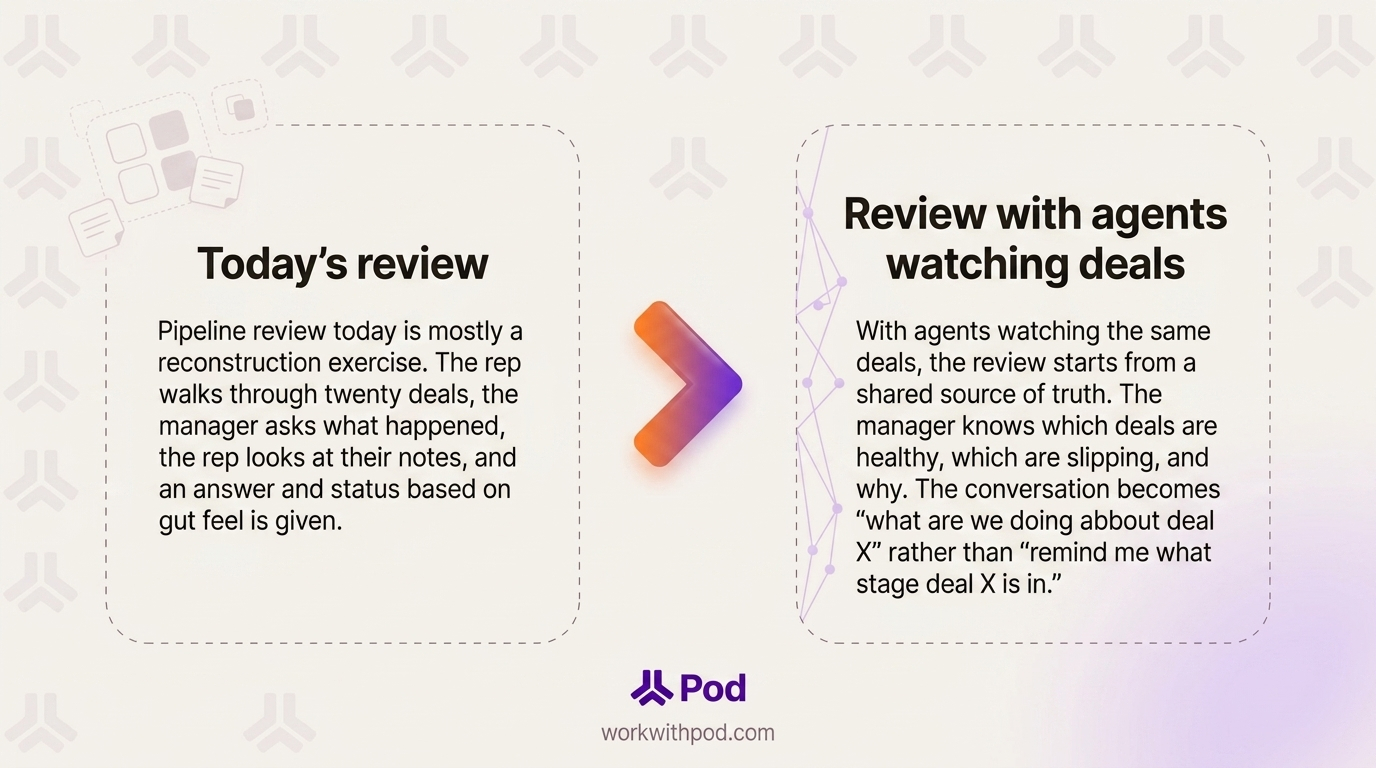
Pipeline review today is mostly a reconstruction exercise. The rep walks through twenty deals, the manager asks what happened, the rep looks at their notes, and an answer and status based on gut feel is given.
With agents watching the same deals, the review starts from a shared source of truth. The manager knows which deals are healthy, which are slipping, and why. The conversation becomes "what are we doing about deal X" rather than "remind me what stage deal X is in." Teams that run this way tend to cut pipeline review time in half without losing coverage.
Forecasts improve when the underlying deal data is fresher and when risk flags are visible rather than hidden in the rep's head. An agent that flags slipping close dates, weak buying committees, and low activity levels the week before the forecast call makes it harder for the quarter to get called out as "commit" purely on optimism. This does not remove the rep's judgment, which remains the most informed view of a deal, but it forces judgment and evidence to align. Leaders who have run this way for a few quarters usually describe it the same way: the forecast stops surprising them.
Any article that skips this section is selling something. A few parts of B2B selling remain stubbornly human, and leaders who roll out an agent per rep on the assumption that the agent closes the deal tend to get burned.
Relationships still require presence. The first meeting with a new champion, the dinner after the pilot goes sideways, the call where you have to tell a VP that their internal timeline is not realistic. None of those are going to be done by an agent, and none of them should be.
Negotiation still requires a human. Reading silence on a call, pushing back on a procurement counteroffer, knowing when to hold a price point and when to trade on terms, deciding when to walk away. This is a judgment built on pattern recognition that the rep has internalized over the years. An agent can prepare the rep. It does not replace the rep at the table.
Reading the room still requires a human. A sentiment score on a transcript is a useful input. It is not a substitute for noticing that the CFO has gone quiet in the last two meetings or that the champion seems distracted. Reps who lean too hard on model output instead of their own read of the room tend to miss the most important signals.
Handling escalations still requires a human. When a deal blows up because of a bad implementation, a contract dispute, or a misaligned expectation, the accountability has to sit with a person. Customers notice when they are being managed by a workflow.
The honest framing is that AI agents take on the operational layer of selling. Relationships, negotiation, empathy, and judgment sit above that layer and continue to belong to the rep. For a broader map of what agents can and cannot do, along with where the frontier is moving next, see the companion piece on what AI agents can and can't do in B2B sales.
The mistake most teams make with any AI rollout is treating it as a tool decision rather than a behavioral decision. The tooling is usually fine. The rollout usually is not. A practical sequence that works for mid-market and enterprise teams looks like this.
Start with read-only use cases. For the first thirty days, let agents observe deals, generate Meeting Briefs, and surface flags. Do not ship write actions yet. The point is to let reps build trust in what the agent sees before it starts suggesting what to do.
Layer in recommendations next. Once reps believe the agent's read of their pipeline, introduce suggested actions. Drafted follow-ups, recommended stakeholders to add, flagged risks to review in pipeline call. Still keep the human in the loop on every action; the rep approves, edits, or rejects.
Add higher-trust actions last. CRM updates, email sends, note creation, Slack messages. These go live only after the team has patterned the lighter surfaces for at least a month. Human-in-the-loop approval is not optional here, especially for anything the customer sees.
Change the coaching cadence to align with the rollout. A 1:1 template that worked before the agents will not hold up. Reps will come to the 1:1 with the basics already covered; leaders need new prompts that go deeper on negotiation, stakeholder strategy, and forecast discipline. If you do not redesign the coaching surface, reps will feel the agent change and leaders will not, which is where adoption quietly stalls.
Pay attention to the laggards, not the champions. The rep who adopts the agent on day one is not the signal. The rep who is quietly skeptical at week three is. If that rep is losing confidence in the agent, it is usually because the data quality under the agent is bad, not because the agent itself is. Fix the data, not the pitch.
The background context for why this matters in 2026: the market is moving fast. Gartner has forecast that 60% of seller work will be executed through generative AI sales technologies by 2028, up from less than 5% in 2023. Teams that treat this as a two-year adoption curve and actually run the rollout disciplined will have compounded six quarters of operating advantage by the time slower teams are starting.
If you run a sales team and you have been sitting on the AI agents question, here is a short list that takes the idea from a slide deck to the floor.
Pick three reps across performance tiers. One top quartile, one median, one newer. Give each a personal agent running against their live pipeline for the next sixty days with read-only and recommendation actions enabled. This is how you learn what the real change is for your team, not the vendor demo team.
Rewrite one pipeline review template. Assume the agent is already surfacing stalled deals, missing stakeholders, and slipping close dates before the call. What is the conversation you actually want to have? Draft that template and run the next review with it.
Decide what does not change. Write down the parts of selling your team owns, no matter what: first meetings, negotiation, escalations, and relationship ownership. Tell the team this out loud during rollout. Adoption stalls when reps think they are being automated. It moves when they believe the agent takes over the operating load and hands the meaningful work back to them more sharply.
If the goal is to see what this looks like on a real pipeline rather than in theory, a live walkthrough is the fastest way to get there.
Book a demo to see how Pod's agent surface fits the three-perspective shift this article describes.