.png)

Want to close more deals?
Get Pod!
Fill out the form and book your demo.
Thank you for subscribing!
Oops! Something went wrong. Please refresh the page & try again.

Stay looped in about sales tips, tech, and enablement that help sellers convert more and become top performers.
In 2026, the pipeline management model is breaking down, and something sharper is taking its place. A new class of AI, built around autonomous agents rather than passive features, is changing what AI sales pipeline management actually looks like day to day.
These agents do not wait for a prompt. They analyze deal signals, recommend next actions, and in some cases execute workflows on behalf of the rep or manager. This post maps the ten most significant changes and what they mean in practice for sales leaders, RevOps teams, and the reps running complex B2B deals.
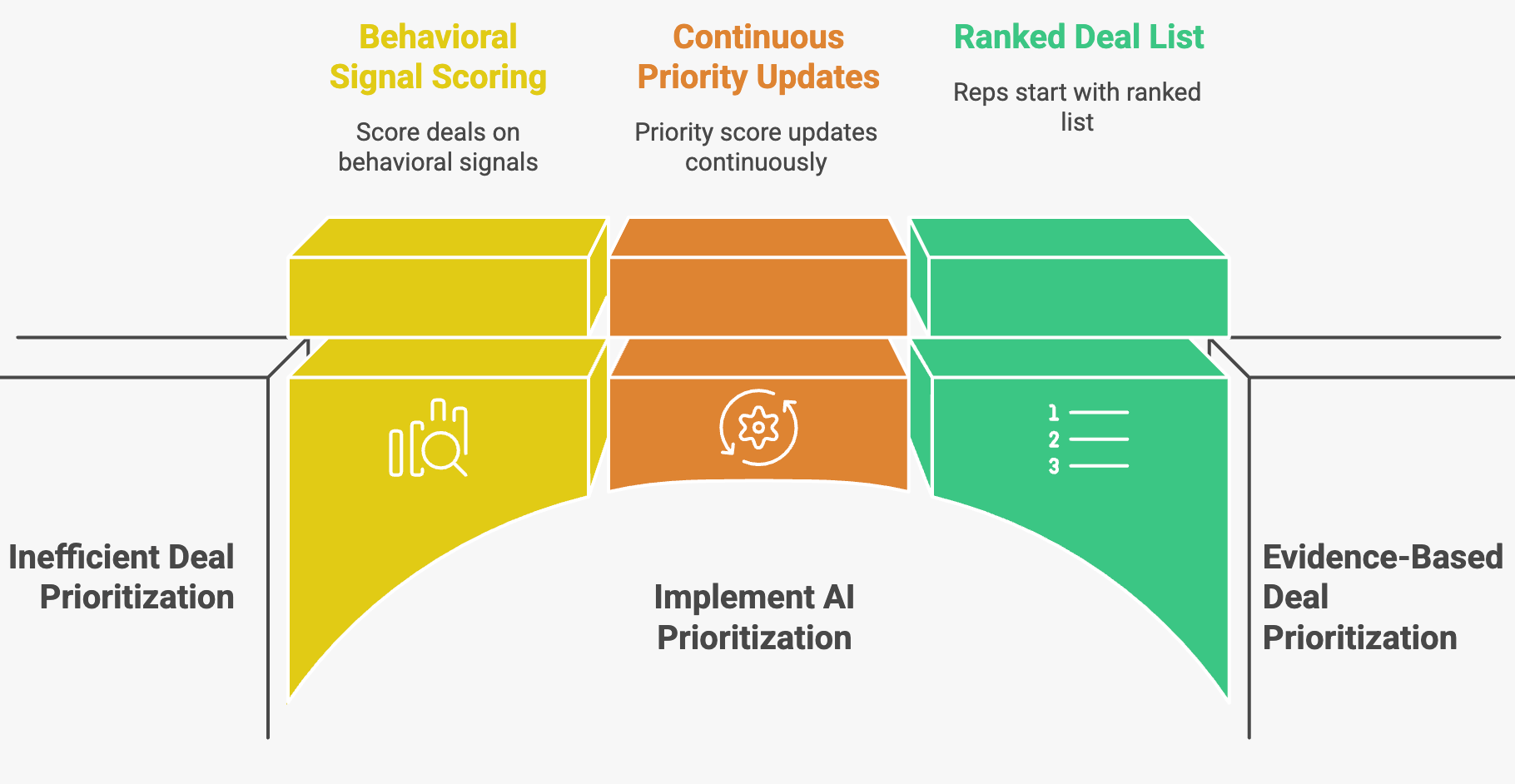
AI agents flip this model by scoring deals on behavioral signals, not just static CRM fields. Activity recency, stakeholder engagement depth, stage velocity, and buying-committee coverage all feed into a composite priority score that updates continuously.
The result is that reps start each day with a ranked list of where to spend their time, not a flat pipeline sorted alphabetically. At-risk deals surface before they go dark, not after. And the deals that look big but have no momentum drop down the list until something changes.
Pod's AI-powered deal prioritization surfaces a ranked view of every open opportunity, flags at-risk deals, and lets reps build watchlists for the deals they want to track closely. A visual Deal Matrix plots urgency against deal temperature so reps and managers can spot mismatches in seconds.
Why it matters: When your agents are scanning every deal on every signal, every day, you stop relying on memory and start relying on evidence. Those changes which deals get worked and when.
Modern AI agents monitor deal health in real time. They track flags like stalled stage progression, thinning stakeholder engagement, slipping close dates, and low touchpoint density. When multiple flags trigger at once, the agent raises the urgency and surfaces the deal in daily reviews.
This is not just a dashboard metric. The agent connects the flag to a recommendation. "This deal has been in Stage 4 for 22 days with no executive contact. Schedule a call with the economic buyer this week."
The difference between a static score and an agent-driven health assessment is the connection between diagnosis and action. The agent does not just tell you a deal is at risk; it tells you what to do about it and, in many cases, helps you do it with a single click.
Why it matters: Real-time health scoring turns pipeline reviews from backward-looking status meetings into forward-looking strategy sessions.
Sales forecasting has historically been one of the least trusted functions in B2B. Industry benchmarks suggest that traditional manual forecasts average 60-70% accuracy, while AI-driven approaches are pushing that range toward 85-95%.
The gap comes down to data coverage. A human forecast relies on what the rep remembers and volunteers. An AI agent pulls from every CRM field, email exchange, transcript summary, calendar event, and engagement signal tied to the deal. It weights each signal by historical correlation with closed-won outcomes and adjusts in real time as new data flows in.
Why it matters: Forecast confidence is a board-level concern. When your AI agents triangulate pipeline analytics, activity signals, and historical accuracy by rep, you compress the gap between what you predict and what actually closes.
Coaching has traditionally been a manual, calendar-dependent process. A manager meets with each rep weekly, reviews a handful of deals, and offers advice. The problem is that this covers maybe 10-15% of the pipeline, and the advice is only as fresh as the last conversation.
Pod's autonomous pipeline coaching generates a personalized daily action plan for every rep. Each morning, the agent analyzes the full pipeline and organizes recommendations into "Today" and "Next 7 Days" buckets. Think of it as a windshield view of your pipeline: what needs attention right now and what is coming up fast.
These are not generic reminders. The agent connects each recommendation to specific deal context: a stalled opportunity that needs a follow-up, a deal where the champion has gone quiet, or a close date that no longer looks realistic based on stage velocity.
Why it matters: The move from weekly coaching sessions to daily, agent-driven action plans means reps get guidance at the moment of execution, not days later. Managers get a real-time view of which recommendations are being acted on and which deals need their direct attention.
AI agents analyze historical win data to identify which stakeholder roles correlate with closed-won outcomes. They then compare the current deal's contact map against that pattern and flag gaps. "Similar deals that closed had a VP of IT and a procurement lead involved by Stage 3. This deal has neither."
Pod's stakeholder mapping recommendations go further by tracking per-contact sentiment and generating relationship health cards. The agent surfaces concerns, excitement signals, follow-up gaps, and questions raised by each stakeholder, so reps can multi-thread with confidence rather than guesswork.
Why it matters: Incomplete buying committees are one of the top reasons enterprise deals die. Agents that map, monitor, and flag stakeholder gaps give reps the visibility to expand relationships before it is too late.
CRM data decays fast. B2B contact data degrades at roughly 2% per month, meaning that within a year, a significant portion of your database is unreliable. And that is just contacts. Deal fields, stage dates, and close-date estimates decay even faster because they depend on reps manually updating records.
AI agents address this by automating the grunt work. After every meeting, email exchange, or call, agents can update CRM fields, log activities, adjust stage dates, and flag records that look stale. The rep does not open the CRM to type notes; the agent captures the context and pushes it to the right fields.
Why it matters: Clean data is the precondition for everything else on this list. If your CRM is unreliable, your forecasts, health scores, and prioritization models are all degraded. Agents that maintain hygiene in real time remove the weakest link in the pipeline management chain.
AI agents compress this to near-zero by generating meeting briefs automatically before every call. Pod's AI-generated meeting briefs pull from CRM data, email history, transcript summaries, and stakeholder context to produce a ready-to-use prep document for each meeting on the rep's calendar.
The brief includes attendee highlights (who they are, what they care about, past interactions), AI-generated discussion topics based on deal context and methodology gaps, and even a draft preparation email to send in advance. After the meeting, the agent generates a structured summary and follow-up email.
Why it matters: Meeting prep is one of the highest-ROI activities in sales, but it is also one of the most time-consuming. Agents that automate it give reps the preparation quality of a top performer without the time cost.
This is where the distinction between "AI features" and "AI agents" becomes clearest. An AI feature might score a lead or draft an email. An AI agent runs a multi-step workflow: it detects a trigger, reasons about the context, executes a sequence of actions, and reports the outcome.
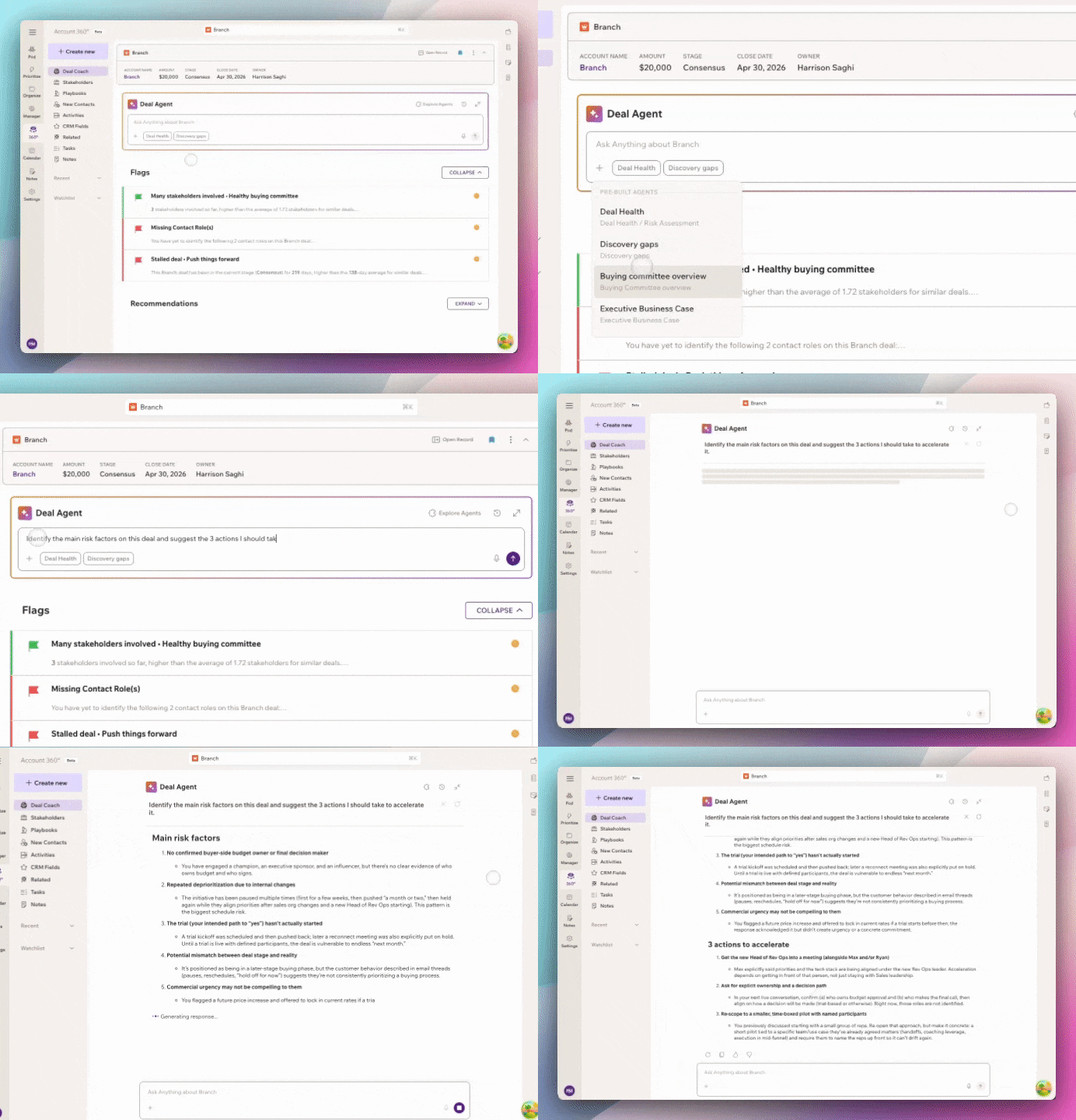
Pod's AI Agent Builder lets teams create custom agents that operate on their deal data. These agents come in three tiers:
Each agent receives the full context of a deal, including CRM data, email history, transcript summaries, and framework analysis, and produces a targeted output. The key difference from a chatbot: agents operate with a structured deal context, not just a freeform prompt.
Why it matters: Custom agents let teams encode their institutional knowledge into repeatable, scalable workflows. When a top performer's deal review process becomes an agent that every rep can run, the floor rises across the entire team.
AI agents make methodology tracking continuous and contextual. Instead of asking reps to manually update qualification fields, agents analyze emails, transcripts, and meeting notes to determine which framework topics have been covered in actual customer conversations, and which gaps remain.
Pod's sales methodology tracking supports MEDDPICC, BANT, NEAT, ALIGN, and custom frameworks. The agent produces a per-topic breakdown for every deal: what has been discussed, what is missing, and AI-generated summaries of the evidence behind each assessment. Admins can also upload custom playbook documents for the AI to reference during analysis.
Why it matters: Methodology compliance stops being a data entry problem and becomes an intelligence layer. Managers can see across their entire team's pipeline which qualification gaps are most common, not in a quarterly audit, but in real time.
AI agents enable coaching at the individual rep level. By analyzing each rep's pipeline activity, deal patterns, stakeholder coverage, and methodology compliance, agents can identify coaching opportunities that are specific to that person's strengths and gaps.
A manager using Pod's Manager Hub sees roster cards for every rep, with performance badges tied to deal engagement, stakeholder management, and process compliance. The data spans configurable time windows (3, 6, or 12 months), so coaching conversations are grounded in trends rather than anecdotes.
Combined with the daily pipeline coaching agents described earlier, this creates a two-layer system: agents coach reps proactively on deal-level actions, and managers coach strategically on patterns and development areas that span the full pipeline.
Why it matters: The best sales organizations in 2026 will not just have better tools. They will have coaching systems that adapt to each rep, each deal, and each stage of the pipeline, delivered by agents that never miss a signal and never run out of time.
The ten shifts above share a common thread: the move from passive dashboards to active agents. If you are evaluating AI pipeline tools for your team, here is a practical framework:
Start with your biggest pipeline gap. Is it prioritization? Forecast accuracy? Methodology compliance? CRM data quality? The right tool should address your specific bottleneck, not just add another layer of AI features.
Look for the manager layer. Many tools are built for individual reps but leave managers without visibility into team-wide patterns. If your goal is pipeline transformation, not just individual productivity, the tool needs to serve both.
Evaluate the coaching loop. The strongest tools do not just flag problems. They recommend actions, make those actions easy to execute, and feed the outcomes back into their models so the next recommendation is better.
Pod brings these capabilities together in a single platform: AI-powered deal prioritization, daily pipeline coaching, methodology tracking, stakeholder intelligence, meeting preparation, and custom AI agents, all built on unified deal context from your CRM, email, calendar, and conversation data.
Ready to see what agent-driven pipeline management looks like for your team? Book a demo and see how Pod's AI agents work on your actual pipeline data.